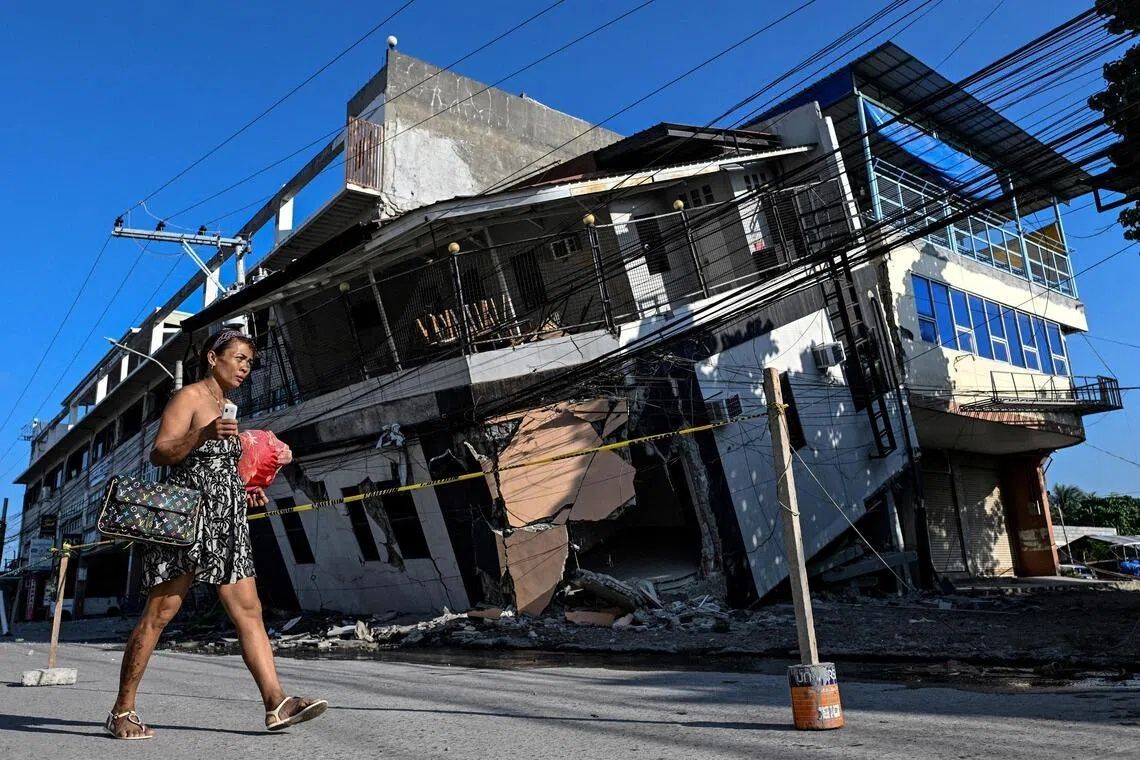
When the earth shifted beneath Arsenio Butil Jr.'s feet in the coastal settlement of Glan last June, the fisherman and pastor fell to his knees in prayer. What unfolded before his eyes as the violent shaking subsided was something far more disorienting than the earthquake itself. The familiar shoreline where he and countless others had spent their entire lives suddenly transformed in real time, with vast expanses of previously hidden coral and seabed erupting above the waterline in a dramatic display of tectonic power. The June 8 seismic event, measuring 7.8 on the magnitude scale and generated by movement along the nearby Cotabato Trench, claimed at least 76 lives, flattened buildings across Mindanao's southern region, and triggered widespread landslides. But alongside this devastation came an extraordinary geological phenomenon: a phenomenon known to scientists as coastal uplift, which fundamentally reshaped not only the physical landscape but also the economic and psychological foundations of communities dependent on the sea.
The transformation Butil observed was neither an optical illusion nor temporary. As he watched the seawater recede and advance several times over the following hours, he witnessed a permanent restructuring of his world. The seafloor had thrust upward by approximately two metres, extending certain sections of shore by roughly 200 metres in initial assessments. This displacement stretched across a zone nearly 100 kilometres long, affecting multiple settlements and fishing communities between two towns that had previously existed in their original locations. For residents accustomed to generations of stability, the experience proved deeply unsettling. The water appeared to vanish from the shoreline, only to return cyclically, a pattern that Butil observed occurring three or four distinct times during the quake's aftermath. Throughout these oscillations, fish floated dead across the water's surface, signalling the ecological disturbance caused by the dramatic, rapid environmental shift.
Nane Danlag, a researcher at the Philippines' seismology centre, confirmed what residents feared most: the changes would persist indefinitely. Speaking from her office in General Santos City, Danlag explained that the newly exposed coastline represented the permanent new reality for affected regions. What appeared to communities as unprecedented geological chaos was, in scientific terms, merely an accelerated manifestation of processes that had been shaping the Philippine archipelago for millennia. The Cotabato Trench, lying as close as 50 kilometres from Mindanao's shores, functions as a zone of intensive tectonic activity where the Earth's crust continuously shifts and deforms. Just months before the June earthquake, during January of the same year, scientists had detected a swarm comprising thousands of smaller tremors in the region. An assessment released by the United Nations in mid-May had cautioned that such seismic swarms could signal the accumulation of stress potentially culminating in a major earthquake event, though predicting the precise timing and location of such catastrophic releases remains beyond current scientific capabilities.
The geological forces responsible for this coastal transformation operate through processes that have, unobserved by human timescales, continually modified the Philippine landscape since the islands' formation. Danlag emphasised that the phenomenon driving the visible changes represented natural crustal movement, neither unprecedented in geological history nor anomalous in the context of tectonic systems operating along major fault zones and trenches. Yet the implications for human communities living atop these dynamic geological boundaries extend far beyond academic interest. Approximately 100 residents from nearby villages who fled to higher ground when the earthquake struck remained encamped in the hills above a neighbouring settlement when journalists visited the affected region. Among them were fishermen and their families, many of whom had lost their homes entirely, hesitant to venture back to their devastated properties despite the passage of weeks. The psychological trauma compounded the physical destruction; many inhabitants harboured persistent fears that additional seismic energy could yet trigger a destructive tsunami, amplifying their anxiety beyond what the visible earthquake damage alone would justify.
Datu Atom Malimpnig, a Maguindanaon chieftain representing the displaced community, articulated the emotional and practical dilemma facing his people. The dramatic transformation of the seafloor had destabilised their psychological sense of security in ways that transcended rational assessment. The fundamental anxiety driving their reluctance to rebuild centred on an elemental fear: that the same forces which had so dramatically altered their landscape might surge forward once more, potentially with even greater destructive capacity. This fear was not unfounded given that over 8,500 aftershocks had rattled the region since the initial June 8 earthquake, each tremor reinforcing the perception of instability and imminent danger. The encampment itself, established on elevated terrain, offered a psychological refuge even if it meant enduring poor living conditions. Government aid workers distributed rice porridge to the evacuees, an interim measure inadequate to address the deeper crisis of displaced livelihoods and shattered homes.
The economic consequences of the coastal transformation extended beyond subsistence fishing communities to commercial enterprises heavily dependent on the region's natural attractions. Edzel Baylon, employed at the Isla Jardin del Mar resort, confronted a stark reality as she surveyed the newly altered landscape that had suddenly undermined her employer's primary market proposition. The resort's fundamental appeal had always centred on the experience of pristine white sand beaches and direct access to the sea—standard offerings throughout Southeast Asia's competitive tourism sector. The coastal uplift had erased this fundamental appeal, replacing the inviting waterfront with a jagged, dead coral wall that stretched for kilometres in both directions. Where once tourists could wade and swim in warm seawater just metres from the shore, visitors now encountered impassably shallow water separated from the beach by this imposing geological barrier. The business model built on marine recreation suddenly faced obsolescence. The newly exposed coral, while temporarily creating a unique geological spectacle, was biologically dead rather than living and vibrant, offering no compensatory ecological interest to offset the loss of beach-based activities. The resort faced a fundamental recalibration not merely of operations but of its entire value proposition in a crowded regional tourism market.
Butil, reflecting on the ongoing situation from his position as both a spiritual leader and practical community member, articulated the paralysis affecting survivors. The visible physical damage to structures paled compared to the invisible but pervasive damage to psychological confidence and sense of security. Large fissures cracked the ground throughout the area, some extending considerable distances, indicating substantial subsurface stress and displacement. The possibility that another earthquake of comparable or greater magnitude could strike at any moment cast a shadow over any consideration of rebuilding efforts. To reconstruct homes and livelihoods on destabilised terrain seemed not courageous but reckless. Residents needed not merely material assistance but also credible assurances regarding seismic stability, assurances that neither science nor government agencies could genuinely provide. The community remained in a state of suspended uncertainty, unable to move forward yet unable to remain static indefinitely.
The situation in Mindanao highlights the particular vulnerability of Philippines' southern regions to tectonic hazards and the cascading consequences that extend far beyond immediate earthquake damage. The archipelago's location along the Pacific Ring of Fire exposes it to continuous seismic activity, yet the distribution of seismic hazards remains geographically uneven. Communities in southern Mindanao, previously experiencing stability during living memory, suddenly confronted geological realities that scientists understood but populations had not recently experienced. The June 8 earthquake and its 8,500-plus aftershocks represented not an anomaly but rather a reassertion of the dynamic tectonic processes that constantly reshape Philippine geography. Understanding that coastal uplift has shaped Philippine landforms for millennia offers little comfort to those whose familiar world has suddenly become unrecognisable and whose livelihoods have been severed from the marine resources upon which they depended.
For Southeast Asia more broadly, the Mindanao earthquake and its geological aftermath reinforce the critical importance of developing resilient infrastructure, effective early-warning systems, and adaptive community strategies in regions traversed by major tectonic systems. The Philippines, like Indonesia, sits amid some of Earth's most seismically active zones, yet population density and economic pressures often force communities to inhabit areas where tectonic hazards remain high. The contrast between communities like Glan that possess traditional knowledge and spiritual frameworks for understanding natural disasters and modern societies accustomed to environmental stability illustrates the challenge of building genuine resilience. Resilience requires not merely technical infrastructure but also psychological preparation and community systems that enable people to adapt when their fundamental environment undergoes permanent transformation. The residents of southern Mindanao, still processing the physical and psychological implications of their altered coastline weeks after the earthquake, represent a case study in how geological transformation intersects with human vulnerability, economic disruption, and the long-term social consequences of living within dynamic tectonic systems.