Hanoi police have filed formal smuggling charges against two women after investigators uncovered a major illicit operation involving the importation and domestic distribution of frozen chicken feet sourced from countries grappling with active poultry diseases. The case, disclosed on Friday, represents a significant breach of Vietnam's food safety and customs regulations, exposing vulnerabilities in the monitoring of perishable agricultural imports and raising concerns about products reaching consumers across multiple provinces.
The accused are Nguyen Thi To Loan, 47, who operated ABF Food Import-Export JSC based in Ninh Binh Province, and Trang Tuyet Ngoc, 45, employed as head of an assistant department at An Binh Group. Both individuals have reportedly acknowledged all charges filed against them. Their operation spanned a three-year period from 2023 to early 2026, during which 339 shipping containers of frozen chicken feet were brought into the country through what authorities describe as a coordinated circumvention of public health safeguards.
The scheme exploited a critical legal distinction in Vietnamese import regulations. Poultry products originating from nations experiencing active disease outbreaks are technically permitted entry solely for processing and subsequent re-export—a controlled mechanism designed to prevent contaminated food from entering domestic supply chains. However, instead of adhering to this requirement, Loan orchestrated the diversion of imported shipments toward illegal domestic sales, directing Ngoc to distribute the products across the Vietnamese market.
The scale of the operation proved substantial. Police determined that more than 10,000 metric tonnes of frozen chicken feet were sold to food-service establishments—restaurants, catering companies, and food processors—spread across multiple provinces including Hanoi, Cao Bang, Ninh Binh, Quang Ninh, and several others. This wide geographic dispersal meant potential health risks were distributed across numerous municipalities and consumer populations. The total declared value of imported goods exceeded VNĐ347 billion, equivalent to approximately US$13 million, yet no import duties were remitted to the state.
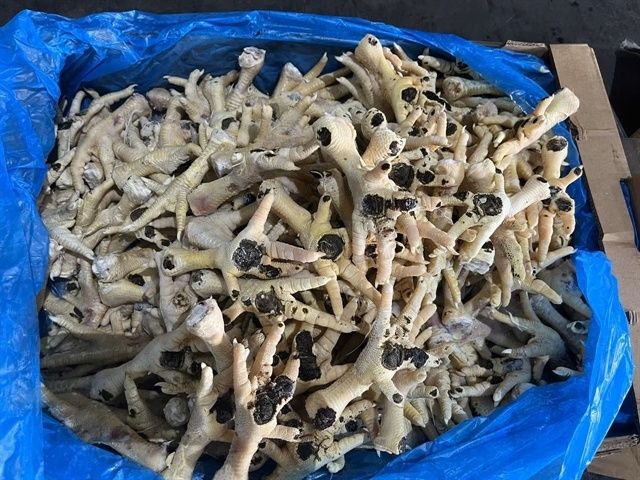
When Hanoi police executed raids on cold-storage facilities connected to the enterprise, the scale of undistributed inventory became apparent. Officers discovered over 2,000 metric tonnes of frozen chicken feet stored across multiple locations. At the An Viet 2 freezer facility located within Hanoi's Quang Minh Industrial Zone, inspectors recovered more than 1,000 metric tonnes, including approximately 260 metric tonnes that had surpassed expiration dates and displayed visible signs of deterioration, including mold growth and putrefaction, yet appeared prepared for further distribution.
A concurrent raid at the THL cold-storage warehouse in Lang Son Province in northern Vietnam yielded an additional 1,030 metric tonnes of frozen product. The discovery of such quantities of expired and visibly contaminated poultry underscores the operation's complete disregard for food safety standards. The condition of these products—bearing unmistakable signs of decomposition—indicates they were potentially destined for sale to restaurants and food-service operators, placing consumers at genuine risk of foodborne illness.
The implications of this case extend beyond the immediate criminal liability of the two accused. Vietnam's food import system, particularly for perishable goods originating from disease-prone regions, faces evident vulnerabilities. The fact that 339 containers of poultry products could enter the country under false pretenses, be stored in multiple facilities, and distributed across five provinces over three years suggests gaps in customs verification, cold-chain monitoring, and inter-agency coordination. For Malaysian importers and food businesses, the case serves as a cautionary reminder of the regulatory risks associated with sourcing from Southeast Asian suppliers without rigorous vetting and documentation protocols.
Both suspects have been formally charged under Article 188 of Vietnam's 2015 Penal Code, which addresses smuggling offences. The charges reflect authorities' classification of the conduct as a customs violation rather than a more narrowly defined food safety infraction, suggesting prosecutorial focus on deliberate circumvention of import regulations. The investigation remains ongoing, with police pursuing leads regarding other individuals and organizations potentially implicated in the broader network. Investigators are seeking to establish whether warehouse operators, cold-chain logistics providers, or downstream food-service purchasers bore knowledge of the illicit origin of the products.
For Vietnamese consumers and regional food businesses, the operation highlights the persistent challenge of ensuring supply-chain integrity when imported ingredients pass through multiple intermediaries. The scheme was ultimately discovered through investigative work rather than routine customs screening, raising questions about detection mechanisms for similar operations occurring beyond official scrutiny. The substantial quantities of expired product found staged in industrial freezers, intended for distribution, indicate that financial incentives—bypassing both import duties and re-export compliance costs—create powerful motivations for regulatory violation.
The case also resonates across Southeast Asia as a reminder of transnational food security concerns. Vietnam's agricultural export sector depends substantially on maintaining international confidence in the safety and legitimacy of its products. Smuggling schemes involving perishable goods, particularly those sourced from disease-affected regions, generate negative externalities affecting the reputation of legitimate Vietnamese food producers and exporters. Neighbouring countries, including Malaysia, may face pressure to intensify border screening of Vietnamese food imports in response to such revelations.
As investigations proceed, authorities will likely examine financial records, customs documentation, and commercial correspondence to map the full structure of the operation and identify recipients of the illicit shipments. Food-service businesses that unknowingly purchased contaminated chicken feet may themselves face regulatory consequences, while consumers who consumed the products remain largely unidentified. The case underscores the importance of traceability systems and mandatory supplier certification in the food industry—areas where many Southeast Asian nations, including Vietnam, continue to strengthen regulatory frameworks.