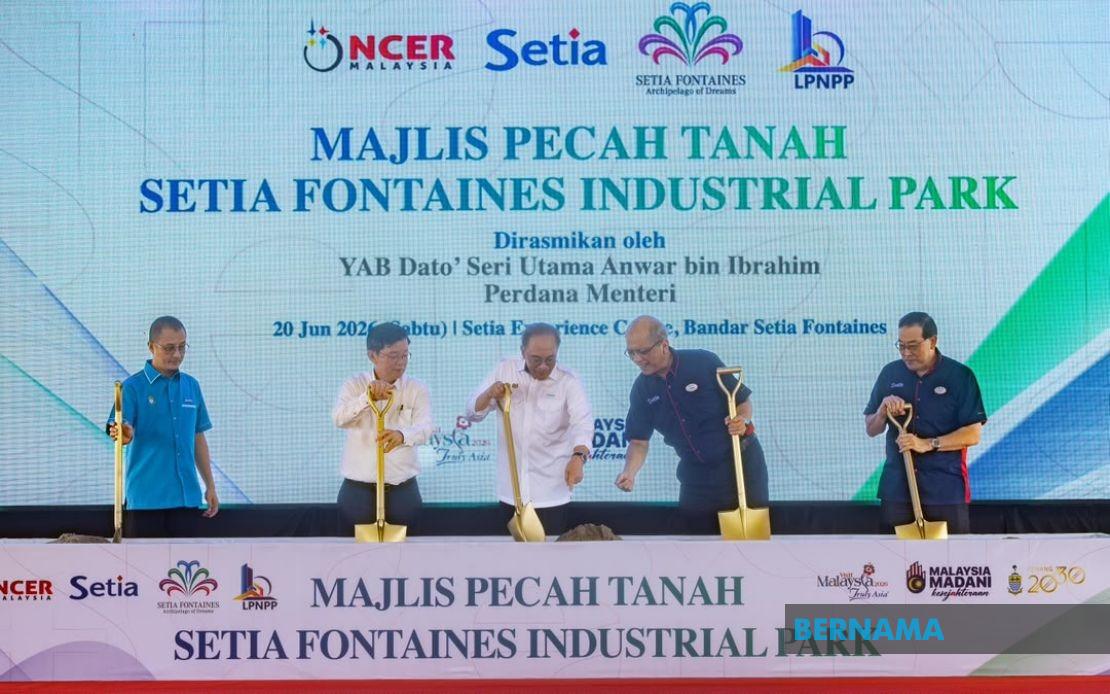
Prime Minister Datuk Seri Anwar Ibrahim has stressed that government-linked corporations and private developers bear a responsibility to structure their projects in ways that generate genuine economic opportunities for middle- and lower-income Malaysians. Speaking at the groundbreaking ceremony for the Setia Fontaines Industrial Park in Bandar Setia Fontaines, Kepala Batas, Anwar cautioned that without deliberate inclusion of such groups, the nation risks deepening socioeconomic divisions that could undermine social cohesion and long-term stability.
Anwar's remarks underscored a fundamental tension within Malaysia's development model: rapid economic expansion and rising investment flows do not automatically distribute benefits equitably across society. The Prime Minister pointed out that approval granted to major institutional investors—including Khazanah Nasional Berhad, Permodalan Nasional Berhad, the Employees Provident Fund, and large private enterprises—must be conditional upon demonstrable commitments to inclusive growth. This framing reframes development approval not merely as a commercial transaction but as a social contract requiring stakeholders to actively widen the circle of beneficiaries.
The underlying concern articulated by Anwar reflects a growing awareness within Malaysia's leadership that conventional growth metrics—GDP expansion, foreign direct investment volumes, or project valuations—mask distributional failures at ground level. When wealth creation concentrates among already-advantaged groups, purchasing power among lower- and middle-income households stagnates, potentially dampening broader consumer spending and domestic demand. This dynamic carries particular significance in Malaysia's Southeast Asian context, where regional competitors are similarly competing for foreign investment and skilled talent; nations perceived as more equitable in distributing development benefits may attract workers and investors seeking stable, inclusive ecosystems.
Anwar's emphasis on equitable planning across all tiers of society also reflects pressure from Malaysia's political economy. Middle-income households face particular vulnerability: increasingly priced out of urban housing, facing stagnant real wages relative to living costs, and sensing reduced upward mobility compared to previous generations. These anxieties have translated into electoral volatility and shifting voting patterns, making inclusive development rhetoric increasingly central to political legitimacy. By explicitly linking government approvals to inclusive outcomes, Anwar positions the administration as responsive to these pressures.
The Setia Fontaines Industrial Park development exemplifies this philosophy in practice. Located in Seberang Perai, the project is designed to accelerate economic advancement on the mainland portion of Penang state, countering historical patterns whereby investment and job creation concentrated on the island and in southern Penang. By directing industrial capacity toward underserved regions, the development aims to geographically distribute opportunity and prevent leaving entire areas behind during periods of expansion. This spatial dimension of inclusion—ensuring that peripheral regions participate in growth rather than remaining economically isolated—represents a critical element of equitable development strategy.
Crucially, Anwar highlighted that Malaysia's economic transition toward higher-value manufacturing and advanced technology sectors creates both opportunity and risk for lower- and middle-income workers. The shift away from labour-intensive, back-end assembly operations means traditional entry-level manufacturing employment is contracting. Simultaneously, emerging technology-driven sectors offer higher-wage positions but demand qualifications—technical certifications, digital literacy, specialised training—that many current workers lack. Without deliberate investment in skills development, this transition could exclude precisely the populations it should elevate, reproducing inequality in new forms.
Addressing this challenge requires unprecedented coordination between industry, education, and workforce development institutions. Anwar called for enhanced collaboration between private sector employers, technical and vocational training providers, and universities including Universiti Sains Malaysia to ensure curriculum and training programmes remain aligned with evolving labour market demands. This coordination problem is acute: technological change accelerates rapidly, often outpacing the pace at which educational institutions update curricula and training materials. Workers require access to continuously updated skill development, yet institutional inertia frequently prevents education systems from responding swiftly. The Prime Minister's emphasis on this institutional alignment reflects recognition that inclusive growth depends not only on political will but on practical mechanisms for keeping workforce capabilities current.
Anwar's insistence that professional employment opportunities prove worthless without correspondingly qualified personnel underscores a sophisticated understanding of labour market dynamics. Many Southeast Asian nations face paradoxical situations wherein unemployment coexists with skilled labour shortages; businesses report difficulty filling positions despite substantial joblessness, reflecting mismatches between available skills and demanded qualifications. Malaysia has encountered this pattern repeatedly, particularly in advanced manufacturing, information technology, and digital services sectors. Closing these gaps requires sustained investment in education and training, partnership between employers and educators to identify emerging skill needs, and pathways enabling workers to transition into higher-value roles.
The technology sector's rapid evolution presents particular challenges. Anwar noted that technological change occurs within one- or two-year cycles, rendering training curricula obsolete surprisingly quickly. This compressed timeline means educational institutions cannot operate on traditional cycles of curriculum review and updating conducted every five or ten years. Instead, continuous dialogue between employers and educators becomes essential, with businesses providing early signals about emerging skill needs and educational institutions rapidly adapting programmes. Several Southeast Asian economies have begun experimenting with industry-education partnerships, apprenticeship models, and employer-sponsored training to accelerate this responsiveness, but systematic, large-scale implementation remains patchy across the region.
From a regional perspective, Anwar's emphasis on inclusive development carries implications for Malaysia's positioning within ASEAN and broader Indo-Pacific economic competition. Countries perceived as delivering development benefits narrowly face risks of social instability, political polarisation, and reduced capacity to build consensus around reform initiatives. Conversely, nations demonstrating inclusive growth trajectories attract talent, investment, and political stability. As Southeast Asian economies compete for manufacturing investment displaced from China and for regional leadership in emerging technology sectors, inclusive development policies may increasingly factor into investment location decisions and talent retention strategies.
The Setia Fontaines project itself signals confidence in Seberang Perai's economic potential and reflects deliberate strategy to rebalance development within Penang. Historically, the island has dominated investment and economic activity, creating disparities with the mainland. By anchoring industrial expansion on the Seberang Perai side, the development aims to catalyse broader regional transformation, drawing workers, suppliers, and complementary services to the area and generating multiplier effects throughout the local economy. Success would demonstrate that inclusive development is not merely aspirational rhetoric but actionable policy with tangible spatial and social outcomes.
Looking forward, Anwar's framing of development approval as contingent upon inclusive benefits suggests potential evolution in how Malaysian authorities evaluate and condition major projects. Rather than approving developments primarily on commercial viability and headline investment figures, this approach would systematically assess whether projects generate opportunity pathways for middle- and lower-income groups, whether through local employment, supplier development, skills training, or community benefit arrangements. Implementing such conditionality at scale requires institutional capacity, monitoring mechanisms, and political will to occasionally deny or significantly modify projects failing to meet inclusive criteria—steps that remain uncertain in Malaysia's implementation capacity and political dynamics.