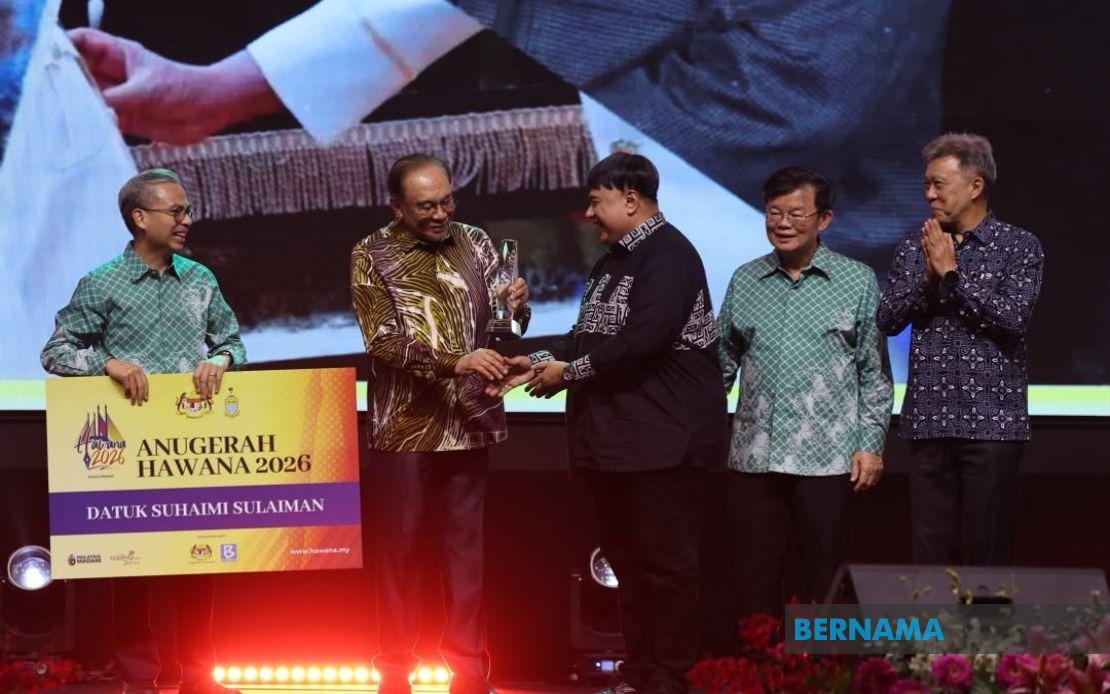
Datuk Suhaimi Sulaiman has been honoured with the HAWANA 2026 Award, Malaysia's National Journalists' Day recognition, in acknowledgement of his extensive career spanning more than three decades in broadcasting and journalism. Prime Minister Datuk Seri Anwar Ibrahim presented the award at the HAWANA 2026 Grand Finale held at PICCA @ Arena Butterworth Convention Centre in Butterworth on June 20, marking a significant moment in the veteran media professional's career trajectory.
The ceremony brought together key figures from Malaysia's media and government establishment to witness the recognition. Penang Chief Minister Chow Kon Yeow, Communications Minister Datuk Fahmi Fadzil, and Malaysian National News Agency (Bernama) chairman Datuk Seri Wong Chun Wai were among those present to acknowledge Suhaimi's contributions. The presence of such senior officials underscores the importance attributed to his role in shaping Malaysia's media landscape over the decades.
Suhaimi's career represents a significant chapter in Malaysia's broadcasting history, particularly through his tenure as Broadcasting Malaysia's director-general, a position that placed him at the helm of the nation's primary state broadcaster during a transformative period for Malaysian media. His career trajectory reflects the evolution of journalism and broadcasting in the country, from traditional terrestrial broadcasting to the contemporary multimedia environment that now dominates news delivery.
In his response to receiving the award, Suhaimi characterised the recognition as both an honour and a profound responsibility that carries substantial weight. He expressed his perspective that the award would serve as motivation to pursue continuous learning and knowledge-sharing within the media profession. His remarks revealed a reflective approach to a career milestone, emphasising that receiving such recognition does not mark an endpoint but rather a moment to recommit to the ongoing development required in the field.
The media landscape has undergone unprecedented transformation during Suhaimi's career, and he identified artificial intelligence as one of the most significant challenges and opportunities confronting contemporary journalism. His acknowledgement that AI is reshaping how media practitioners operate reflects the current realities facing newsrooms across Malaysia and the broader region. He stressed that media professionals must actively adapt their skills and expand their knowledge base to remain relevant and effective in an AI-driven environment.
Suhaimi's perspective on continuous learning in the age of artificial intelligence carries particular resonance for Malaysia's media industry at a critical juncture. As newsrooms grapple with automation, algorithmic content distribution, and AI-assisted reporting tools, experienced professionals like Suhaimi emphasise that foundational journalistic principles and human judgment remain irreplaceable. His willingness to embrace new technologies while maintaining editorial integrity positions him as a bridge between traditional media values and digital-era realities.
The HAWANA 2026 award programme represents Malaysia's formal recognition system for journalistic excellence and media contributions. By honouring practitioners like Suhaimi, the programme acknowledges the vital role that journalism plays in democratic societies and the importance of sustaining quality reporting during periods of technological disruption. The involvement of senior government officials and Bernama leadership in the award ceremony demonstrates official commitment to recognising media professionals who have maintained high standards throughout their careers.
For Malaysian media practitioners and journalism students, Suhaimi's career and his approach to professional development offer instructive examples of how to navigate industry change while preserving core journalistic values. His emphasis on learning and adaptation, particularly regarding emerging technologies, suggests a model for sustainable careers in journalism that acknowledges both continuity and change. In a region where media landscapes vary significantly, his experience in Malaysian broadcasting provides valuable context for understanding how local journalism has evolved.
The recognition also occurs within a broader context of Southeast Asian media development, where questions about journalism's future, the impact of digital platforms, and the role of traditional broadcasters remain pressing concerns. Suhaimi's career demonstrates the enduring importance of broadcast journalism in Malaysia's media ecosystem, even as digital platforms have proliferated and transformed news consumption patterns across the region. His continued engagement with emerging challenges suggests that experience and institutional memory remain valuable as the industry adapts.
Looking forward, Suhaimi's articulation of the relationship between recognition and responsibility indicates that receiving the award has reinforced his commitment to engaging with contemporary media challenges. His emphasis on knowledge-sharing implies that his contributions to Malaysian journalism may extend beyond direct broadcasting work to include mentoring emerging journalists and contributing to industry discussions about adaptation and innovation. The award thus recognises not only past achievements but also ongoing potential contributions to the profession.
%22%2F%3E%3C%2Fpattern%3E%3C%2Fdefs%3E%3Crect%20width%3D%22100%25%22%20height%3D%22100%25%22%20fill%3D%22url(%23ph4tykpg)%22%2F%3E%3Crect%20width%3D%22100%25%22%20height%3D%22100%25%22%20fill%3D%22url(%23ph4tykpp)%22%2F%3E%3Ctext%20x%3D%2250%25%22%20y%3D%2250%25%22%20text-anchor%3D%22middle%22%20dominant-baseline%3D%22central%22%20fill%3D%22rgba(255%2C255%2C255%2C0.95)%22%20font-family%3D%22Georgia%2C%20'Times%20New%20Roman'%2C%20serif%22%20font-weight%3D%22700%22%20font-size%3D%22272%22%20letter-spacing%3D%22-0.02em%22%3EJohor%3C%2Ftext%3E%3C%2Fsvg%3E)
%22%2F%3E%3C%2Fpattern%3E%3C%2Fdefs%3E%3Crect%20width%3D%22100%25%22%20height%3D%22100%25%22%20fill%3D%22url(%23ph1ni6dg)%22%2F%3E%3Crect%20width%3D%22100%25%22%20height%3D%22100%25%22%20fill%3D%22url(%23ph1ni6dp)%22%2F%3E%3Ctext%20x%3D%2250%25%22%20y%3D%2250%25%22%20text-anchor%3D%22middle%22%20dominant-baseline%3D%22central%22%20fill%3D%22rgba(255%2C255%2C255%2C0.95)%22%20font-family%3D%22Georgia%2C%20'Times%20New%20Roman'%2C%20serif%22%20font-weight%3D%22700%22%20font-size%3D%22272%22%20letter-spacing%3D%22-0.02em%22%3EMedia%3C%2Ftext%3E%3C%2Fsvg%3E)
%22%2F%3E%3C%2Fpattern%3E%3C%2Fdefs%3E%3Crect%20width%3D%22100%25%22%20height%3D%22100%25%22%20fill%3D%22url(%23ph4o0rkg)%22%2F%3E%3Crect%20width%3D%22100%25%22%20height%3D%22100%25%22%20fill%3D%22url(%23ph4o0rkp)%22%2F%3E%3Ctext%20x%3D%2250%25%22%20y%3D%2250%25%22%20text-anchor%3D%22middle%22%20dominant-baseline%3D%22central%22%20fill%3D%22rgba(255%2C255%2C255%2C0.95)%22%20font-family%3D%22Georgia%2C%20'Times%20New%20Roman'%2C%20serif%22%20font-weight%3D%22700%22%20font-size%3D%22320%22%20letter-spacing%3D%22-0.02em%22%3E95%3C%2Ftext%3E%3C%2Fsvg%3E)