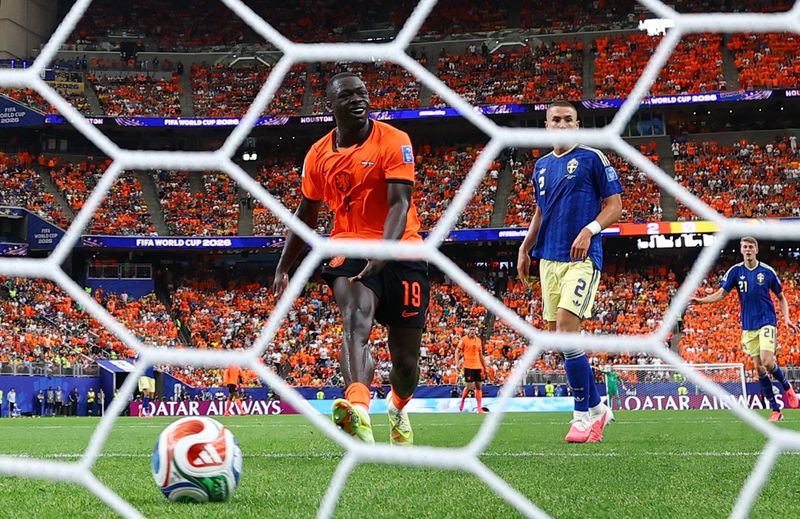
Ronald Koeman's tactical fortunes shifted dramatically in the space of a weekend when the Netherlands coach moved from facing fierce criticism over his substitution strategy to widespread acclaim for his attacking setup. Following the Dutch side's unconvincing 2-2 draw with Japan that opened their World Cup campaign in Dallas, Koeman acknowledged that his in-game adjustments had failed to deliver the anticipated impact. However, his selection decisions for the subsequent fixture proved far more astute, as the Netherlands dismantled Sweden 5-1 with an attacking display that vindicated his team selection and raised the profile of striker Brian Brobbey in the process.
The 24-year-old forward's emergence as a key attacking weapon represents a significant development for the Dutch squad, particularly given his trajectory through the international system. Brobbey had languished on the periphery of the national setup during qualifying matches for the 2026 World Cup, effectively sidelined from competitive consideration. His recall to the squad in March came after a year-long absence from the international stage, suggesting that most observers had written him off as a serious contender for a starting role at tournament level. Yet his decisive performance against Sweden has fundamentally altered perceptions of his role within the Dutch attacking structure.
Brobbey's contribution to the rout proved decisive from the opening moments, as he struck twice within the opening 17 minutes to establish Netherlands dominance. His rapid finishing set the tone for a comprehensive performance, establishing the foundation upon which the team constructed its emphatic scoreline. The clinical nature of his finishing stood in sharp contrast to the struggles that characterised the earlier encounter with Japan, where the Dutch had laboured to create clear-cut opportunities despite their technical superiority. Brobbey's movement and predatory instincts injected a new dimension into the Netherlands attack that had previously been absent.
The catalyst for Brobbey's transformation into a genuine frontline contender can be traced to his recent spell in English football. A season spent with Sunderland in the Premier League has fundamentally reshaped his understanding of the striker's role and equipped him with attributes that extend beyond the physical confrontations he previously relied upon. Speaking to reporters during the Dutch training camp, Brobbey articulated the evolution of his game with considerable self-awareness, noting that he has developed into a more multifaceted forward capable of operating effectively across multiple tactical scenarios.
Brobbey's own assessment of his development provides crucial insight into why Koeman entrusted him with the central attacking responsibility. The forward emphasised that his improvement transcends the traditional centre-forward archetype of battling opposition defenders for possession. Instead, he has cultivated the ability to execute sophisticated movement patterns, including timing runs from deeper positions, identifying pockets of space within crowded defensive setups, and occasionally dropping back into midfield to link play. These attributes represent the hallmarks of contemporary elite strikemanship, where physical dominance alone no longer suffices.
The supporting cast surrounding Brobbey during the Sweden encounter further illustrates why Koeman's tactical setup proved so effective. Cody Gakpo's control of the left flank provided consistent attacking width, whilst the high positioning of right-back Denzel Dumfries created overload situations in the wide areas. Newcomer Crysencio Summerville contributed further attacking impetus, creating a system designed to generate numerous scoring opportunities for the centre-forward. This attacking structure presents considerable scope for continuing development as the tournament progresses, provided Brobbey maintains the finishing form he demonstrated against the Swedes.
Brobbey's ascendancy occurs within the broader context of succession planning for the Dutch national team. Memphis Depay remains the Netherlands' record international goalscorer, yet his recent availability has been severely compromised by injury layoffs that have disrupted his rhythm and match fitness. The extended period on the sidelines has necessarily prompted Koeman to develop alternatives rather than persist with a player lacking consistent playing time. Brobbey has capitalised on this opportunity with a display that suggests he possesses the requisite quality to assume a prominent attacking role should Depay's injury concerns persist.
From a purely footballing perspective, the contrast in sharpness between the two forwards has become increasingly apparent. Brobbey's match fitness and recent competitive experience in the Premier League have equipped him with the predatory instincts necessary to convert chances at the highest level. Depay, despite his undoubted quality, cannot replicate the same cutting edge when returning from extended periods away from competitive football. The timing of Brobbey's resurgence therefore works strongly in his favour, as he can stake his claim whilst in peak physical condition and enjoying an abundance of confidence stemming from his two-goal performance.
The implications for Malaysian and Southeast Asian football observers merit consideration beyond the immediate context of Dutch squad dynamics. Brobbey's experience in the English Premier League demonstrates the continuing importance of European competition as a platform for developing young attacking talent. For aspiring strikers throughout the region seeking international prominence, the pathway through competitive overseas football remains the most reliable route to elite-level exposure. Brobbey's case illustrates how a season away from the national team setup, when channelled into intensive development elsewhere, can ultimately strengthen a player's credentials rather than diminish them.
Looking ahead, the remaining matches of the Dutch campaign will either consolidate or undermine Brobbey's candidacy for the striker position. Consistent performances across multiple opponents will substantially strengthen his position, whilst a reversion to inconsistency could allow Depay or other alternatives to reclaim prominence. The manner in which he performed against Sweden suggests genuine maturity and understanding of high-level football, extending beyond mere goal-scoring prowess. His movement patterns, decision-making in possession, and ability to link attacking play with defensive responsibilities indicate a more rounded player than the peripheral figure overlooked during qualifying matches. Koeman's decision to elevate Brobbey may ultimately prove instrumental in establishing a striker capable of leading the Dutch attack effectively for years to come.