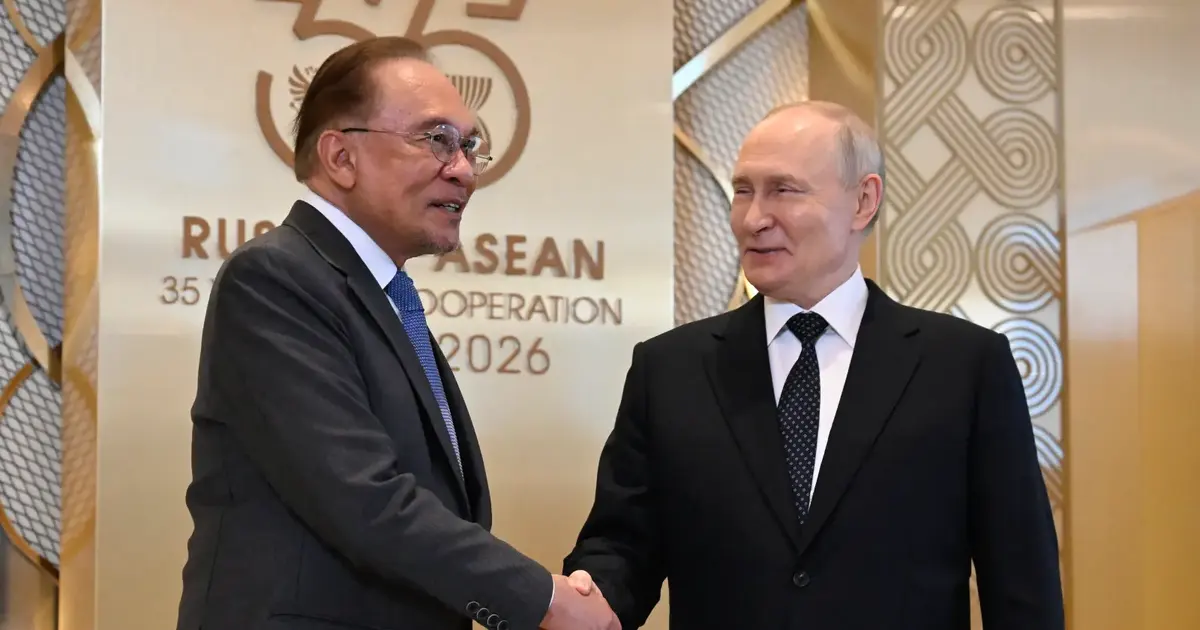
Prime Minister Anwar Ibrahim has secured a long-term energy commitment from Russian President Vladimir Putin, establishing a framework for Malaysia to receive consistent supplies of oil and gas throughout the next two decades. The pledge reflects Russia's strategic interest in deepening economic ties with Southeast Asia's third-largest economy, particularly as Moscow seeks to diversify its trading relationships amid international sanctions and geopolitical tensions.
The assurance comes at a pivotal time for Malaysia's energy security. The nation relies significantly on imported hydrocarbons to meet domestic consumption and industrial demands, with oil and gas playing crucial roles in power generation, petrochemical manufacturing, and transportation. A guaranteed two-decade supply agreement with a major global energy producer addresses long-standing concerns about price volatility and supply disruptions that could impact Malaysia's economic stability and competitiveness in regional markets.
Russia has emerged as an increasingly important supplier for Asian economies seeking to reduce dependence on Middle Eastern energy sources. For Malaysia, which maintains substantial oil and gas infrastructure and refining capacity, Russian supplies offer geographic and economic advantages. The stability provided by such a long-term arrangement allows Malaysian energy planners to invest confidently in downstream industries and infrastructure projects that depend on reliable feedstock availability.
Beyond energy security, Anwar's engagement encompasses broader economic objectives. His planned visit to Turkmenistan signals Malaysia's intent to strengthen commercial relationships across Central Asia and the Caucasus region, corridors that have historically been less prioritized in Malaysian foreign trade strategy. This diversification effort reflects a sophisticated understanding that Malaysia's prosperity depends on multiple, resilient trade partnerships rather than concentration in traditional markets.
The expansion into Central Asian energy markets also serves Malaysia's export ambitions. Malaysian goods, ranging from petrochemicals and palm oil derivatives to manufactured products and services, face growing demand in Chinese, Japanese, and South Korean markets. However, accessing these major economies often requires establishing intermediary trade relationships and demonstrating reliable supply chains. Stronger ties with Turkmenistan and Russia can facilitate Malaysia's penetration of these lucrative markets by creating reciprocal trade opportunities and leveraging Russian and Central Asian influence in Asian supply networks.
China represents the most significant opportunity in this strategic equation. Beijing's energy hunger and ambitious infrastructure investments across Central Asia make it a natural partner for countries expanding their continental trade presence. Japan and South Korea, as advanced manufacturing and technology-driven economies, offer premium markets for specialized Malaysian products. By positioning itself as a reliable trading partner in Central Asia, Malaysia enhances its ability to compete for market share in these highly developed economies.
The timing of these diplomatic initiatives reflects Malaysia's broader economic recalibration. Following pandemic-related disruptions and evolving global supply chains, Malaysian policymakers recognize the necessity of geographic diversification in both supply sources and export markets. The energy agreement with Russia and the concurrent focus on Central Asian trade routes represent components of a comprehensive strategy to insulate Malaysia from over-reliance on any single partner or region.
For Malaysian businesses, particularly those in energy-intensive industries such as petrochemicals, steel production, and electronics manufacturing, the predictability of Russian energy supplies over 20 years facilitates long-term investment planning and capital allocation. Companies can confidently commit to capacity expansion and technological upgrades when assured of stable energy input costs and availability. This reduces operational risk and enhances Malaysia's attractiveness as an investment destination for multinational corporations seeking regional manufacturing hubs.
The diplomatic outreach also signals Malaysia's pragmatic approach to international relations. While balancing relationships with Western powers and regional allies, Anwar's government maintains substantive economic engagement with Russia and Central Asian states. This non-aligned positioning allows Malaysia to maximize economic benefits while avoiding the polarization that constrains some nations' trade options in the current geopolitical environment.
Central Asia itself presents untapped opportunities for Malaysian exporters and investors. The region encompasses substantial emerging markets with growing consumer purchasing power and infrastructure development needs. Malaysian companies with expertise in telecommunications, construction, petroleum services, and financial technologies could find significant opportunities in these developing economies, particularly if Malaysia establishes itself as a reliable trading partner through high-level political engagement.
The twenty-year duration of the energy commitment is particularly significant. This extended timeframe transcends typical political cycles and market fluctuations, indicating genuine structural cooperation rather than transactional arrangements. Such duration allows both parties to invest in supporting infrastructure, including pipelines, storage facilities, and distribution networks, that would be economically unfeasible under shorter-term agreements.
Looking forward, Malaysia's dual strategy of securing energy supplies while expanding export markets reflects the complex interdependencies of modern regional economies. Success in Central Asian markets will likely depend on Malaysia's ability to deliver competitive products consistently and to understand local preferences and business practices. The energy agreement with Russia provides both foundation and incentive for developing the sustained commercial relationships necessary for this expansion to yield substantial benefits.
%22%2F%3E%3C%2Fpattern%3E%3C%2Fdefs%3E%3Crect%20width%3D%22100%25%22%20height%3D%22100%25%22%20fill%3D%22url(%23ph3e4fag)%22%2F%3E%3Crect%20width%3D%22100%25%22%20height%3D%22100%25%22%20fill%3D%22url(%23ph3e4fap)%22%2F%3E%3Ctext%20x%3D%2250%25%22%20y%3D%2250%25%22%20text-anchor%3D%22middle%22%20dominant-baseline%3D%22central%22%20fill%3D%22rgba(255%2C255%2C255%2C0.95)%22%20font-family%3D%22Georgia%2C%20'Times%20New%20Roman'%2C%20serif%22%20font-weight%3D%22700%22%20font-size%3D%22320%22%20letter-spacing%3D%22-0.02em%22%3ENew%3C%2Ftext%3E%3C%2Fsvg%3E)