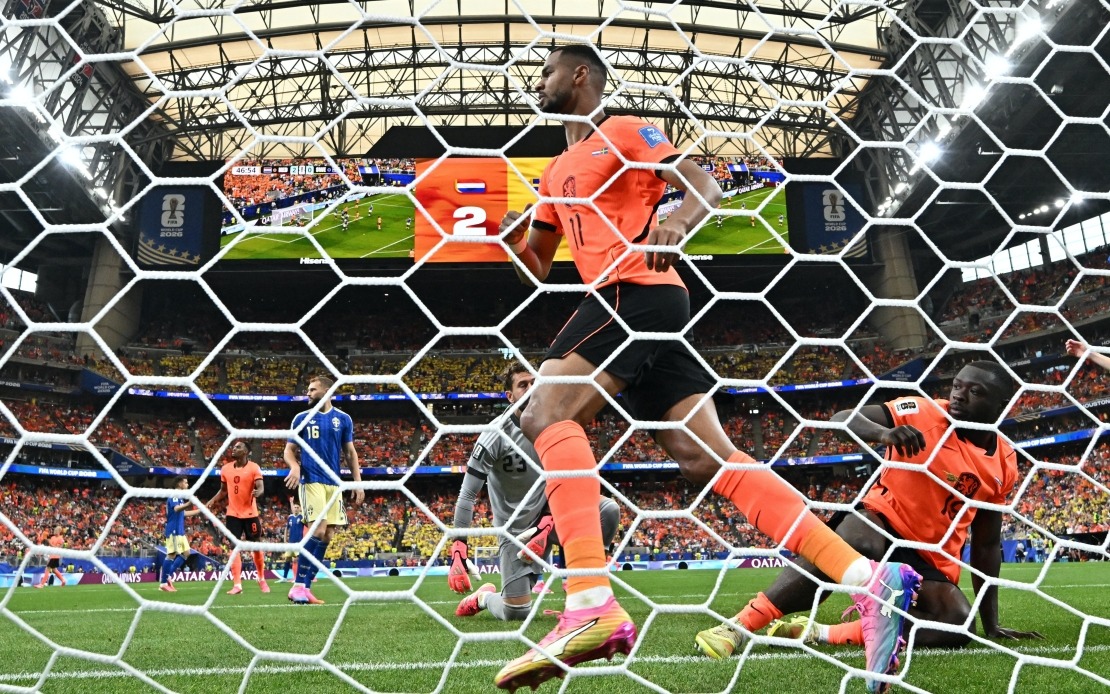
The 2024 World Cup has shattered historical scoring records, hitting the century mark for goals in its 33rd match when Netherlands forward Cody Gakpo found the net during his country's commanding 5-1 demolition of Sweden. This achievement represents the swiftest pace at which the tournament has reached 100 goals since Switzerland hosted the competition in 1954, when it took merely 20 matches—a benchmark that has stood unchallenged for seven decades. The current rate of 3.03 goals per match underscores a tournament characterised by attacking prowess and defensive vulnerabilities in equal measure.
Historical context illuminates just how dramatic the scoring acceleration has become. When Brazil hosted in 2014, teams required 36 matches to accumulate 100 goals, while Spain's 1982 tournament witnessed a similar requirement. Earlier competitions proved even tighter defensively: Argentina 1978 and the United States 1994 both needed 38 matches to reach the milestone. The gap between today's scoring rate and recent tournaments suggests fundamental shifts in how the modern game is being played at its highest level, raising intriguing questions about what factors have conspired to unlock such prolific offensive football.
Technical specifications of the official match ball have become a subject of intense scrutiny among analysts and commentators seeking explanations for the offensive onslaught. The Trionda, as the tournament's designated ball is called, has drawn criticism from various quarters who contend that its aerodynamic properties have created complications for goalkeepers attempting to handle long-range strikes. The evidence appears damning: ten goals have already been registered from outside the penalty area, a statistic that would have been unthinkable in tighter defensive eras. Whether intentional or not, the ball's characteristics seem to have shifted the equilibrium between attacking and defensive play in favour of teams seeking to score from distance.
Environmental conditions have equally played their role in reshaping the tournament's tactical landscape. The intense heat affecting matches has accelerated player fatigue, creating defensive lapses during critical moments when concentration inevitably wanes. Administrators have responded by introducing mandatory three-minute cooling breaks, ostensibly for player welfare—yet these stoppages paradoxically furnish coaching staff with additional strategic opportunities to reorganise tactics, communicate instructions, and refresh their teams' approaches. What appears as a humanitarian measure thus inadvertently becomes another tool facilitating attacking play by interrupting defensive shape and momentum.
The structural expansion to 48 participating nations from the traditional 32 has fundamentally altered competitive dynamics in ways that extend beyond simple mathematics. Early results appeared to vindicate sceptics who worried about one-sided encounters: Germany's 7-1 annihilation of Curaçao, Canada's 6-0 demolition of Qatar, and Tunisia's separate 5-1 and 4-0 drubbings suggested a tournament vulnerable to blowouts. These scorelines raised legitimate concerns that smaller footballing nations would struggle hopelessly against elite competition, producing dreary mismatches rather than compelling sport.
Yet the narrative becomes considerably more nuanced upon closer examination of the broader fixture list. Curaçao managed to frustrate Ecuador in a goalless draw, demonstrating defensive discipline against quality opposition. Cabo Verde earned genuine respect by holding Spain to a stalemate, a result that would have seemed improbable during the qualifying campaign. Qatar's defeat to Canada, while lopsided on the scoreline, came after the tournament hosts were reduced to nine men, a contextual detail that fundamentally reframes the result's significance. These outcomes suggest that the expanded format has produced far greater competitive balance than pessimists initially anticipated.
Further evidence emerges from the performances of perceived underdogs who have proven considerably more resilient than anticipated. Jordan and Uzbekistan, nations hardly considered traditional World Cup powerhouses, mounted respectable challenges despite ultimately succumbing 3-1 to Austria and Colombia respectively. These results indicate that even the expanded format's weakest participants possess sufficient quality to compete meaningfully, rather than merely serving as cannon fodder for stronger nations. The tournament has developed genuine unpredictability in outcomes, where knowledge of team rankings provides less certainty than in previous editions.
For Malaysian observers and Southeast Asian football enthusiasts, these developments carry significant implications. The tournament's emphasis on attacking prowess and the apparent vulnerability of even accomplished defensive systems suggests that tactical innovation and aggressive intent may matter more than traditional defensive stability. The high-scoring character of the competition potentially rewards teams with creative attacking players and unpredictable offensive approaches—qualities that developing footballing nations might cultivate more readily than the deep defensive infrastructure required in lower-scoring tournaments. Regional nations seeking to compete at higher levels might find encouragement in a tournament that has proven less predictable and more open to surprises than recent World Cups.
The expanded format's apparent success in maintaining competitive balance while increasing scoring output presents a compelling case for tournament organisers contemplating future competition structures. Rather than diluting quality through sheer expansion, the 48-team format appears to have created conditions favouring entertaining football where surprises remain possible and heavyweight nations cannot sleepwalk through matches. The combination of structural changes, technical specifications, and environmental conditions has coalesced into an environment where traditional hierarchies seem more fluid than ever. Whether this represents a permanent shift in World Cup football or a temporary anomaly remains an open question as the tournament progresses.

%22%2F%3E%3C%2Fpattern%3E%3C%2Fdefs%3E%3Crect%20width%3D%22100%25%22%20height%3D%22100%25%22%20fill%3D%22url(%23ph3rzqsg)%22%2F%3E%3Crect%20width%3D%22100%25%22%20height%3D%22100%25%22%20fill%3D%22url(%23ph3rzqsp)%22%2F%3E%3Ctext%20x%3D%2250%25%22%20y%3D%2250%25%22%20text-anchor%3D%22middle%22%20dominant-baseline%3D%22central%22%20fill%3D%22rgba(255%2C255%2C255%2C0.95)%22%20font-family%3D%22Georgia%2C%20'Times%20New%20Roman'%2C%20serif%22%20font-weight%3D%22700%22%20font-size%3D%22170%22%20letter-spacing%3D%22-0.02em%22%3ETambirat%3C%2Ftext%3E%3C%2Fsvg%3E)