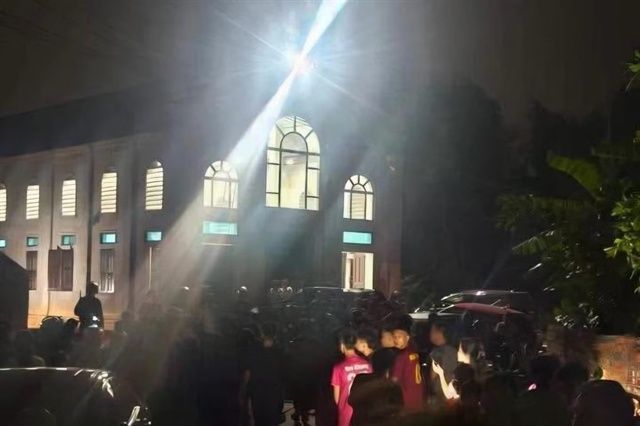
A devastating act of domestic violence in Bac Ninh Province, northern Vietnam has ended with four deaths and one serious injury, underscoring the continuing dangers of intimate partner disputes that periodically grip the region. Local authorities in Viet Yen Ward confirmed the tragic incident on Sunday, June 21, after emergency responders discovered the bodies in the Bai Bang residential quarter. The sequence of events appears to have unfolded during what began as a personal disagreement between two adults but escalated into a catastrophic loss of life affecting an entire household.
Investigators determined that 36-year-old Nguyen Van Tuyen from Bac Lung Commune initiated the violence against his 31-year-old girlfriend, identified as N.T.N., during what preliminary inquiries suggest was a relationship conflict. The confrontation quickly turned deadly when Tuyen deployed a knife as a weapon against those in the residence, demonstrating the lethal potential of domestic disputes that might otherwise have been resolved through mediation or separation. The presence of children within the home transformed what might have remained a bilateral conflict into a broader tragedy affecting vulnerable young people who had no involvement in the underlying disagreement.
Two children residing in the household became victims of the violence: a ten-year-old boy identified as N.H.P. and a six-year-old girl, N.B.B. Both youngsters were fatally wounded during Tuyen's attack, representing the most troubling aspect of this incident from a social perspective. The deaths of children in domestic violence scenarios raise urgent questions about household safety, the vulnerability of minors in abusive environments, and whether earlier intervention by family services or community members might have prevented the tragedy. In many such cases across Southeast Asia, warning signs of escalating tension precede the violent episode, yet institutional responses remain inadequate.
After attacking the mother and her two children, Tuyen took his own life, transforming what might have been a criminal matter subject to prosecution into a murder-suicide that removes the possibility of justice or accountability through the legal system. This pattern—where the perpetrator ends his own life following a violent outburst—appears with troubling regularity in domestic violence homicides throughout the region. The psychological state of the aggressor, whether involving untreated mental health conditions, substance abuse, or simply an inability to manage relationship stress constructively, remains an area where prevention efforts could theoretically intervene before violence occurs.
An 11-year-old adopted sister of the girlfriend, identified as N.B.N., was also present during the incident and sustained injuries from the attack. This child was transported to Viet Yen General Hospital for emergency medical care, where she presumably underwent treatment for wounds inflicted during the same violent episode. Her survival and recovery, assuming no life-altering complications, may allow investigators to gather eyewitness testimony regarding the sequence of events and the motivations behind the violence, though the trauma inflicted on a young witness to such horror carries its own psychological consequences.
The response from local law enforcement appears to have been reasonably swift, with officers from the provincial Police Investigation Agency and the Criminal Police Division of Viet Yen Ward arriving at the scene to secure the area and begin preliminary assessments. Such multi-agency coordination is standard protocol in homicide investigations across Vietnam, though the presence of multiple perpetrators, victims, and deaths in a single incident compounds the investigative complexity considerably. Officers conducted initial interviews with neighbours and witnesses who reported the disturbance, attempting to reconstruct the timeline and circumstances that led to the violence.
Forensic teams undertook detailed crime scene examination and evidence collection procedures to document the physical evidence and establish the sequence of injuries and deaths. These investigations serve multiple purposes: confirming the circumstances already suggested by preliminary enquiry, ruling out alternative explanations for the deaths, and creating an official record that might inform future policy discussions about domestic violence prevention. The forensic findings would typically include weapon analysis, injury patterns, and toxicology results that might indicate whether substance use played a role in lowering the threshold for violence.
Domestic violence remains a significant social problem across Vietnam and throughout Southeast Asia, though official statistics often undercount the true prevalence due to underreporting and cultural factors that discourage families from involving authorities in private disputes. The appearance of such tragic incidents in police reports represents only the most extreme manifestation of a broader pattern of intimate partner violence affecting thousands of households. Efforts to address this challenge require coordination between law enforcement, healthcare systems, social services, and community education initiatives that promote healthier conflict resolution and gender equality.
This incident in Bac Ninh Province reflects patterns observed elsewhere in the region where relationship breakdowns, economic stress, and inadequate access to mental health services converge to create dangerous situations. The involvement of children demonstrates how domestic violence extends its harm beyond the immediate parties to relationships, affecting the next generation and creating orphans from preventable tragedies. For Malaysian and other Southeast Asian readers, such incidents serve as reminders of the importance of supporting domestic violence prevention efforts, maintaining accessible reporting mechanisms, and ensuring that vulnerable family members—particularly children—receive protection when warning signs of abuse emerge.
%22%2F%3E%3C%2Fpattern%3E%3C%2Fdefs%3E%3Crect%20width%3D%22100%25%22%20height%3D%22100%25%22%20fill%3D%22url(%23ph2rwkog)%22%2F%3E%3Crect%20width%3D%22100%25%22%20height%3D%22100%25%22%20fill%3D%22url(%23ph2rwkop)%22%2F%3E%3Ctext%20x%3D%2250%25%22%20y%3D%2250%25%22%20text-anchor%3D%22middle%22%20dominant-baseline%3D%22central%22%20fill%3D%22rgba(255%2C255%2C255%2C0.95)%22%20font-family%3D%22Georgia%2C%20'Times%20New%20Roman'%2C%20serif%22%20font-weight%3D%22700%22%20font-size%3D%22320%22%20letter-spacing%3D%22-0.02em%22%3EMuda%3C%2Ftext%3E%3C%2Fsvg%3E)
%22%2F%3E%3C%2Fpattern%3E%3C%2Fdefs%3E%3Crect%20width%3D%22100%25%22%20height%3D%22100%25%22%20fill%3D%22url(%23ph32kvkg)%22%2F%3E%3Crect%20width%3D%22100%25%22%20height%3D%22100%25%22%20fill%3D%22url(%23ph32kvkp)%22%2F%3E%3Ctext%20x%3D%2250%25%22%20y%3D%2250%25%22%20text-anchor%3D%22middle%22%20dominant-baseline%3D%22central%22%20fill%3D%22rgba(255%2C255%2C255%2C0.95)%22%20font-family%3D%22Georgia%2C%20'Times%20New%20Roman'%2C%20serif%22%20font-weight%3D%22700%22%20font-size%3D%22170%22%20letter-spacing%3D%22-0.02em%22%3EMalaysia%3C%2Ftext%3E%3C%2Fsvg%3E)