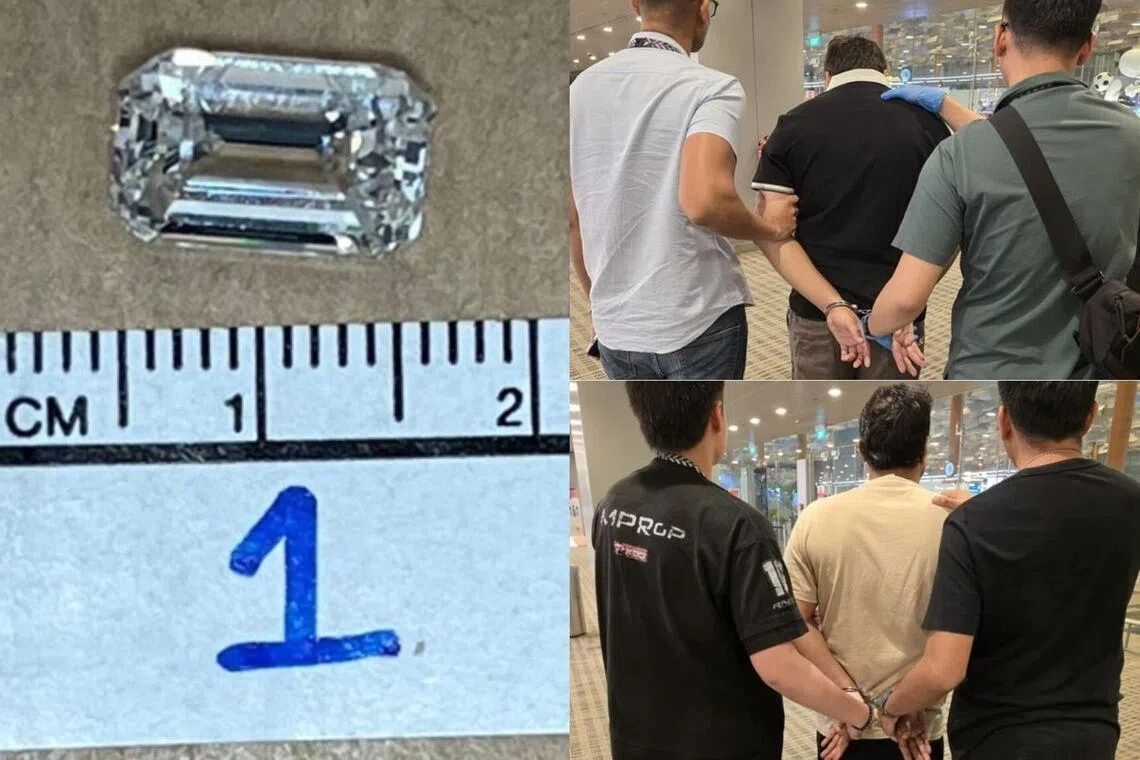
Singapore authorities have made arrests in a high-value jewellery theft that unfolded in the heart of Chinatown this month. Two men, aged 30 and 42, face charges related to the disappearance of a diamond worth more than S$235,000 from a retail store on Kreta Ayer Road. The swift police response led to their detention at Changi Airport Terminal 3 on the same day as the incident, with investigators recovering the stolen gemstone and detailing a sophisticated bait-and-switch operation that exploited routine commercial transactions.
The theft was reported to police at 3.40pm on June 19 after store staff discovered that a diamond had vanished and been replaced with a counterfeit. The jewellery store assistant grew suspicious when the two men departed without completing a purchase despite showing considerable interest in the item. Upon conducting an inventory check, the shop worker confirmed that a substitution had taken place, prompting an immediate alert to authorities. This discovery mechanism—a vigilant employee noticing the inconsistency—proved crucial in activating the investigation machinery that would locate the suspects within hours.
Central Police Division officers collaborated with the Police Operations Command Centre to piece together the sequence of events. Investigators deployed multiple investigative tools including ground enquiries, closed-circuit television footage from the jewellery store, and police camera networks throughout the Chinatown district. The technological advantage of Singapore's extensive surveillance infrastructure enabled officers to track the suspects' movements and establish their identities. The men were identified and located with sufficient speed to intercept them before they could depart the island, suggesting they may have been attempting to leave via the airport's international terminals.
According to preliminary investigations, the pair had deliberately examined the genuine diamond at the store counter, creating an opportunity to execute their scheme. While handling the gemstone under the pretext of considering a purchase, they executed a sleight-of-hand manoeuvre to swap it for a fake replica. The substitute was crafted convincingly enough to pass an initial visual inspection, though store staff uncovered the deception during their follow-up verification. This modus operandi—posing as genuine customers while engaging in manual dexterity-based theft—represents a persistent challenge for luxury retail operations across Southeast Asia, where high-value items remain vulnerable to organised theft syndicates.
The authorities have not disclosed the nationalities of the two arrested men, a detail that remains withheld pending legal proceedings. Both individuals are scheduled to face charges of theft in dwelling with common intention, a charge that reflects the collaborative nature of the alleged crime and the domestic setting where it occurred. Singapore's Penal Code prescribes substantial penalties for such offences: conviction carries a maximum imprisonment term of seven years and exposure to financial penalties. The severity of these provisions underscores how seriously the jurisdiction treats organised jewellery theft, particularly when substantial values are involved.
This incident carries particular relevance for Malaysia and other regional economies where luxury retail theft has become increasingly sophisticated. The technique employed—substituting genuine items with counterfeit versions—requires either detailed knowledge of gemstone identification or accomplices with such expertise. It suggests possible involvement by organised criminal networks with understanding of jewellery valuation and the ability to source convincing replicas. Such operations often transcend national boundaries, with stolen goods moving across Southeast Asia for resale or laundering through underground markets.
Singapore's Police Force issued an alert to all retailers selling premium merchandise, explicitly warning jewellery store operators to recognise and guard against identical tactics. The advisory highlights the vulnerability of the customer-examination process, where legitimate business practices create windows for criminal exploitation. Shop owners are urged to implement heightened scrutiny when customers express interest in high-value items, including verification procedures before and after handling, increased use of security personnel, and modern anti-theft technologies such as electronic item tracking and reinforced display cases.
For Malaysian jewellery merchants and retail establishments across the region, this case underscores the importance of staff training and vigilance. Many similar thefts go unreported or undetected because employees fail to notice substitutions immediately, allowing suspects to establish distance. The Chinatown incident demonstrates how employee awareness—the shop assistant's decision to verify the inventory—can be the decisive factor in crime detection and prevention. This speaks to the value of investing in staff training programmes focused on recognising suspicious behaviour and conducting systematic verification protocols.
The speed of apprehension also reflects regional law enforcement cooperation capabilities, particularly within Singapore's jurisdiction where airport terminals serve as choke points for departing suspects. Changi Airport's integrated security systems and coordination with police enabled the interception before international borders could be crossed. For Malaysia, where cross-border movement to Thailand, Brunei, and Indonesia remains relatively fluid, similar coordination mechanisms at entry and exit points represent critical infrastructure for combating organised retail theft and smuggling operations.
The recovery of the stolen diamond within hours of the theft represents a successful outcome, though it raises questions about the operational sophistication of the suspected theft ring. That the men were apprehended before reaching international airspace suggests either that the operation was conducted by relative newcomers to organised theft or that police surveillance capabilities exceeded the planning capacity of those involved. The recovery of physical evidence—the genuine diamond seized as case exhibit—will be crucial for prosecution, providing tangible proof of the crime and supporting charges under theft statutes.
As the legal process moves forward through Singapore's courts, the broader implications for retail security across Southeast Asia remain evident. Organised jewellery theft represents an ongoing challenge for merchants throughout the region, with syndicates continuously adapting their methods to counter security measures. This incident, while resolved through swift police action, illustrates vulnerabilities that persist across luxury retail sectors in Malaysia and neighbouring jurisdictions where comparable security measures may not yet be standardised. Retail businesses must balance customer service accessibility with security protocols that prevent exploitation of the examination and transaction process.