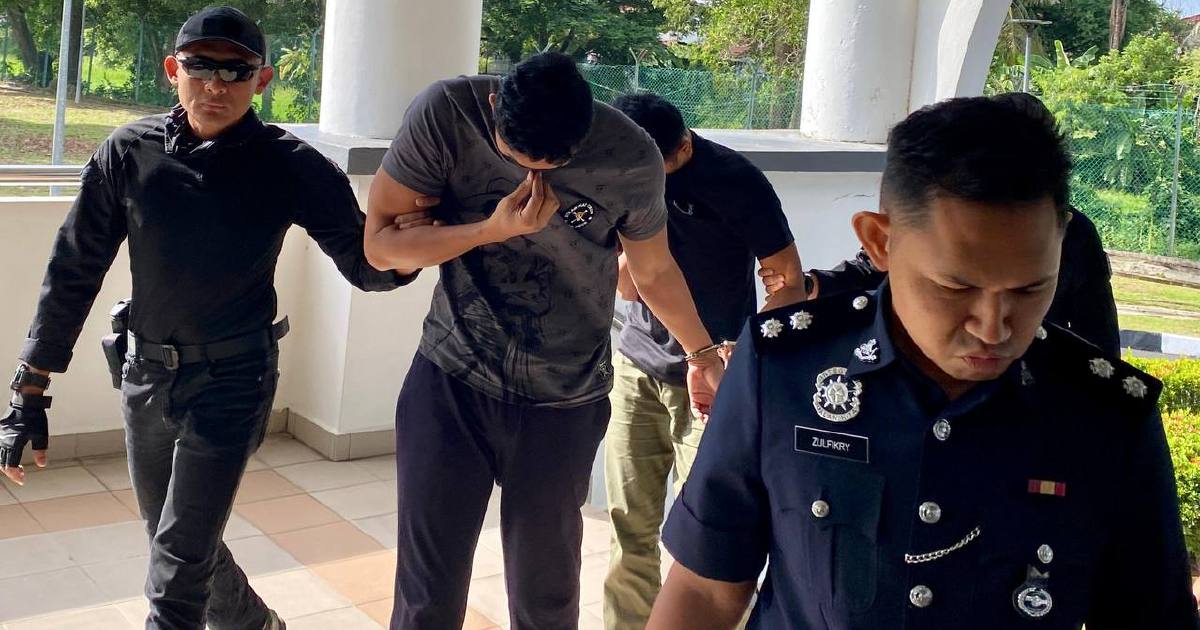
Two active-duty soldiers appeared before the Sessions Court in Alor Star today to face charges relating to human trafficking offences involving three Myanmar nationals. The allegations centre on their involvement in unlawfully facilitating the passage of the migrants across the Malaysia-Thailand border during the preceding month, marking another instance of security personnel allegedly exploiting their position for profit through irregular migration networks.
The prosecution of the servicemen underscores a persistent vulnerability within Malaysia's border security apparatus, where uniformed personnel with legitimate access to frontier regions have occasionally been implicated in assisting clandestine movement of undocumented migrants. Such cases raise particular concerns because soldiers occupy positions of trust and authority that can be manipulated to circumvent established checkpoint procedures and enforcement mechanisms designed to regulate cross-border movement.
Border security between Malaysia and Thailand remains a complex enforcement challenge across multiple jurisdictional points. The northern frontier experiences sustained pressure from migration flows originating in Myanmar, where ongoing political instability and humanitarian crises have displaced substantial populations seeking safer passage toward more economically developed nations. Thailand itself functions partly as a transit country for these movement routes, creating multiple layers of vulnerability where corruption or exploitation can occur.
The specific allegation of moving three individuals represents a relatively small-scale operation, yet illustrates how even modest smuggling activities require complicity from individuals with institutional access. Professional soldiers typically possess secure area passes, transportation credentials, and operational familiarity with border crossing protocols that enable them to move persons across barriers that would obstruct ordinary citizens. This insider knowledge transforms them into valuable assets within trafficking networks that frequently operate on referral-based systems.
Myanmar nationals constitute a substantial proportion of irregular migrants in Malaysia, driven by the military coup and subsequent political turmoil that destabilised the country beginning in 2021. Many flee seeking employment opportunities or family reunification, yet lack legal pathways to enter Malaysia given restrictive immigration policies. Consequently, they depend on smuggling networks that exploit both their desperation and international gaps in enforcement capacity.
The decision to prosecute active servicemen signals commitment from relevant authorities to address corruption within the security establishment. Malaysia has historically struggled with public confidence in border law enforcement, with sporadic reports of uniform personnel facilitating contraband movement and migrant trafficking. Visible prosecution serves both deterrent purposes for would-be offenders and reassurance functions for public confidence in institutional integrity.
The Sessions Court jurisdiction indicates these charges likely fall under Malaysian human trafficking legislation rather than simple immigration violations, suggesting prosecutors believe sufficient evidence exists to prove deliberate facilitation of irregular migration. Such charges typically carry substantial penalties including imprisonment and fines, making conviction outcomes consequential for both the individuals and broader military personnel attitudes toward corruption.
Southeast Asia's migration patterns have intensified significantly since Myanmar's political collapse, with Malaysia absorbing disproportionate numbers relative to other regional destinations. The country hosts substantial Myanmar migrant communities in manufacturing zones, construction sectors, and domestic work industries where employers historically turned a blind eye to documentation irregularities. This economic demand perpetuates smuggling networks that remain profitable precisely because employers maintain willingness to hire undocumented workers despite enforcement rhetoric.
Thailand's concurrent role as both transit corridor and destination complicates regional responses. Border towns along the Malaysian-Thai frontier experience regular cross-border commerce and population movement that creates camouflage for illicit activities. Soldiers deployed to these regions experience career exposure to smuggling opportunities and may become gradually socialised toward viewing participation as financially rational when government salaries remain modest relative to opportunities available through corruption.
The prosecutions contribute to an emerging pattern of accountability mechanisms targeting security sector involvement in human trafficking. International pressure through mechanisms like the United States Trafficking in Persons Report has encouraged Malaysian authorities to demonstrate enforcement against institutional corruption. However, experts observe that successful prosecution requires sustained political will beyond immediate court cases, including salary reforms, vetting procedures, and anti-corruption training within military institutions.
Migrant protection organisations have emphasised that genuine border security requires addressing both supply-side factors driving migration and demand-side factors creating illicit labour markets. Individual prosecutions, while necessary for accountability, do not resolve underlying structural factors that make smuggling profitable or desperation-driven migration inevitable. Myanmar's continued instability ensures migrant pressure will persist across regional borders regardless of individual enforcement actions.
The Sessions Court proceedings will likely extend across multiple dates as evidence presentation and defence arguments progress. Observers expect the case will generate significant attention within military circles and among migration advocacy networks monitoring Malaysia's compliance with international human trafficking standards. The ultimate sentencing will signal the judicial system's seriousness regarding security personnel exploitation of their privileged positional access for purposes of human exploitation.