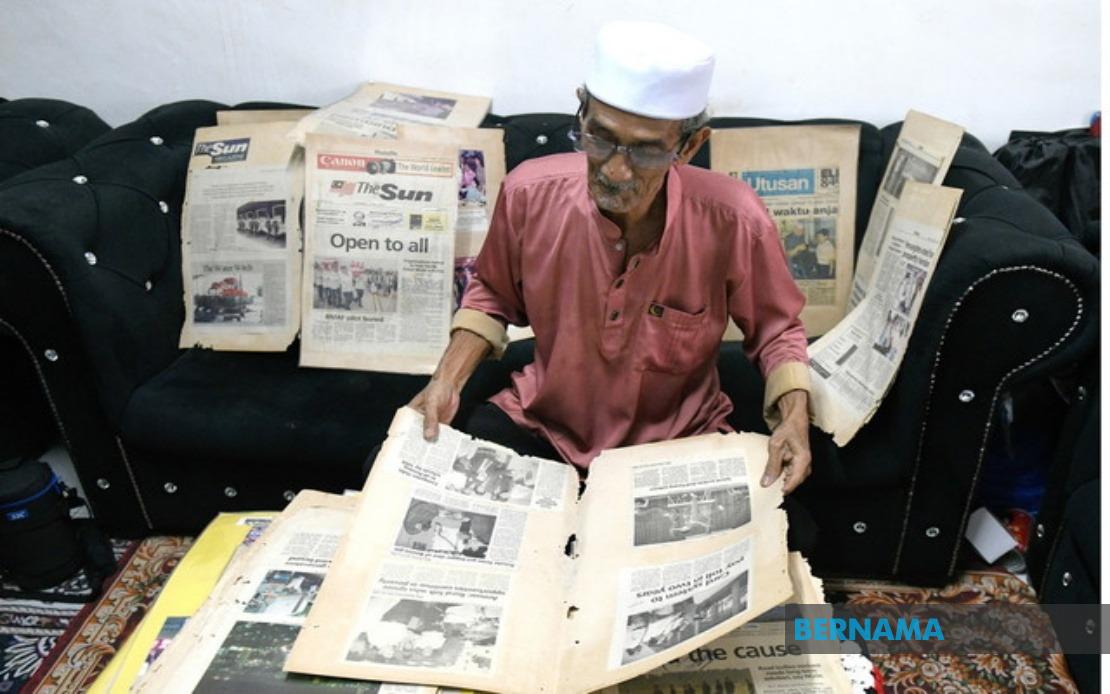
Azmi Sapiei has endured far more than most journalists encounter in a single assignment. Throughout his thirty-year career spanning multiple newsrooms across Malaysia, the 64-year-old veteran was kicked and spat upon by a suspect while covering court proceedings around 2001, an incident he carried with him as a stark reminder of the occupational hazards awaiting those who document the nation's stories. Yet despite such violent encounters, Sapiei remained committed to his craft, retiring only in mid-2020 after serving as a part-time cameraman for Radio Televisyen Malaysia Penang from 2003 onwards.
Sapiei's trajectory into journalism began unconventionally. He initially worked in factory operations before discovering his passion for photography in the mid-1980s, eventually migrating to Kuala Lumpur to pursue the field independently whilst contributing to various agencies and women's publications. This pathway led him to join Bernama, the national news agency, in 1993 as a photographer. His nearly three years there proved formative, establishing professional foundations that would sustain him through subsequent positions at The Sun, Bernama Television, and ultimately RTM Penang, demonstrating how Malaysian newsrooms functioned as rigorous training grounds for visual journalists.
Among his most significant professional achievements was securing exclusive photographs of Shamsiah Fakeh, a former Malayan Communist Party member, during her return from China in July 1994. This assignment illustrated both the competitive nature of news gathering and the resourcefulness required to scoop rivals. Sapiei and a journalist managed to gain early access to Shamsiah's residence in Gombak before security restrictions were imposed, allowing them to document her homecoming when competing media outlets remained locked out. The episode also revealed the challenging economics of pre-digital journalism: after returning to his newsroom with three rolls of film, his editor initially dismissed the modest quantity, questioning whether the effort justified the material. Yet upon development, major newspapers across Malaysia published his images prominently the following day, vindicating both his instincts and his investment of resources.
Working during the analogue era imposed substantial constraints on journalists unfamiliar with digital workflows. Sapiei operated within a system where every photograph required film processing before editors could evaluate its newsworthiness or visual composition. Beyond simply capturing images, he bore responsibility for composing detailed captions that explained context, identified subjects, and articulated the editorial significance of each frame—supplementary labour that contemporary digital photographers often outsource or abbreviate. These processes created unavoidable delays between assignment completion and publication, fundamentally altering how news stories developed and how journalists could adapt their coverage based on real-time feedback.
The transition from still photography to television camerawork introduced fresh physical demands that tested Sapiei's endurance. Working with Betacam technology during his tenure at Bernama Television required operating equipment that staff cynically nicknamed "junk iron" due to its substantial weight of approximately twelve kilogrammes. Carrying such apparatus mounted on one's shoulder throughout extended assignments—whether covering protests, political events, or court proceedings—demanded muscular stamina and postural resilience that still photographers could largely avoid. This corporeal element of broadcast journalism remained underappreciated in public discussions of media work, yet it fundamentally shaped what reporters could accomplish and the physical toll their profession extracted.
Sapiei consistently reflected upon Bernama's institutional role in shaping Malaysian journalism standards. He characterised the national news agency as a "school" that cultivated discipline, accuracy, and editorial judgment among generations of photographers and journalists. The rigorous standards Bernama demanded—insisting not merely that images be technically competent but that they possess genuine news value and contextual appropriateness—established expectations that persisted throughout his career transitions. This emphasis on institutional discipline and professional rigour distinguished his era from contemporary digital journalism, where volume and velocity sometimes overshadowed thoughtful editorial consideration.
The progression from film to digital technology fundamentally altered the economics and operational rhythms of visual journalism. Where Sapiei once calculated film usage conservatively, aware that wastage invited managerial criticism, digital photographers could capture hundreds of frames instantaneously with minimal marginal cost. This abundance created new editorial challenges: distinguishing genuinely significant moments from incidental documentation, resisting the temptation toward unfocused mass-capture, and maintaining the disciplined restraint that characterised film-era practice. Sapiei's experience bridging these technological eras positioned him uniquely to appreciate both the advantages of digital speed and the virtues of the thoughtfulness that scarcity once imposed.
The violence Sapiei encountered whilst performing his duties underscores a frequently overlooked dimension of journalism in Malaysia and Southeast Asia more broadly. News gathering, particularly in contentious criminal or political contexts, exposes journalists to confrontation, intimidation, and physical assault. Yet professional norms often discourage detailed discussion of such incidents, permitting a sanitised public narrative that obscures the genuine occupational dangers workers face. Sapiei's willingness to speak candidly about being kicked and spat upon whilst executing his responsibilities contributes valuable testimony to understanding journalism's true conditions, particularly for aspiring practitioners considering entry into the profession.
Professional recognition came late in Sapiei's career when he received the 2006 Penang State Media Award in the visual electronic media category. Such awards, whilst validating individual achievement, constitute only fragmentary recognition of the sustained dedication journalists invest across their working lives. Most assignments generate no accolades, many prove contentious or dangerous, and the cumulative impact of professional commitment often becomes apparent only in retrospective reflection. For Sapiei, the award represented institutional acknowledgement that his decades of discipline, technical skill, and willingness to endure discomfort had contributed meaningfully to Malaysian journalism's evolution.
Succession within journalism families remains uncommon in Malaysia, yet Sapiei's second son, Muhammad Syafiq, now 30 years old, has embraced visual media as a professional calling whilst employed at Media Prima Television Network. Syafiq's career trajectory directly traces to childhood exposure, when observing his father transporting equipment home sparked curiosity that evolved into sustained interest. Upon completing his Sijil Pelajaran Malaysia in 2016, Syafiq began accompanying his father to assignment locations, gradually developing operational competence before assuming independent camera responsibilities a year later. This mentoring relationship—wherein Sapiei functioned simultaneously as father, instructor, and professional exemplar—transmitted not merely technical skills but embodied understanding of discipline, visual composition judgment, and the mental fortitude necessary to maintain professional standards despite external pressures.
The intergenerational transmission of journalistic values through Sapiei's family represents a broader pattern of cultural knowledge transfer that institutional training programs alone cannot replicate. Syafiq absorbed lessons about filming technique, camera angles, positioning, and work ethics through direct observation and hands-on guidance in authentic professional contexts. He witnessed firsthand how his father navigated difficult assignments, processed disappointments, and maintained commitment despite encountering violence or disrespect. Such experiential education, rooted in relationship and observation rather than classroom instruction, cultivates journalists fundamentally shaped by understanding journalism's true conditions and genuine demands.
Sapiei's retirement in mid-2020 concluded an era of Malaysian journalism characterised by technological transitions, institutional evolution, and the accumulation of hard-won professional experience. His career arc—from factory worker to Bernama photographer, through multiple newsrooms, adapting successively to film, tape, and digital technologies whilst enduring physical assault and institutional criticism—encapsulates the resilience required of journalists documenting the nation's transformation. Beyond specific assignments or awards, his legacy comprises the values he transmitted to his son and the implicit lessons his career communicates about journalism's essential role in Malaysian society. As news gathering becomes increasingly rapid, distributed, and commercially pressured, Sapiei's example of disciplined professionalism, personal endurance, and institutional integrity offers counterweight to contemporary tendencies toward sensationalism and expedience. The veteran cameraman's journey reminds practitioners and audiences alike that meaningful journalism requires sustained commitment, technical skill, ethical judgment, and willingness to absorb considerable personal costs in service of public documentation.