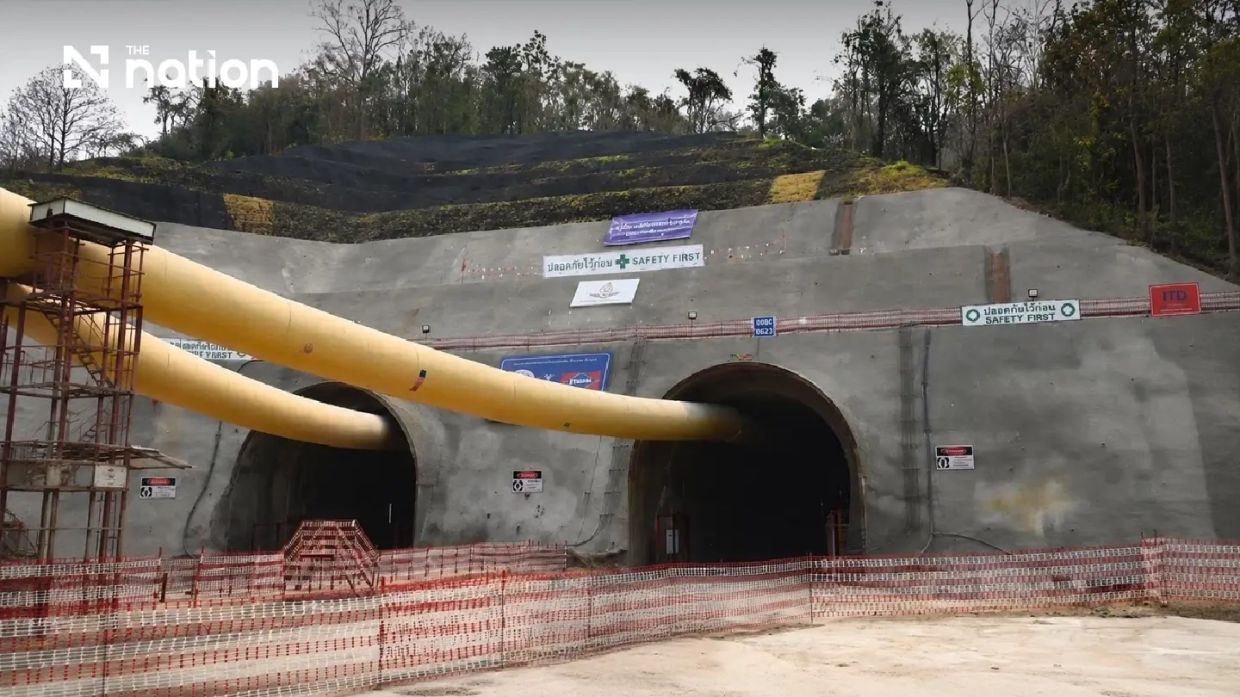
A construction accident at Thailand's Doi Luang railway tunnel in Chiang Rai province has claimed two lives and left seven workers injured, casting a shadow over the State Railway of Thailand's ambitious Den Chai-Chiang Rai-Chiang Khong railway line project. The incident unfolded on Saturday evening when scaffolding gave way inside the tunnel, halting progress on one of the country's most significant regional transport infrastructure initiatives.
According to Deputy Transport Minister Siripong Angkasakulkiat, the accident occurred around 8.35pm on June 20, with initial investigations pointing to falling rocks from the tunnel wall as the likely trigger. Workers had been engaged in installing a waterproofing system when the collapse occurred, creating a dangerous combination of structural weakness and active construction operations. The precise sequence of events that led to the catastrophic failure remains under examination by transport ministry officials and the State Railway of Thailand's investigative teams, though preliminary assessments have also referenced complications in the shotcrete work area immediately preceding the incident.
The human toll of the accident has been carefully documented. Two workers were pronounced dead, three sustained serious injuries, and four others suffered minor harm. All injured personnel were promptly evacuated to hospital facilities for medical treatment, with transport authorities confirming that the emergency response activated rapidly following the initial distress call. Deputy Transport Minister Siripong assured the public that the situation had stabilised by the time of his statement, with the accident zone secured to prevent further incidents during the investigative process.
The Doi Luang tunnel represents a critical component of the broader Chiang Rai-Chiang Khong railway corridor development. The tunnel, situated in Chiang Saen district, stretches 3.4 kilometres in length and has already been successfully bored through, meaning construction crews were concentrating on interior finishing and systems installation rather than primary excavation work. This detail underscores that even in advanced project phases, significant hazards remain present, a reality that has prompted urgent safety reviews across the construction site.
The tunnel falls within Contract 3 of the Chiang Rai-Chiang Khong section, a THB19.385 billion contract encompassing far more than just the tunnel itself. The full scope of work includes approximately 87 kilometres of both at-grade and elevated railway tracks, the construction of three stations and three halts, signalling and telecommunications infrastructure, and various ancillary systems. These elements collectively represent the substantial investment Thailand is making to enhance regional connectivity between its central and northern territories, facilitating improved trade, tourism, and passenger movement.
The work has been entrusted to the CKST-DC3 Joint Venture, a consortium bringing together CH. Karnchang Public Company Limited, a prominent Thai construction firm with extensive infrastructure experience, alongside Sino-Thai Engineering & Construction Public Company Limited and Chiangmai Construction Co., Ltd. The partnership structure reflects Thailand's approach to major projects, combining domestic expertise with international collaboration to manage technical complexity and financial scale.
The State Railway of Thailand's Special Projects and Construction Department has initiated an urgent site inspection and taken direct operational control of the accident location. This decisive action underscores the seriousness with which transport authorities are treating the incident, with the priority now shifting towards determining root causes and implementing corrective measures to prevent recurrence. Officials have sealed the affected area pending completion of detailed forensic investigation, restricting access to qualified inspectors and engineers.
For Malaysian observers and regional stakeholders, this accident carries broader implications. Thailand's railway modernisation programme, connecting northern provinces to central Thailand and potentially facilitating cross-border trade with Laos and Myanmar, represents significant economic integration within Southeast Asia. Any disruption to major projects of this magnitude affects regional supply chains and investment confidence. The incident also highlights universal construction safety challenges across the region, where rapid development ambitions sometimes outpace safety culture implementation, a lesson particularly relevant for Malaysia's own expanding rail infrastructure agenda.
The investigation's findings will likely generate scrutiny not only within Thailand but across Southeast Asian development circles. Detailed reports on what caused experienced contractors to encounter such hazardous conditions may inform safety protocols region-wide, particularly for tunnel construction methodologies and waterproofing system installation procedures. Transport ministry officials have indicated that comprehensive findings will be released once investigative work concludes, allowing proper accountability and learning from this preventable tragedy.
The accident arrives during a period of accelerated infrastructure expansion throughout mainland Southeast Asia, where construction projects frequently operate under tight timelines and sometimes competing pressures between schedule adherence and worker safety. How Thailand's authorities investigate and respond to this incident may establish precedent for safety accountability across comparable regional projects, potentially influencing how neighbouring countries, including Malaysia, approach oversight of large-scale railway and tunnel construction contracts.
Looking ahead, the Den Chai-Chiang Rai-Chiang Khong railway line project will need to demonstrate that it can continue development safely and effectively despite this setback. The railway, once completed, promises to strengthen Thailand's northern region economically and enhance regional logistics networks, making it strategically important that work resumes with reinforced safety protocols rather than abandonment of the ambitious vision underlying the project.