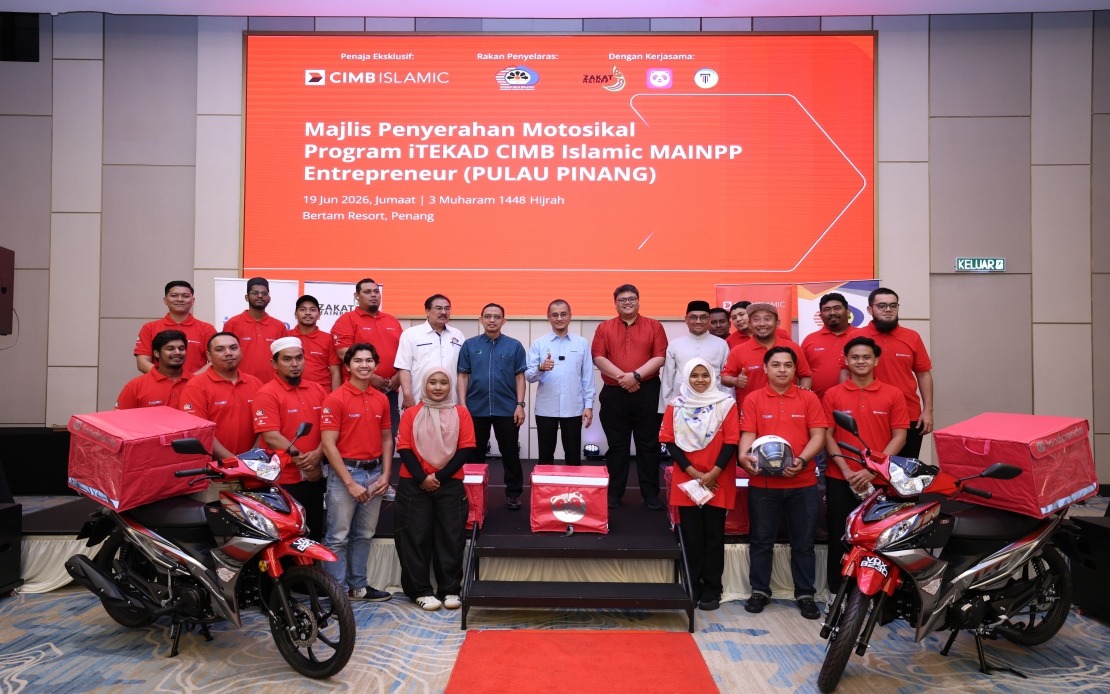
Twenty individuals have been selected to receive motorcycles and delivery equipment under the iTEKAD CIMB Islamic-MAINPP Entrepreneur programme, marking a significant step forward in efforts to uplift marginalised communities in Penang through structured employment and income-generation initiatives. The motorcycles were handed over at a ceremony held at Bertam Resort in Kepala Batas, underscoring the commitment of multiple stakeholders to deliver tangible support that extends beyond temporary relief to create lasting economic transformation.
The programme represents a collaborative effort between CIMB Islamic Bank Berhad and the Penang Islamic Religious Council, known as MAINPP, which channels zakat funds toward community development. Implementation is supported by several partners including the Malaysian Youth Foundation, Taylor's Community, and foodpanda Malaysia, each contributing specialised expertise to ensure comprehensive support for participants. This multi-stakeholder approach reflects a broader recognition that addressing poverty and economic marginalisation requires coordinated action across financial, government, and commercial sectors rather than isolated interventions.
Penang Deputy Chief Minister I Datuk Dr Mohamad Abdul Hamid, who also serves as MAINPP president, emphasised that the initiative provides far more than material assets. Beyond motorcycles and equipment, recipients undergo training in foundational financial management, workplace discipline, and entrepreneurial practices designed to enable structured income generation. This holistic support model acknowledges that sustainable poverty alleviation depends on building human capacity alongside providing productive assets, reducing the likelihood that recipients will face repeated economic vulnerability.
The funding mechanism demonstrates innovative partnerships within Malaysia's zakat ecosystem. The programme operates on a seed fund of RM400,000 structured as a matching grant, with RM200,000 contributed by the CIMB Islamic Bank Berhad Wakalah Zakat fund and an equivalent amount from Bank Negara Malaysia. This arrangement reflects growing recognition within the financial sector that zakat can be deployed strategically to catalyse economic participation among disadvantaged groups, particularly through partnerships that combine religious charitable principles with commercial delivery infrastructure.
The selection process itself was rigorous, beginning with 151 applications from individuals seeking to participate. Candidates underwent intensive evaluation including formal interviews and participation in a five-day Entrepreneurship BootCamp held from May 31 to June 3, 2026. This screening approach ensures that resources are directed toward individuals demonstrating genuine commitment and foundational capability, increasing the likelihood of programme success and sustainable business development among selected recipients.
For Malaysian readers unfamiliar with delivery-based entrepreneurship models, the partnership with foodpanda Malaysia is particularly significant. This arrangement enables programme participants to immediately access established logistics networks and customer bases through the platform, substantially reducing the startup barriers faced by individuals entering the delivery economy. This model has gained traction across Southeast Asia as a viable pathway for income generation, particularly for those without prior business experience or substantial capital reserves.
The programme aligns strategically with Penang's broader Islamic Religious Development Agenda 2030, or APAI2030, which prioritises comprehensive community advancement spanning education, economic participation, family support, and youth development. By concentrating resources on economic empowerment, the initiative contributes to this wider vision while addressing immediate employment gaps for asnaf communities—those individuals eligible to receive zakat support under Islamic law.
From a regional perspective, this initiative offers a model relevant to other Malaysian states and Southeast Asian nations grappling with post-pandemic economic recovery and persistent structural inequality. The combination of zakat funding, commercial platform access, and skills training demonstrates how religious charitable mechanisms can be modernised to address contemporary employment challenges while maintaining Islamic principles. Similar approaches could potentially be adapted across the region where comparable zakat systems and digital delivery platforms exist.
The state government's framing of this assistance as a catalyst rather than a temporary safety net reflects important policy thinking about poverty alleviation. Rather than viewing support as consumption or welfare, the approach positions resources as enabling investments that unlock individual economic potential. This philosophical distinction carries implications for how communities perceive both the assistance and their own capacity for self-improvement, potentially influencing long-term outcomes and social mobility.
As Malaysia continues navigating economic transitions and grapples with persistent inequality, programmes like iTEKAD demonstrate how targeted interventions combining religious charitable frameworks with modern commercial infrastructure can create practical pathways for marginalised groups. The success of this Penang-based initiative will likely inform discussions about scaling similar models elsewhere, particularly as policymakers seek cost-effective approaches to employment generation and poverty reduction that leverage existing institutional infrastructure.
The motorcycle handover ceremony itself carries symbolic weight beyond the material transfer. According to Datuk Dr Mohamad, the distribution represents institutional confidence that recipients possess genuine potential for success and meaningful life transformation. This messaging may prove equally important as the practical support, potentially affecting recipients' self-perception and motivation as they navigate new entrepreneurial responsibilities while building delivery-based businesses within competitive digital platforms.