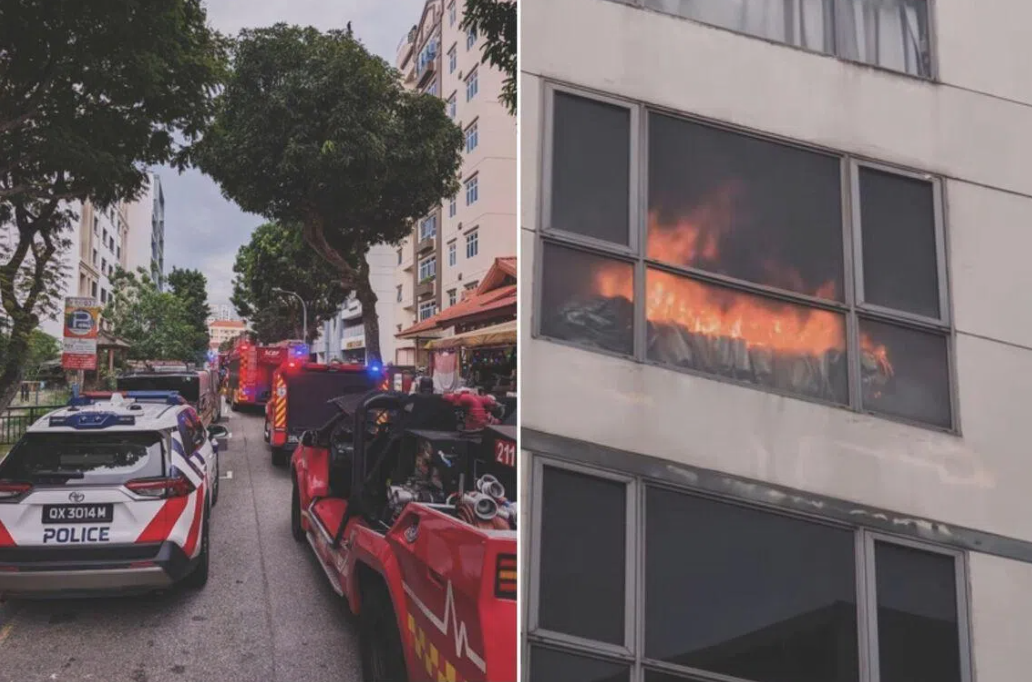
Fire safety officials in Singapore have issued a fresh warning to residents following an incident in which an unattended, charging power-assisted bicycle ignited inside a condominium unit, forcing the evacuation of five neighbouring residents. The Singapore Civil Defence Force responded to the blaze at 9 Lorong 26 Geylang, a residential complex known as Casa Aerata, on Sunday evening at 5.35pm on June 21. The rapid response prevented injuries and highlighted the increasing hazards posed by improperly charged battery-powered mobility devices in multi-unit residential settings across the city-state.
The fire originated from a power-assisted bicycle (PAB) battery being charged unattended in the living room of a seventh-floor unit. Emergency responders from both the police and the SCDF evacuated residents from adjacent homes as a precautionary measure, concerned that the flames might spread or cause structural damage. The firefighting team extinguished the flames using a hosereel and a compressed air foam backpack, containing the incident to the single unit. Fortunately, the operation concluded without any reported injuries, though the incident underscored how quickly such fires can develop in enclosed residential spaces.
The SCDF's preliminary investigation determined that the fire originated from an electrical fault within the PAB battery itself. This finding carries particular significance for urban residents across Southeast Asia, where the adoption of electric and battery-powered mobility solutions has accelerated dramatically. Power-assisted bicycles and personal mobility devices have become increasingly popular for short-distance commuting and leisure activities, yet awareness of their associated fire risks remains inconsistent among users and residents.
Philip Cai Yinzhou, Member of Parliament for Bishan-Toa Payoh GRC, arrived at the scene after observing smoke and hearing emergency sirens. He described clearing the area directly below the burning unit in anticipation of potential window breakage from the intense heat, which subsequently occurred. His immediate action demonstrated the critical importance of rapid public awareness and emergency response coordination in densely populated residential environments where seconds can determine the difference between containment and escalation.
The SCDF has issued explicit guidance to the public regarding the safe use and charging of active mobility devices (AMDs), a category that encompasses PABs, personal mobility devices (PMDs), and personal mobility aids. The authority strongly advises against purchasing or using non-original batteries as replacements, warning that counterfeit or substandard battery packs present significantly higher fire risks than manufacturer-approved components. This concern reflects broader challenges in Southeast Asia's growing second-hand and informal retail markets, where consumers may unknowingly purchase defective or incompatible battery systems at discounted prices.
Beyond battery authenticity, the SCDF has cautioned residents against charging these devices for extended periods or leaving them charging overnight, practices that increase the likelihood of thermal runaway—a cascade failure leading to fires. Many users adopt these habits without recognizing the cumulative stress they place on battery management systems. The guidance underscores a critical gap between user behaviour and device safety specifications in the region's rapidly expanding personal mobility sector.
Statistical data from Singapore's fire services provides important context for understanding the severity of the problem. In 2025 alone, the SCDF recorded 304 electrical fire incidents across residential premises, of which 34 involved active mobility devices. This represents a proportion that demands serious attention from both policymakers and residents. The figures reveal shifting patterns in device-related fires: while overall active mobility device incidents decreased from 67 cases in 2024 to 49 in 2025—a welcome trend suggesting some improvement in safety awareness—personal mobility device fires specifically increased from 25 to 31 incidents, indicating that not all categories of devices have benefited equally from enhanced precautions.
For Malaysian and broader Southeast Asian audiences, the Singapore incident carries direct relevance. Malaysia has witnessed similar growth in PAB adoption across urban centres like Kuala Lumpur and George Town, yet safety infrastructure and public awareness campaigns lag behind technological uptake. The regulatory frameworks governing battery specifications, retail distribution, and user education remain underdeveloped compared to mature markets in North America and Western Europe. These gaps create conditions where incidents like the Geylang fire become foreseeable consequences rather than anomalies.
The incident also highlights the particular vulnerability of multi-unit residential buildings, where a fire in one unit can threaten multiple households simultaneously. In Malaysia's context, many condominiums and apartment blocks lack standardized safety protocols for charging mobility devices in common areas or individual units. The density of residents, the age of electrical installations in older developments, and variable enforcement of building codes increase the complexity and severity of potential fire scenarios. The evacuation of five households from neighbouring units in a relatively contained incident suggests that larger buildings could face far more serious consequences.
Manufacturers and retailers of PABs and PMDs bear responsibility for ensuring that genuine components are sold and that clear, accessible safety instructions accompany products. However, enforcement mechanisms in Southeast Asia remain inconsistent, and many devices are imported through channels where traceability and accountability are questionable. Malaysian consumers purchasing PABs online or through informal retail networks face particular difficulty in verifying authenticity or securing reliable technical support when issues arise.
The financial implications of device-related fires extend beyond immediate property damage. Insurance claims, emergency response costs, and potential liability issues create broader economic consequences for residential communities. In Malaysia, where insurance penetration in the housing sector remains variable, residents in affected units may face significant uncompensated losses. Building management corporations often lack specific protocols for managing or preventing these incidents, creating a systemic vulnerability.
Moving forward, policymakers, residential authorities, and consumer protection agencies across Southeast Asia should consider whether existing safety frameworks adequately address the risks posed by rapid adoption of battery-powered personal mobility devices. Singapore's proactive warnings and incident documentation provide a model, though implementation in Malaysian contexts would require adapted approaches reflecting local market conditions and consumer behaviours. Educational campaigns targeting users, retailers, and building managers could significantly reduce incident frequency and severity before further incidents occur.
The Geylang fire ultimately serves as a timely reminder that the convenience of emerging mobility technologies carries corresponding responsibilities for safe usage and environmental management. As adoption spreads throughout the region, building this safety consciousness into user practices and regulatory frameworks must occur deliberately and systematically, or incidents like this will become increasingly commonplace across Southeast Asia's residential landscapes.
%22%2F%3E%3C%2Fpattern%3E%3C%2Fdefs%3E%3Crect%20width%3D%22100%25%22%20height%3D%22100%25%22%20fill%3D%22url(%23ph435ojg)%22%2F%3E%3Crect%20width%3D%22100%25%22%20height%3D%22100%25%22%20fill%3D%22url(%23ph435ojp)%22%2F%3E%3Ctext%20x%3D%2250%25%22%20y%3D%2250%25%22%20text-anchor%3D%22middle%22%20dominant-baseline%3D%22central%22%20fill%3D%22rgba(255%2C255%2C255%2C0.95)%22%20font-family%3D%22Georgia%2C%20'Times%20New%20Roman'%2C%20serif%22%20font-weight%3D%22700%22%20font-size%3D%22320%22%20letter-spacing%3D%22-0.02em%22%3EKing%3C%2Ftext%3E%3C%2Fsvg%3E)