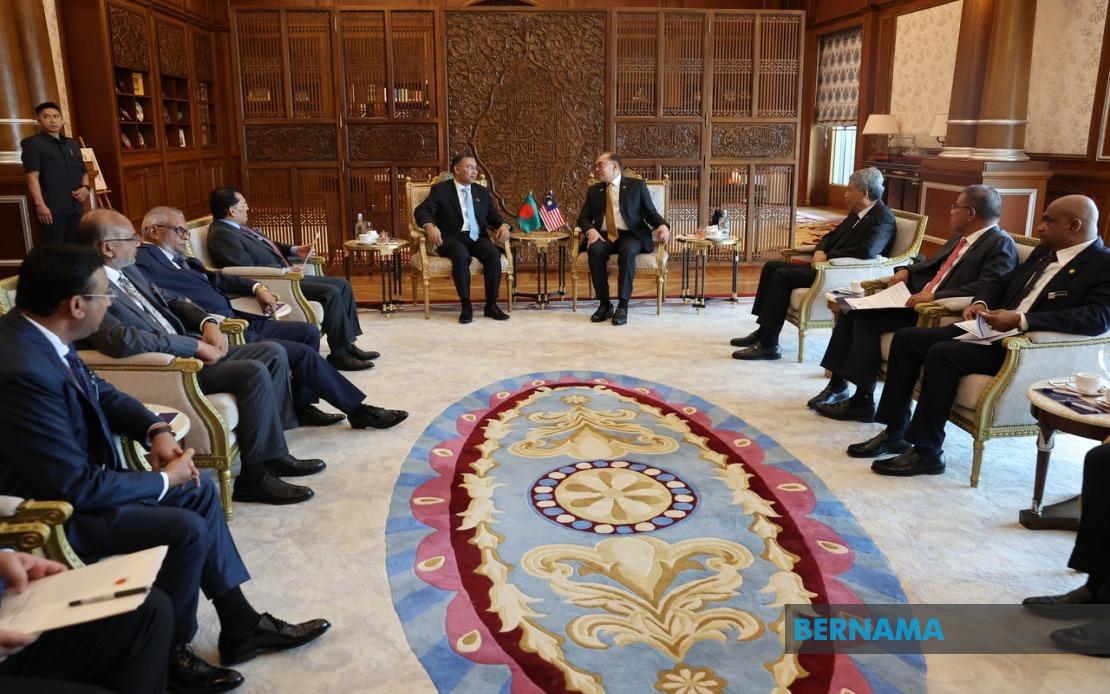
Prime Minister Anwar Ibrahim and visiting Bangladesh Prime Minister Tarique Rahman have signalled a renewed commitment to tackling the Rohingya refugee challenge by leveraging ASEAN's collective diplomatic machinery, underscoring the regional dimension of a humanitarian crisis that has persisted for years. Speaking during a joint press conference in Putrajaya on June 22, Anwar outlined a framework whereby both Malaysia and Bangladesh would mobilise their foreign ministries and utilise ASEAN platforms as vehicles for constructive dialogue with Myanmar's government, reflecting the understanding that multilateral engagement offers greater diplomatic weight than bilateral efforts alone.
The Rohingya situation represents one of Southeast Asia's most intractable humanitarian challenges, with roughly 1.2 million refugees sheltering in sprawling camps across Bangladesh, while Malaysia hosts an estimated 180,000 undocumented Rohingya. Anwar's emphasis on working "through the good offices of their respective foreign ministers and ASEAN mechanisms" signals recognition that resolving this crisis requires sustained, structured engagement rather than ad-hoc interventions. The invocation of ASEAN—a bloc that has historically struggled with consensus on sensitive matters—suggests both leaders believe regional peer pressure and institutional frameworks may gradually influence Myanmar's approach to addressing the grievances and displacement that fuelled the humanitarian emergency.
Tarique Rahman, who arrived in Putrajaya for his first official bilateral visit abroad since assuming office in February 2026, expressed profound concern about the humanitarian conditions endured by Rohingya communities sheltering in Bangladesh. His public acknowledgement of Malaysia's "continued support towards ensuring their safe, dignified and sustainable repatriation to Myanmar" reflects appreciation for Kuala Lumpur's role as a de facto secondary host nation, even as Bangladesh shoulders the primary burden of accommodation. This framing also contains an implicit diplomatic message: successful repatriation depends not only on Bangladesh's capacity to support returnees, but on Myanmar's willingness to accept them and guarantee their safety—a precondition that remains contested.
Beyond the Rohingya question, the two leaders held substantive bilateral discussions addressing the broadening canvas of Malaysia-Bangladesh relations. Their dialogue encompassed trade expansion, human resource mobility, semiconductor manufacturing, renewable energy cooperation, agricultural development, and educational partnerships—a list suggesting both nations view their relationship through a forward-looking economic lens rather than viewing it primarily through the lens of crisis management. This diversification of engagement areas reflects the reality that while the Rohingya situation commands moral and diplomatic attention, Malaysia and Bangladesh recognise mutual benefits in expanded commercial and technological cooperation.
Commerce between the two nations has grown substantially, with 2025 trade reaching RM12.18 billion. Malaysia's export portfolio to Bangladesh, valued at RM10.08 billion, remains heavily weighted towards petroleum products, reflecting Bangladesh's substantial energy requirements as its manufacturing base expands. Conversely, Bangladesh supplies Malaysia with textiles, apparel, and footwear valued at RM2.10 billion annually—sectors in which Bangladeshi producers maintain competitive advantage through labour costs and established supply chains. Within the South Asian context, Bangladesh now ranks as Malaysia's second-largest trading partner, export market, and import source after India, a position reflecting both demographic scale and complementary economic structures.
The bilateral talks culminated in the exchange of three formal agreements signalling deepening institutional ties. A Memorandum of Understanding on Cultural Cooperation creates framework for educational exchanges, artistic collaborations, and soft power initiatives that strengthen people-to-people connections beyond governmental channels. Two Exchanges of Notes addressing counter-terrorism research and investment promotion reflect shared security concerns and mutual interest in facilitating capital flows—sectors where trust and formal coordination mechanisms underpin confidence.
The timing of Tarique Rahman's visit carries strategic significance for regional stability. Bangladesh, as a major South Asian economy and ASEAN dialogue partner, wields considerable influence over how the bloc approaches Myanmar-related matters. By hosting the Bangladesh Prime Minister and reinforcing cooperative mechanisms, Malaysia positions itself as a bridge between South Asian and Southeast Asian governance networks. This diplomatic positioning becomes increasingly valuable as geopolitical tensions in the Indo-Pacific region intensify, requiring coherent responses to transnational challenges ranging from maritime security to refugee management.
The emphasis on ASEAN mechanisms rather than unilateral or bilateral pressure reflects a sophisticated understanding of Myanmar's sensitivities. The Myanmar government has often resisted what it characterises as external interference in internal affairs, viewing pressure from individual nations as illegitimate. By channelling efforts through ASEAN—an organisation that includes Myanmar as a member and operates on consensus principles—Malaysia and Bangladesh signal respect for regional protocols while simultaneously leveraging collective moral authority. This approach acknowledges that sustainable solutions cannot be imposed but must emerge through patient dialogue and incentive structures that make cooperation more attractive than intransigence.
The Rohingya crisis poses particular challenges for Malaysia, a Muslim-majority nation with constitutional commitments to protecting vulnerable populations, yet facing severe constraints on its capacity to integrate or permanently settle stateless refugees. Bangladesh, despite hosting the world's largest refugee population per capita, similarly confronts economic pressures and social tensions arising from protracted displacement. Neither nation can unilaterally solve a problem rooted in Myanmar's internal political dynamics and the underlying grievances of the Rohingya minority. ASEAN engagement therefore becomes not a guaranteed solution but a necessary condition for progress—creating diplomatic space where Myanmar might gradually shift its position through patient persuasion rather than confrontational pressure that hardens resistance.
The joint commitment outlined by Anwar and Tarique represents continuity with Malaysia's long-standing advocacy for Rohingya rights and dignity, while simultaneously broadening the bilateral relationship into areas offering tangible benefits for Malaysian businesses and workers. This balancing act—maintaining moral clarity on humanitarian issues while pursuing pragmatic economic and security cooperation—characterises contemporary Malaysian foreign policy under Anwar's leadership. For Bangladesh, the reaffirmation of Malaysian support and the expansion of bilateral ties offer reassurance that its burden-sharing in hosting Rohingya refugees receives regional acknowledgement and support.
Looking forward, the effectiveness of this ASEAN-centred approach will depend on sustained commitment from multiple member states, coherent diplomatic messaging, and willingness to engage Myanmar constructively over years rather than months. The refugee crisis will not resolve quickly, but the institutionalisation of cooperation through bilateral mechanisms and multilateral frameworks creates structures within which solutions might gradually emerge. Both Malaysia and Bangladesh have signalled that they view this not as a temporary humanitarian emergency but as a long-term regional challenge requiring patient, persistent, and coordinated effort.