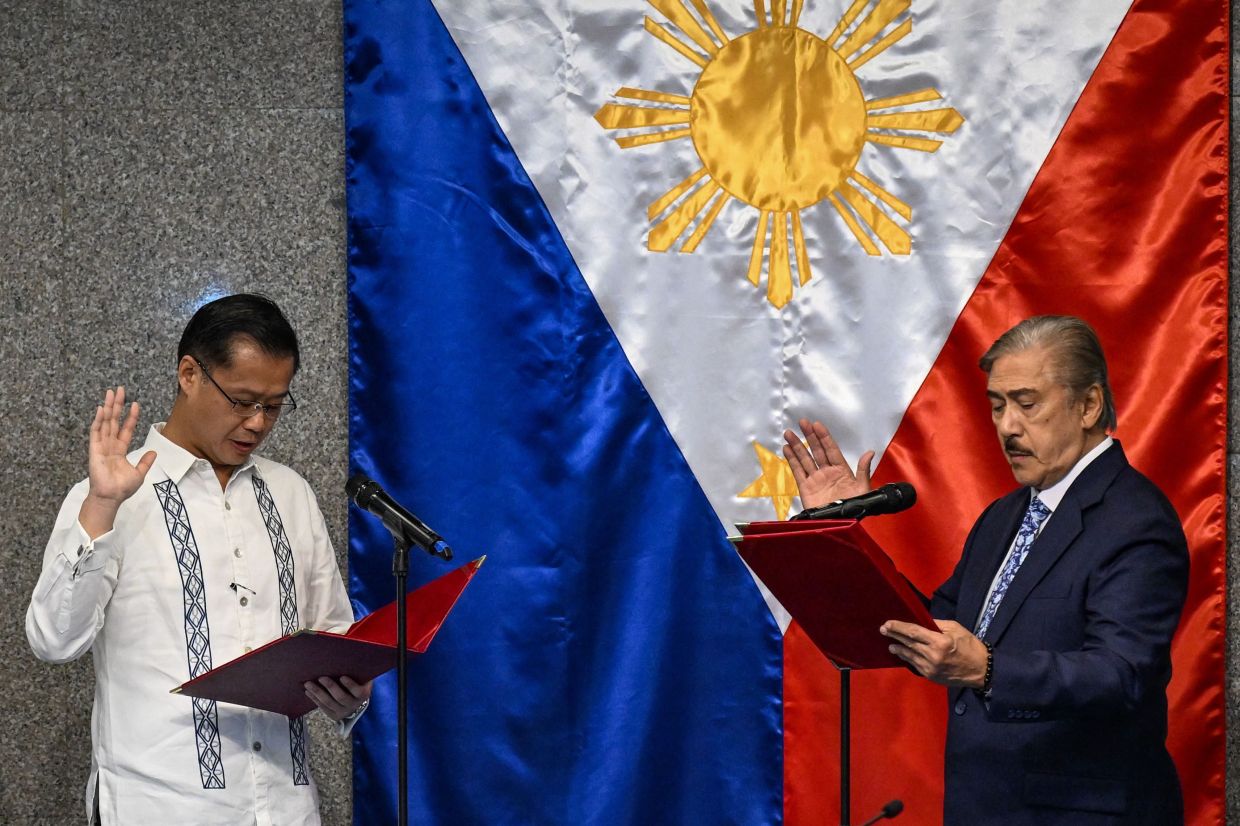
The Philippine Senate has formally installed Senator Sherwin Gatchalian as its new president following a special session on Wednesday, June 17, marking a significant shift in the chamber's leadership hierarchy. The vote, which secured the minimum 13-senator threshold required under chamber rules, reflects the fluid and often unpredictable nature of Philippine legislative politics, where shifting alliances can dramatically alter institutional power dynamics within a matter of weeks.
Gatchalian's political trajectory spans multiple levels of government, including a tenure as Mayor of Valenzuela City in the Manila metropolitan region and earlier service in the House of Representatives. His elevation to the Senate presidency represents a consolidation of influence among a particular faction within the chamber, though the path to his leadership position was anything but straightforward. The maneuvering that led to his election reveals the delicate balance of power in the 24-member Senate, where individual senators' allegiances can fundamentally reshape institutional structures and executive influence.
The political drama intensified when, on June 3, exactly two weeks before Gatchalian's formal election, a faction of 12 senators moved to remove Alan Peter Cayetano from the Senate presidency, which he had assumed on May 11. That same faction simultaneously elected Gatchalian as Senate president pro tempore, effectively creating a parallel claim to leadership. Cayetano, however, disputed this action, arguing that the removal required the support of at least 13 senators and that those claiming his ouster lacked the numerical strength to enforce it under Senate rules.
The constitutional and procedural dispute that emerged underscores a persistent tension in Philippine legislative governance regarding the thresholds needed to install or remove chamber officers. Cayetano's argument that 13 votes were necessary created legal ambiguity, as his opponents contended that a simple majority of those present could effect change. This disagreement reflected deeper questions about Senate rules and their interpretation, issues that often become flashpoints during leadership transitions when political stakes run highest.
The pivotal moment came when Senator Joel Villanueva, who had previously supported Cayetano's claim to the presidency, unexpectedly shifted his allegiance to Gatchalian's bloc. This defection proved numerically decisive. On Tuesday, June 16—a day before the formal election—Cayetano publicly acknowledged that the arithmetic had fundamentally shifted in his opponents' favour. Following a conversation with Villanueva, Cayetano indicated his willingness to relinquish the presidency, effectively conceding that maintaining his position had become untenable.
Villanueva's move highlights how individual senators' decisions can cascade through the chamber's internal dynamics. His switch from backing Cayetano to supporting Gatchalian provided the deciding margin, transforming what had been a contested and uncertain situation into a clear outcome. In Philippine Senate politics, where personalities and individual calculations often outweigh party discipline, such shifts are neither unusual nor necessarily surprising, yet their consequences for institutional stability can be substantial.
The Senate currently operates with only 22 sitting members, down from its full complement of 24. This reduction in membership has material consequences for the voting thresholds required to conduct legislative business. Senator Jinggoy Estrada surrendered to police earlier in June and subsequently faced a 90-day suspension ordered by the Sandiganbayan, the nation's anti-graft court, in connection with corruption allegations. This suspension removes his voice from chamber deliberations during a critical period. Additionally, Senator Ronald Dela Rosa remains a fugitive, wanted by the International Criminal Court with his current whereabouts unknown, effectively leaving that seat vacant for practical purposes.
The reduced membership underscores broader institutional vulnerabilities within the Senate. With only 22 active members instead of the full 24, procedural requirements and voting thresholds take on heightened significance. Gatchalian's election with exactly the minimum required 13 votes illustrates how narrow majorities can be and how dependent the Senate's functioning has become on maintaining consensus among a relatively small group of decision-makers. Any further absences or shifts in allegiance could destabilize future legislative initiatives.
For Southeast Asian observers, the Philippine Senate's internal dynamics offer instructive lessons about legislative politics in presidential systems across the region. Unlike parliamentary systems where executive-legislative relations are tightly bound, presidential systems create spaces where legislative chambers can develop their own internal power structures, rivalries, and succession mechanisms. The Philippines offers a particularly vivid example of how rapidly such structures can shift when personalities and factional interests override institutional continuity.
Gatchalian's assumption of the Senate presidency also carries implications for the broader legislative agenda and executive-legislative relations under the Marcos administration. As Senate president, Gatchalian will wield substantial influence over which bills receive floor time, how committees are structured, and what priority the chamber gives to executive-backed initiatives. His leadership could shape economic policy, constitutional amendments, and budgetary allocations during a period when the Philippines navigates recovery from the pandemic and grapples with regional security concerns.
The episode also demonstrates the importance of procedural rules and their interpretation in resolving political disputes. Gatchalian's victory was ultimately enabled by clarity regarding voting thresholds and quorum requirements, which allowed the Senate to definitively resolve the leadership question rather than remaining trapped in a prolonged dispute. However, the narrowness of his margin—exactly 13 senators—leaves his leadership dependent on maintaining the allegiances of key figures like Villanueva, suggesting potential vulnerabilities should political winds shift again in coming months.