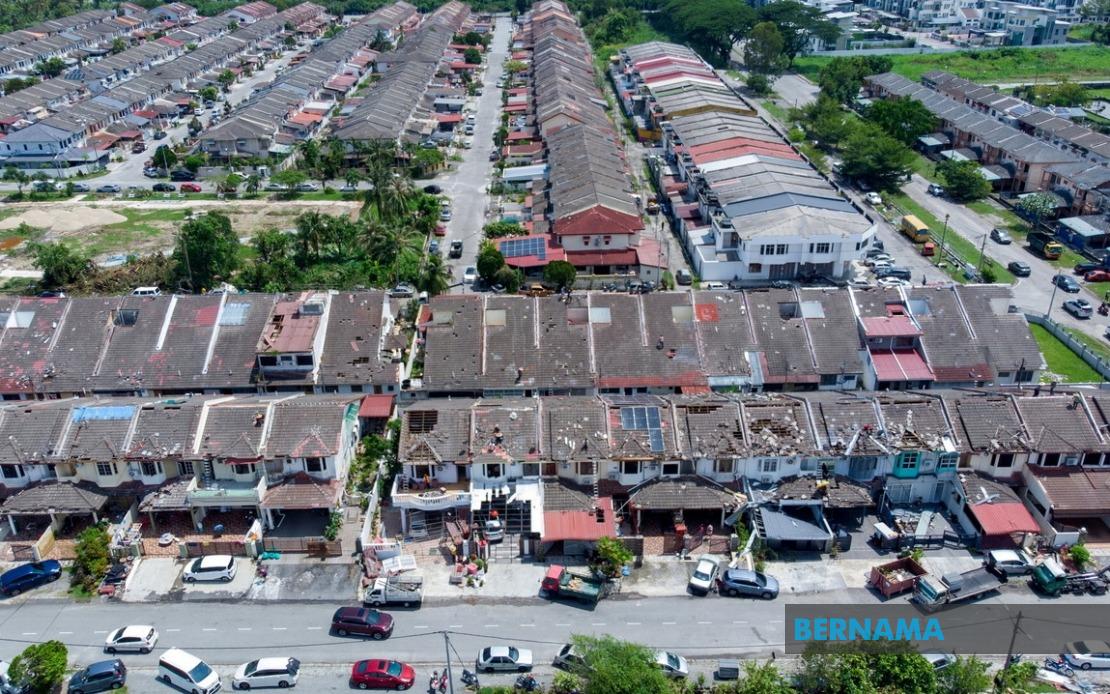
Authorities in Ipoh have implemented strict access controls across five separate zones in the Bercham district following a powerful storm that devastated the residential area, with police chief ACP Muhammad Najib Hamzah confirming that movement into and out of affected neighbourhoods is now monitored to protect vulnerable properties from potential criminal exploitation.
The decision to seal off zones comes amid heightened security concerns following the Friday storm, which impacted more than 200 residences across multiple residential clusters including Anjung Bercham Utara, Taman Mujur, Kampung Bercham, Kampung Tersusun Tasek, Taman Pusat Bercham and Taman Indah Sakti. Such targeted closures are a standard preventive measure in disaster zones, as communities grappling with infrastructure damage become vulnerable to organised theft and break-ins, with looters exploiting the chaos and absence of normal policing.
While acknowledging the legitimate needs of residents seeking to recover their possessions and salvage belongings, Muhammad Najib indicated that the police will exercise measured discretion regarding authorised entry, particularly during evening and night-time hours when visibility is limited and monitoring becomes more challenging. Those wishing to conduct clean-up operations within their own homes will be permitted access, subject to police verification of property ownership and genuine intent—a protocol designed to distinguish legitimate recovery efforts from suspicious activity.
Night-time access has emerged as a particular concern for law enforcement, given that several affected neighbourhoods, notably Anjung Bercham, remain without electricity following the storm's destruction of power infrastructure. The absence of street lighting creates ideal conditions for criminal activity, prompting police to adopt a stricter posture during darkness hours. Residents planning nocturnal clean-up activities will face enhanced scrutiny, with officers conducting spot checks to confirm the individuals entering properties are genuine householders rather than persons posing as disaster victims to facilitate theft.
As of the morning briefing, police had documented 492 storm-related reports through the Op Bencana emergency reporting system, with authorities making clear that no deadline exists for victims to lodge formal complaints. This open-ended reporting window allows displaced residents and property owners time to assess damage comprehensively before submitting claims, though it also extends the period during which affected areas remain in heightened alert status.
Quantifying the total financial impact of the disaster has proven premature, with Muhammad Najib declining to provide preliminary loss estimates during the press conference at Bercham police station. Such assessments typically require comprehensive damage surveys and insurance assessments, processes that take weeks or months to complete. However, given the scale affecting more than 200 properties, the aggregate loss is expected to reach several million ringgit, placing considerable strain on individual households and municipal recovery resources.
Ipoh Barat Member of Parliament M. Kulasegaran, who also serves as Deputy Minister in the Prime Minister's Department (Law and Institutional Reform), has characterised the meteorological event as extraordinary and unprecedented for the district. Preliminary meteorological analysis suggests the storm may have been caused by a landspout phenomenon—a rare but destructive atmospheric occurrence where a rotating column of air forms beneath cloud cover but does not extend into typical tornado patterns. Such events can generate winds exceeding hurricane-force speeds over highly localised areas, explaining the concentrated damage footprint in Bercham.
The landspout hypothesis carries particular significance for Perak and Selangor residents, as it suggests that climate variability or localised atmospheric conditions may be producing increasingly severe convective events. Unlike widespread thunderstorms that allow community warning systems time to activate, landspouts develop rapidly with minimal advance warning, making preparedness and rapid emergency response the primary mitigation strategies available to authorities.
For Malaysian readers across peninsular regions, the Bercham incident illustrates the unpredictable nature of modern meteorological hazards and the importance of disaster preparedness frameworks. The police response—swift cordon establishment, systematic reporting protocols, and property protection measures—reflects lessons learned from previous flood and storm events. However, questions persist regarding early warning systems for rapidly-forming atmospheric phenomena and whether communities in high-risk areas possess adequate shelter protocols.
The broader implications extend to Southeast Asia's rapidly urbanising landscape, where informal settlements and densely-packed residential areas may lack the infrastructure resilience required to withstand extreme weather events. The concentration of damage in Bercham's specific neighbourhoods suggests that building standards, topography, and urban layout play crucial roles in determining storm vulnerability. As climate patterns continue evolving, regional governments may need to reassess building codes and zoning regulations to accommodate more severe convective events.
Recovery efforts in Bercham will likely extend across multiple months, involving debris clearance, electrical system reconstruction, and individual property restoration. The police cordon represents merely the immediate security stabilisation phase; the subsequent reconstruction phase will test community resilience and municipal capacity. For residents, navigating the intersection between restricted access zones and legitimate recovery needs underscores the complex choreography required when public safety and private loss intersect.