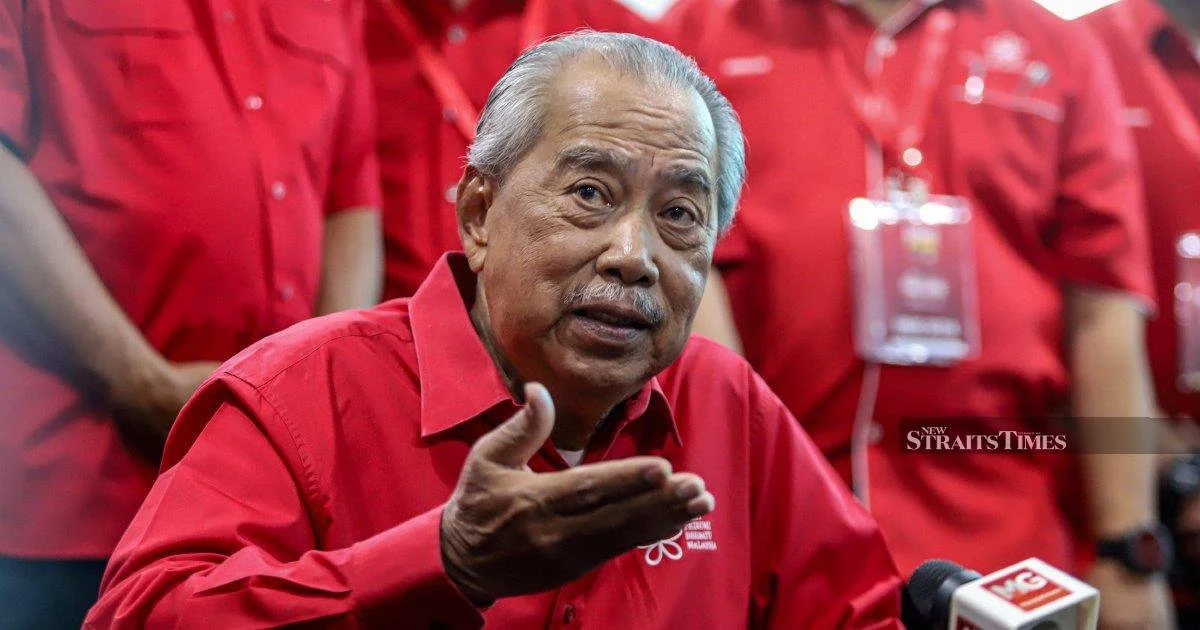
Tan Sri Muhyiddin Yassin, the president of Bersatu, has emphatically restated his party's resolve to maintain its membership within the Perikatan Nasional coalition for the foreseeable future, seeking to quell recurring speculation about the stability and trajectory of the opposition grouping.
The assertion comes amid persistent conjecture surrounding the coalition's durability, particularly as Malaysia's political landscape continues to shift following the 2022 general election. Coalition dynamics have remained a focal point of national political discourse, with observers closely monitoring whether member parties will sustain their alignment or pursue alternative arrangements that might reshape parliamentary configurations.
Bersatu's position within Perikatan Nasional represents a significant anchor for the coalition, given the party's substantial parliamentary representation and grassroots presence across several states. The party's sustained participation has been crucial to maintaining PN's viability as a coherent opposition force capable of challenging the governing coalition at both federal and state levels.
The reaffirmation of commitment from the party leadership carries particular weight given Bersatu's history of strategic political manoeuvres. The party, which emerged from a split within UMNO and was instrumental in toppling the Pakatan Harapan government in 2020, has consistently repositioned itself as circumstances evolved. Muhyiddin's unequivocal statement attempts to provide clarity and stability to party members and coalition partners regarding institutional direction.
Perikatan Nasional itself comprises multiple political entities with sometimes divergent regional and ideological interests. The coalition has managed to maintain cohesion despite internal tensions, largely through careful negotiation and shared opposition to the current federal government. The inclusion of Bersatu, alongside other significant parties, has enabled PN to present itself as a comprehensive alternative capable of attracting diverse voter constituencies across the peninsula.
The timing of Muhyiddin's remarks reflects an apparent desire to counter destabilising narratives that frequently circulate within Malaysian political circles. Political realignments in Malaysia have historically occurred with limited warning, as demonstrated by several watershed moments over the past decade. By issuing such categorical statements, coalition leaders seek to project confidence and discourage member parties from exploring alternative partnerships or going independent.
State-level considerations also influence coalition stability. Several PN-governed states have demonstrated the coalition's administrative capacity, and maintaining these regional power bases depends upon unwavering party loyalty and institutional cooperation. Defections or shifting alliances could jeopardise PN's control of these states and diminish its leverage in negotiations with federal authorities.
For Malaysian voters and observers assessing the political landscape, statements of coalition permanence warrant careful interpretation. While Muhyiddin's declaration provides reassurance regarding medium-term stability, the history of Malaysian politics suggests that such commitments remain subject to unexpected developments. Parliamentary mathematics, electoral considerations, and leadership transitions can rapidly alter political calculations that appear settled at any given moment.
The opposition coalition's fortunes also depend upon broader national factors beyond internal party dynamics. Public perception of government performance, economic conditions, and emerging policy issues all influence whether opposition alliances remain viable or whether voter sentiment shifts dramatically. Bersatu and Perikatan Nasional must therefore maintain both internal coherence and external relevance to sustain their political position.
Muhyiddin's statement also serves to communicate confidence to potential supporters and allies, signalling that Bersatu views its PN affiliation as strategically advantageous rather than provisional. This framing becomes increasingly important as the coalition contemplates the next general election, expected within the coming years, when such institutional credibility becomes paramount in attracting voter confidence.
Looking forward, the sustainability of Perikatan Nasional will largely depend upon whether member parties derive sufficient benefits from coalition membership to outweigh alternative options. Bersatu's leadership appears convinced that unity within the opposition framework serves party interests more effectively than isolated competition. Whether this calculation remains valid through successive electoral cycles and political developments remains a matter for ongoing assessment by political observers and analysts across the region.

%22%2F%3E%3C%2Fpattern%3E%3C%2Fdefs%3E%3Crect%20width%3D%22100%25%22%20height%3D%22100%25%22%20fill%3D%22url(%23ph32hyvg)%22%2F%3E%3Crect%20width%3D%22100%25%22%20height%3D%22100%25%22%20fill%3D%22url(%23ph32hyvp)%22%2F%3E%3Ctext%20x%3D%2250%25%22%20y%3D%2250%25%22%20text-anchor%3D%22middle%22%20dominant-baseline%3D%22central%22%20fill%3D%22rgba(255%2C255%2C255%2C0.95)%22%20font-family%3D%22Georgia%2C%20'Times%20New%20Roman'%2C%20serif%22%20font-weight%3D%22700%22%20font-size%3D%22151%22%20letter-spacing%3D%22-0.02em%22%3EPerikatan%3C%2Ftext%3E%3C%2Fsvg%3E)