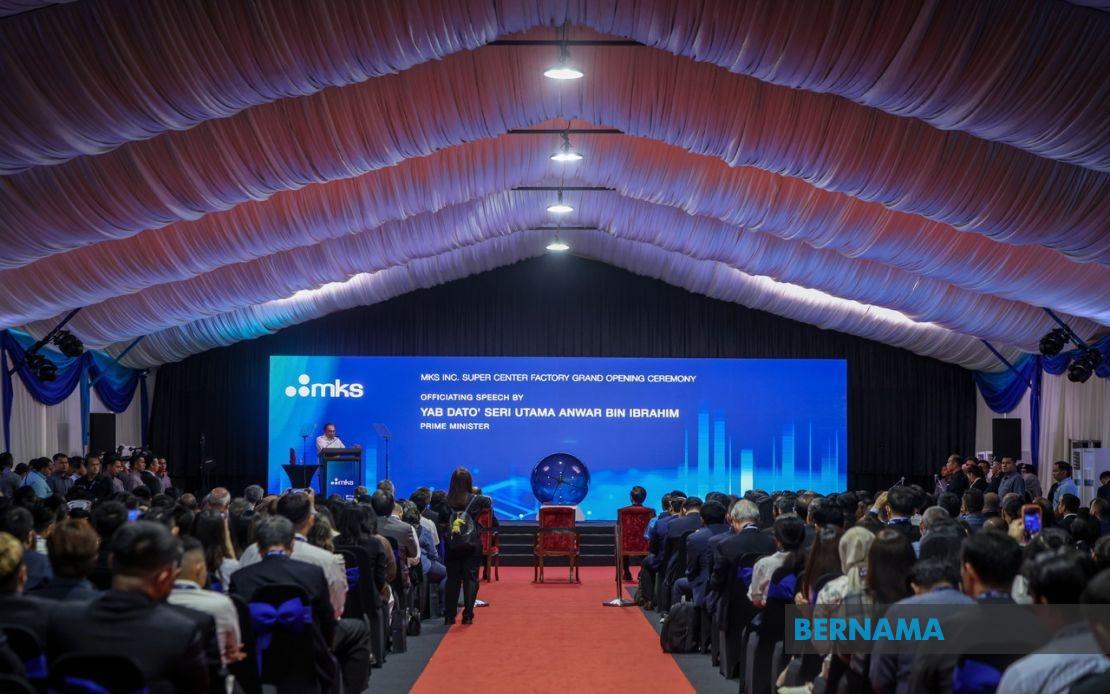
Prime Minister Datuk Seri Anwar Ibrahim has articulated a vision of Malaysia as a strategic bridge between competing global powers, positioning the nation's equidistant diplomacy as a cornerstone of economic advancement. Speaking at a factory inauguration ceremony in Bandar Cassia Technology Park, Batu Kawan, on June 20, Anwar underscored how Malaysia's refusal to align exclusively with any geopolitical bloc has paradoxically strengthened its international standing and created tangible commercial opportunities that might otherwise remain inaccessible.
The Prime Minister's remarks reflect a deliberate policy calculus that has defined his administration's foreign relations architecture. Rather than choosing sides in great-power competition, Malaysia has cultivated a deliberate posture of engagement with the United States, China, India, and Russia simultaneously, extracting mutual benefits from each relationship without surrendering strategic autonomy. This approach represents a calculated departure from zero-sum thinking that traditionally forces smaller nations into binary alliances, instead leveraging Malaysia's geographical position and economic significance as leverage in bilateral negotiations.
Anwar specifically highlighted the diplomatic dividends of this strategy, pointing to high-level engagements with United States President Donald Trump during his previous administration and more recent interactions with Russian officials, positioned alongside established partnerships with China and India. These overlapping relationships, maintained without contradiction, demonstrate Malaysia's ability to compartmentalise foreign policy according to sectoral interests rather than ideological conformity. The accumulation of such engagements, Anwar suggested, reinforces Malaysia's perceived centrality in regional and global affairs, enhancing its negotiating position across multiple fronts.
The economic manifestations of this diplomatic orientation have begun materializing in concrete commercial agreements. Anwar cited Petroliam Nasional Bhd's recent transaction in Turkmenistan as emblematic of how Malaysia's non-aligned stance opens doors that exclusively aligned nations might find closed. Energy cooperation with Central Asian states, historically within Russia's sphere of influence, becomes feasible when Malaysia maintains cordial relations with Moscow while simultaneously strengthening ties with Western partners. This flexibility in foreign relations directly translates into opportunities for Malaysian corporations to operate across fragmented geopolitical territories.
The broader context of Malaysia's positioning reflects a sophisticated understanding of twenty-first-century international dynamics. Rather than retreating into regional isolationism or defaulting to post-colonial alignment patterns, Anwar's framework treats neutrality and independence not as passive positions but as active diplomatic assets. Malaysia explicitly reserves the right to voice positions on contentious global issues—from human rights to international law—without allowing such statements to jeopardise strategic partnerships. This calibrated approach requires nuance and careful messaging but generates goodwill from multiple quarters precisely because Malaysia avoids appearing subservient or instrumentalised.
For Southeast Asian observers, Malaysia's strategy holds particular relevance as a template for smaller powers navigating great-power competition. The region faces intensifying pressure from the United States, China, and increasingly India to choose sides on issues ranging from technology standards to military alignment. Malaysia's demonstrated ability to resist such pressures while extracting economic benefits offers a counterpoint to narratives suggesting that middle powers must inevitably choose between competing blocs. The success of this approach, however, depends on consistent execution and clear communication of Malaysia's actual limitations and red lines.
The event at which Anwar made these remarks—the opening of an MKS Super Centre manufacturing facility—underscores the practical connections between diplomatic positioning and industrial development. Foreign direct investment flows more readily to nations perceived as stable, non-threatening, and open to partnerships across ideological boundaries. Multinational corporations, when evaluating investment locations, increasingly value political stability and access to diverse supply chain partners. Malaysia's reputation as a reliable, non-aligned actor enhances its appeal as a manufacturing and business hub, potentially attracting companies seeking to reduce dependence on any single geopolitical sphere.
The presence of Penang Chief Minister Chow Kon Yeow at the ceremony signals alignment between federal and state-level economic development strategies. Penang, as a manufacturing and technology hub, directly benefits from Malaysia's diplomatic openness, which facilitates access to foreign investors and multinational corporate partnerships. The state has historically leveraged its position as a manufacturing centre and open-minded administration to attract companies seeking alternatives to other Southeast Asian locations. Federal-level diplomatic strategy thus provides crucial scaffolding for state-level economic initiatives.
Anwar's articulation of Malaysia's approach also addresses domestic political constituencies that might harbour concerns about the government's international orientation. By framing neutrality and independence as expressions of Malaysian sovereignty and strength rather than weakness or vacillation, the Prime Minister reframes what critics might characterise as fence-sitting into active strategic choice. This rhetorical positioning proves important in a Malaysian context where post-colonial consciousness remains influential and where segments of the electorate view non-alignment with particular favour.
The emphasis on welcoming participation from all countries, provided Malaysia maintains its independent voice, suggests recognition that economic opportunities increasingly transcend traditional alliance structures. Supply chains are becoming geographically distributed across multiple jurisdictions and political systems, creating interdependencies that cut across Cold War-style divisions. Malaysia's policy framework appears designed to position the nation as a node within these complex global networks rather than as a peripheral participant forced to choose between competing poles.
Looking forward, the sustainability of Malaysia's non-aligned strategy depends on careful navigation of genuine conflicts of interest that cannot be indefinitely finessed through diplomatic language. Issues such as technology standards, military acquisitions, and critical mineral supply chains will eventually force more explicit choices. The government's current task involves maximising economic and strategic benefits from the ambiguous middle ground while building sufficient national resilience and diplomatic capital to weather inevitable pressures when explicit choices do become necessary.