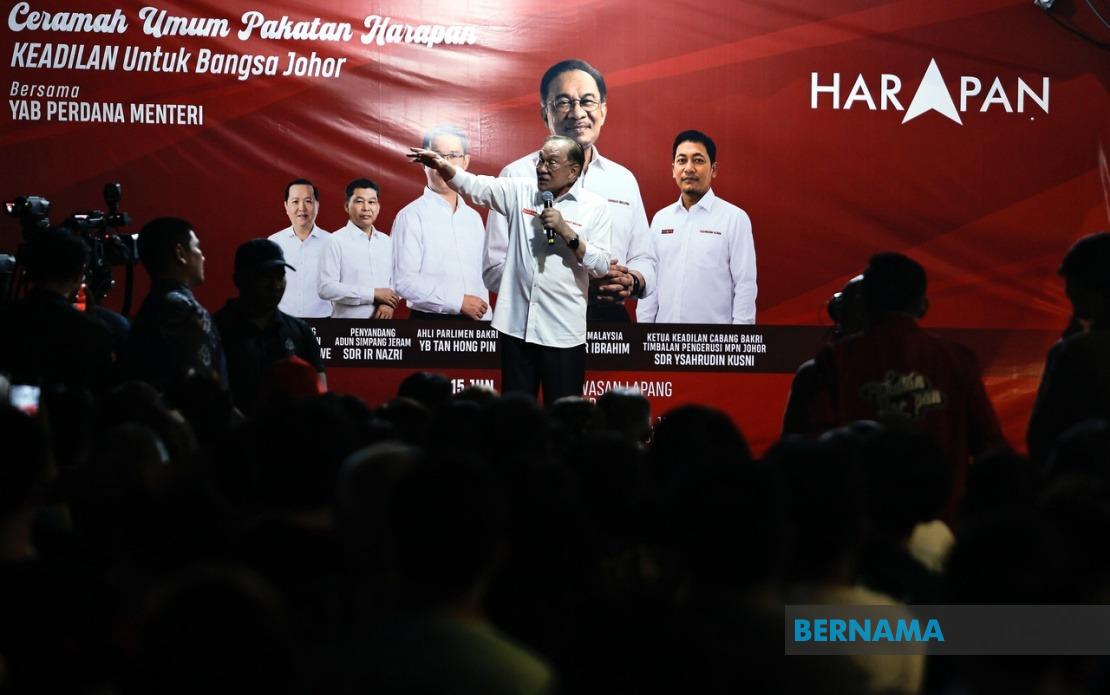
Prime Minister Datuk Seri Anwar Ibrahim has delivered a pointed message to Malaysia's political landscape: the nation's trajectory depends far more on technological advancement and foreign capital than on the habitual partisan bickering that consumes much of public discourse. Speaking at a Pakatan Harapan rally in Muar, Anwar articulated a vision that positions AI, quantum computing, and data-centre development as the pillars upon which Malaysia's future economic security rests, effectively challenging both his own coalition members and opposition rivals to recalibrate their priorities away from communal grievances and toward tangible national development.
The Prime Minister's remarks arrived as Malaysia continues to position itself as a potential regional hub for technology and digital infrastructure. His recent visit to Japan has reinforced this strategic orientation, providing the government with insights into quantum computing applications and international best practices for attracting technology investments. Anwar's emphasis on these sectors reflects a broader recognition within Southeast Asia that nations lagging in the AI revolution risk economic marginalisation within a decade. The statement essentially frames technological competitiveness as a matter of intergenerational responsibility, arguing that Malaysia's children will inherit either opportunity or obsolescence depending on decisions made today.
The tension Anwar identified between petty political contestation and visionary governance strikes at a genuine weakness in Malaysian public discourse. His invocation of endless disputes over religious and cultural symbols—temples, mosques, ethnicity—captures a recognisable pattern wherein political actors have historically mobilised identity-based grievances to consolidate support, often to the detriment of substantive policy debate. By explicitly contrasting this mode of politics with the work required to advance quantum technology and artificial intelligence infrastructure, Anwar has positioned himself as transcending divisive communal politics, though such a stance inevitably carries its own political calculations.
Malaysia's current economic positioning makes such technological ambitions both necessary and urgent. The country has historically relied on commodities, manufacturing, and services, but faces intensifying competition from nations with superior digital ecosystems and research capabilities. Thailand, Vietnam, and Singapore have all accelerated their AI strategies in recent years. Malaysian policymakers recognise that data centres and quantum computing capabilities represent genuine wealth-creation opportunities, capable of attracting multinational technology firms and generating high-skilled employment. Without deliberate government investment and a receptive ecosystem, Malaysia risks ceding this terrain to neighbours better positioned to capture these industries.
The investment landscape that Anwar references has already begun shifting. Technology companies evaluate potential host countries not merely on labour costs but on regulatory clarity, digital infrastructure quality, skilled talent availability, and the stability of the operating environment. Malaysia's appeal to international investors depends substantially on projecting competence, forward-thinking governance, and freedom from the perception that political instability or communal tensions create operational risks. Anwar's speech can therefore be understood as simultaneously addressing two audiences: internal stakeholders needing coordination on development priorities, and international investors assessing whether Malaysia represents a stable jurisdiction for substantial capital commitments.
The call for national unity that concluded Anwar's remarks carried particular weight given Malaysia's historical experience with communal politics. His invocation of Malays, Chinese, and Indians working together to build the nation acknowledges the multicommunal composition of the electorate whilst attempting to redirect that diversity toward productive collaboration rather than zero-sum competition. Yet the very necessity of making such an appeal underscores how deeply identity-based political mobilisation remains embedded in Malaysian political culture. That Anwar felt compelled to articulate this basic proposition—that Malaysians of different backgrounds should work together—suggests how far the political system has drifted from treating such cooperation as a given.
The international dimension Anwar highlighted—that people globally are observing Malaysia and approaching it with investment proposals—reflects legitimate diplomatic positioning but also contains aspirational elements. Malaysia does enjoy genuine advantages as a potential technology hub, including geographic proximity to major markets, English-language proficiency, and existing manufacturing expertise that can transition into more sophisticated sectors. However, attracting sustained investment in quantum computing and advanced AI requires not merely political declarations but concrete infrastructure development, regulatory reform, and sustained research funding. Several Southeast Asian competitors are moving faster on these fronts, and rhetorical appeals to national unity, while valuable, cannot substitute for institutional capacity and financial commitment.
Anwar's implicit criticism of political leadership extends to his own coalition, suggesting that internal PKR and Pakatan Harapan actors must also recalibrate away from narrow factional interests toward broader national objectives. This represents an unusually direct challenge to the political ecosystem's default operating logic. Malaysian politicians across the spectrum typically derive power from mobilising particular constituencies around specific grievances or interests. Asking them to subordinate those dynamics to technocratic development priorities encounters structural resistance, as political survival in Malaysia's system depends significantly on maintaining community support through acknowledgment of communal concerns. Whether political actors can genuinely transition to Anwar's proposed framework remains an open question.
The quantum computing emphasis particularly signals Malaysia's awareness of emerging technological hierarchies. Quantum computing represents a genuinely transformative technology with applications across cryptography, drug discovery, materials science, and optimisation problems. Nations and companies that master quantum systems early will enjoy disproportionate advantages. Malaysia's exploration of quantum technology during Anwar's Japan visit indicates aspiration to participate in this field rather than remaining a mere consumer of technology developed elsewhere. Such participation requires sustained investment, research partnerships, and policy frameworks that may compete for budgetary resources with other developmental priorities.
Anwar's framing of AI and quantum advancement as essential to Malaysia's future competitiveness resonates with global technology trends but also reflects anxiety about the nation's current trajectory. Malaysia faces the genuine risk of becoming trapped in middle-income status without technological transformation. The government's efforts to attract data-centre investments and quantum-computing initiatives represent rational responses to this challenge. However, the success of these initiatives depends on follow-through with specific policies, infrastructure investment, and educational reforms that translate ambitious rhetoric into operational capacity.
The political context surrounding Anwar's remarks also merits consideration. The Prime Minister was addressing a Pakatan Harapan rally featuring colleagues including PKR Vice-President Datuk Seri Dr. Zaliha Mustafa and Johor PH Chairman Aminolhuda Hassan. This setting allowed Anwar to establish himself as the custodian of national vision whilst implicitly positioning rivals as trapped in narrow partisan or communal concerns. Whether this rhetorical strategy translates into genuine deprioritisation of identity politics within Malaysian governance structures remains uncertain, as structural incentives within the political system continue favouring mobilisation around ethnic and religious lines.
Moving forward, the critical question involves whether Malaysia's technology ambitions can generate sufficient visible progress to maintain political momentum around development priorities. Early successes in attracting major data-centre projects or quantum-computing partnerships could validate Anwar's framework and encourage broader political alignment. Conversely, if these initiatives stall whilst identity-based disputes continue dominating headlines, the effort to reframe Malaysian politics around technological advancement will appear merely performative. The nation's political leadership faces a genuine test of whether it can sustain focus on transformative technological projects amid the constant pressures of electoral competition and communal politics.

%22%2F%3E%3C%2Fpattern%3E%3C%2Fdefs%3E%3Crect%20width%3D%22100%25%22%20height%3D%22100%25%22%20fill%3D%22url(%23ph21o2sg)%22%2F%3E%3Crect%20width%3D%22100%25%22%20height%3D%22100%25%22%20fill%3D%22url(%23ph21o2sp)%22%2F%3E%3Ctext%20x%3D%2250%25%22%20y%3D%2250%25%22%20text-anchor%3D%22middle%22%20dominant-baseline%3D%22central%22%20fill%3D%22rgba(255%2C255%2C255%2C0.95)%22%20font-family%3D%22Georgia%2C%20'Times%20New%20Roman'%2C%20serif%22%20font-weight%3D%22700%22%20font-size%3D%22170%22%20letter-spacing%3D%22-0.02em%22%3EGabungan%3C%2Ftext%3E%3C%2Fsvg%3E)