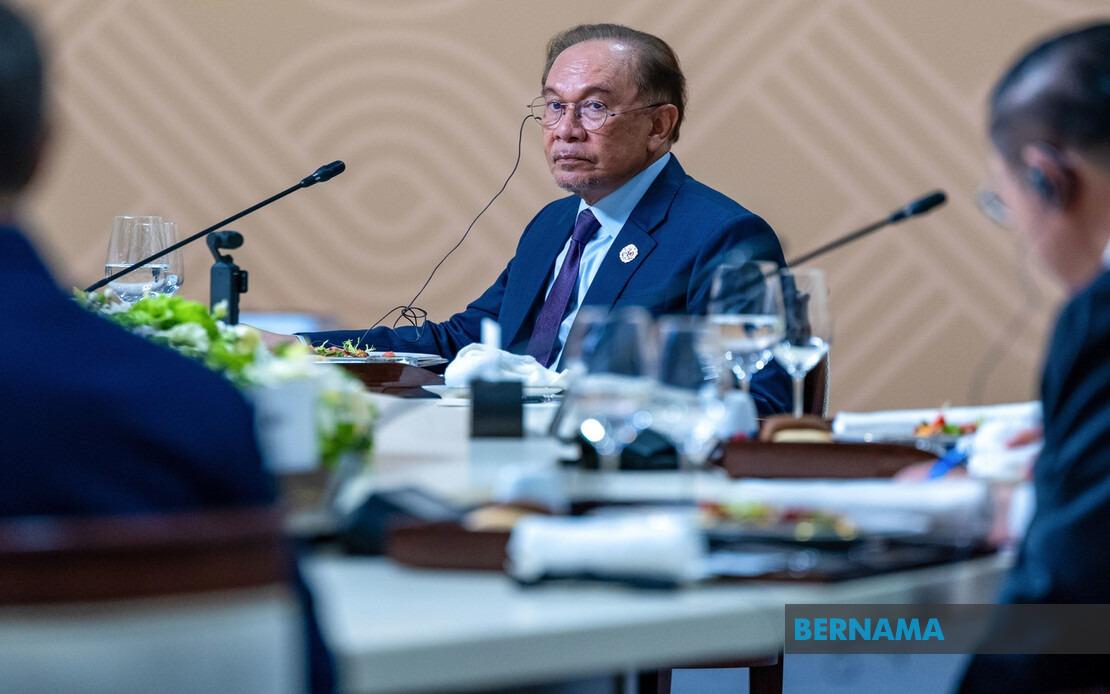
Prime Minister Datuk Seri Anwar Ibrahim's recent four-day diplomatic journey through Tashkent, Kazan, and Ashgabat represents far more than a routine regional tour. The carefully sequenced visits reveal a fundamental reorientation in Malaysia's economic strategy, reflecting how the nation is adapting to seismic shifts in the global financial order and intensifying strategic competition among major powers. The timing proves critical, arriving as the international system navigates one of its most consequential transformations since the Cold War ended, with trade restrictions, sanctions, and industrial policies increasingly weaponised as instruments of geopolitical influence.
For a trading nation like Malaysia, the implications of this turbulent environment extend beyond immediate growth prospects or supply chain security. The challenge encompasses preserving economic autonomy, safeguarding strategic flexibility, and building institutional resilience within a world growing progressively more fragmented and contested. The three-nation itinerary exemplified this multidimensional approach, with each destination serving a distinct yet interconnected purpose within a coherent economic strategy.
The Tashkent stopover initially framed as a courtesy visit to President Shavkat Mirziyoyev evolved into substantive working discussions that built upon cooperation frameworks initiated during Malaysia's previous official visit in 2024. This transformation underscores how personal diplomatic engagement can catalyse deeper economic exploration, moving beyond protocol into practical collaboration across multiple sectors. The discussions demonstrated that even brief visits, when carefully orchestrated, can advance significant deliverables on bilateral economic matters.
In Kazan, Malaysia's participation in the ASEAN-Russia Commemorative Summit positioned Southeast Asia within broader Eurasian economic networks while engaging both governmental and business constituencies across the wider region. These interactions revealed an important recognition: Russia, despite representing relatively modest trade volumes with ASEAN compared to other major economies, harbours untapped commercial potential in sectors spanning energy, agriculture, digital technology, advanced manufacturing, and food security infrastructure.
The Ashgabat segment of the journey renewed focus on Malaysia's decades-long energy partnership with Turkmenistan, through which Petronas has invested approximately USD12 billion since establishing operations three decades ago. This relationship transcends simple commercial extraction; Petronas has become woven into Turkmenistan's industrial fabric through infrastructure development, technological transfer, and human capital enhancement. Recent landmark agreements effectively expanded Petronas's participation in one of the world's largest gas fields, signalling what President Serdar Berdimuhamedov characterised as entry into a new critical phase of cooperation.
The broader significance of these engagements lies in their collective illustration of how Malaysia's economic diplomacy is fundamentally evolving. Rather than concentrating relationships within narrow bilateral corridors or established trade blocs, the nation is deliberately architecting a diverse portfolio of partnerships across geographically dispersed regions. This diversification strategy proves particularly prudent as the global economy gravitates toward multipolar configuration, where countries maintaining broader networks of mutually beneficial ties enjoy substantially greater flexibility and resilience than those whose options remain geographically or sectoral confined.
Crucially, this widening of external partnerships does not diminish Malaysia's existing relationships; instead, it expands the nation's strategic optionality in responding to unforeseen disruptions or shifting circumstances. Recent geopolitical crises have starkly illustrated how rapidly localized energy or supply disruptions cascade across global networks, elevating the strategic imperative of diversified partnership architecture. By establishing substantive economic relationships across multiple regions and sectors, Malaysia creates defensive advantages against shocks originating from any single geographic area or market segment.
The interactions in Kazan also highlighted an often-underappreciated dimension of contemporary economic statecraft: the rising significance of subnational actors. Tatarstan, frequently overshadowed by Moscow in international perception, has emerged as one of Russia's most dynamic industrial and technological hubs. Malaysian engagement with Tatarstan spanning biotechnology, the halal ecosystem, maritime capabilities, Islamic finance, and industrial cooperation demonstrates sophisticated recognition that economic cooperation increasingly operates through multiple governmental levels simultaneously. Regional governments, industrial clusters, and innovation centres function as genuine economic actors, capable of generating practical opportunities that complement and sometimes exceed traditional capital-to-capital arrangements.
The ASEAN-Russia Strategic Programme on Trade and Investment Cooperation 2026-2035 encapsulates this recalibrated approach to regional engagement. The framework acknowledges fundamental realities confronting middle powers: future competitiveness increasingly hinges upon innovation capacity, technological sophistication, and institutional adaptability rather than merely raw resource endowments or labour cost advantages. For Malaysia, this recognition implies that economic partnerships must encompass knowledge-sharing, research collaboration, and technological capacity-building, not simply commodity exchange or capital flows.
Energy diplomacy constitutes a particularly vital component of Malaysia's diversification strategy, particularly given how hydrocarbon markets have become geopolitically sensitive. Turkmenistan's natural gas reserves rank among the world's largest, and Petronas's expanded role securing production-sharing arrangements and exploration participation creates long-term energy security arrangements extending decades into the future. This commitment extends beyond commercial rationales into fundamental strategic considerations: reliable energy supplies constitute foundational prerequisites for industrial competitiveness and economic stability.
Yet viewing these engagements purely through trade statistics and investment metrics risks missing their essential character. As Prime Minister Anwar consistently emphasised throughout bilateral discussions, contemporary economic diplomacy operates across multiple intersecting domains simultaneously. Food security collaborations intersect with technological capability. Energy partnerships overlap with industrial development and infrastructure investment. Digitalisation simultaneously creates innovation opportunities while raising concerns about governance standards and technological dependence. These connections demand integrated policy responses rather than compartmentalised sectoral approaches.
The substantive discussions extending beyond purely commercial matters into education, research, the halal ecosystem, and Islamic financial services exemplify this holistic orientation. These domains increasingly function as core components of competitive economic advantage rather than peripheral considerations. Nations successfully integrating these elements into comprehensive partnership frameworks gain competitive advantages in attracting both investment and talent while building constituencies favouring sustained cooperation.
Ultimately, Malaysia's Central Asian and Russian engagement reflects a sophisticated understanding that economic resilience in the contemporary era demands both breadth and depth. Breadth manifests through partnerships spanning diverse geographies and sectors, reducing vulnerability to disruptions concentrated in any single market. Depth emerges through patient relationship-building creating mutual trust and institutional interconnection that withstand inevitable fluctuations in commercial cycles or political circumstances. The four-day journey, though brief in duration, exemplified this patient, calculated approach to constructing enduring economic partnerships positioned to sustain Malaysian prosperity amid accelerating global transformation.
%22%2F%3E%3C%2Fpattern%3E%3C%2Fdefs%3E%3Crect%20width%3D%22100%25%22%20height%3D%22100%25%22%20fill%3D%22url(%23ph5ulg1g)%22%2F%3E%3Crect%20width%3D%22100%25%22%20height%3D%22100%25%22%20fill%3D%22url(%23ph5ulg1p)%22%2F%3E%3Ctext%20x%3D%2250%25%22%20y%3D%2250%25%22%20text-anchor%3D%22middle%22%20dominant-baseline%3D%22central%22%20fill%3D%22rgba(255%2C255%2C255%2C0.95)%22%20font-family%3D%22Georgia%2C%20'Times%20New%20Roman'%2C%20serif%22%20font-weight%3D%22700%22%20font-size%3D%22226%22%20letter-spacing%3D%22-0.02em%22%3EFormer%3C%2Ftext%3E%3C%2Fsvg%3E)
%22%2F%3E%3C%2Fpattern%3E%3C%2Fdefs%3E%3Crect%20width%3D%22100%25%22%20height%3D%22100%25%22%20fill%3D%22url(%23ph4ee2ug)%22%2F%3E%3Crect%20width%3D%22100%25%22%20height%3D%22100%25%22%20fill%3D%22url(%23ph4ee2up)%22%2F%3E%3Ctext%20x%3D%2250%25%22%20y%3D%2250%25%22%20text-anchor%3D%22middle%22%20dominant-baseline%3D%22central%22%20fill%3D%22rgba(255%2C255%2C255%2C0.95)%22%20font-family%3D%22Georgia%2C%20'Times%20New%20Roman'%2C%20serif%22%20font-weight%3D%22700%22%20font-size%3D%22151%22%20letter-spacing%3D%22-0.02em%22%3EStrategic%3C%2Ftext%3E%3C%2Fsvg%3E)
%22%2F%3E%3C%2Fpattern%3E%3C%2Fdefs%3E%3Crect%20width%3D%22100%25%22%20height%3D%22100%25%22%20fill%3D%22url(%23ph5487fg)%22%2F%3E%3Crect%20width%3D%22100%25%22%20height%3D%22100%25%22%20fill%3D%22url(%23ph5487fp)%22%2F%3E%3Ctext%20x%3D%2250%25%22%20y%3D%2250%25%22%20text-anchor%3D%22middle%22%20dominant-baseline%3D%22central%22%20fill%3D%22rgba(255%2C255%2C255%2C0.95)%22%20font-family%3D%22Georgia%2C%20'Times%20New%20Roman'%2C%20serif%22%20font-weight%3D%22700%22%20font-size%3D%22320%22%20letter-spacing%3D%22-0.02em%22%3EUS%3C%2Ftext%3E%3C%2Fsvg%3E)