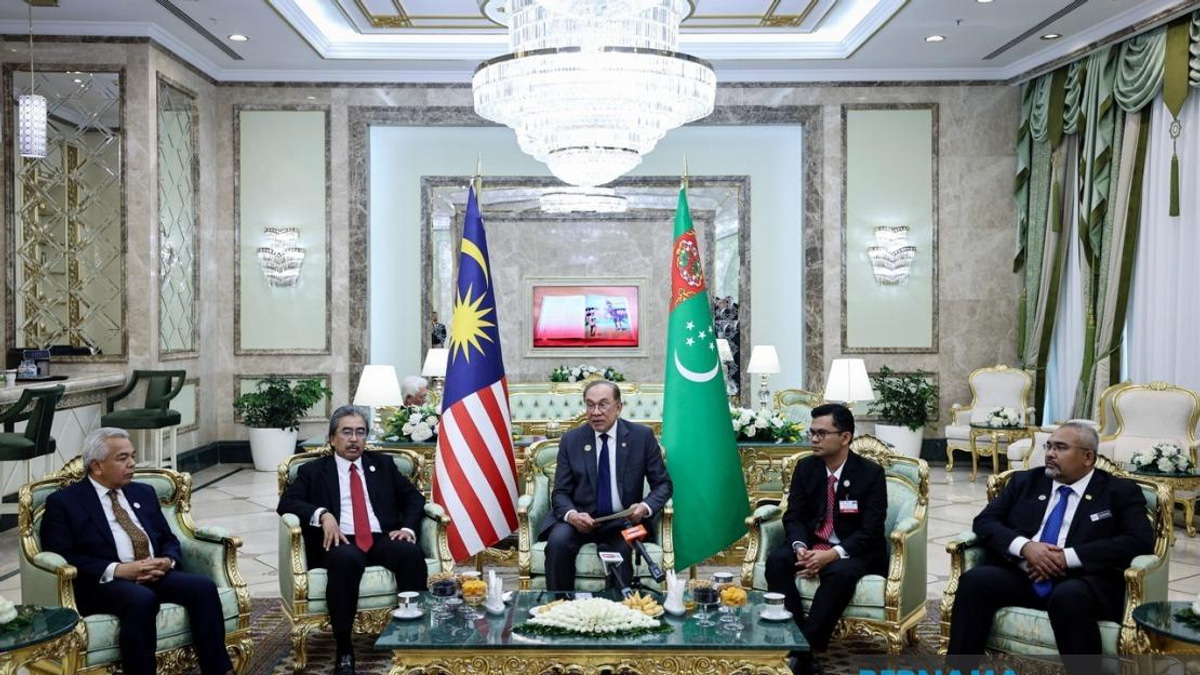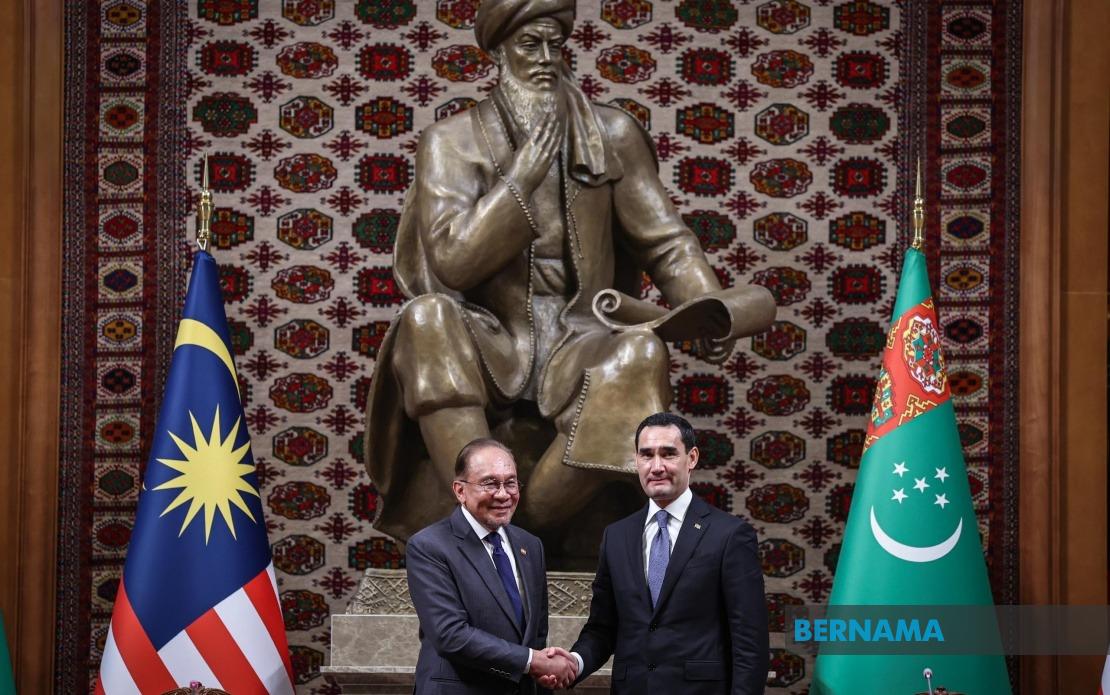
Prime Minister Datuk Seri Anwar Ibrahim has signalled Malaysia's intent to forge a more intentional and mutually beneficial relationship with Turkmenistan, announcing a suite of formal agreements designed to elevate cooperation between the two countries to a more structured footing. Speaking at a joint press conference in Ashgabat following his bilateral talks with President Serdar Berdimuhamedov at the Presidential Palace, Anwar described the partnership as one grounded in shared strategic interests and long-term prosperity for both populations.
The commitment materialised in the form of multiple memoranda of understanding and an air services agreement exchanged during the diplomatic visit. These documents represent far more than ceremonial gestures; they establish frameworks for implementing cooperation across sectors that matter significantly to Malaysia's economic diversification and regional positioning. Both leaders underscored that implementation would proceed with discipline, transparency and measurable outcomes, moving beyond the common pattern of agreements that languish without concrete follow-through.
Anwar's visit, undertaken at Berdimuhamedov's invitation, marks his first official journey to Turkmenistan since assuming office as Malaysia's 10th Prime Minister in November 2022. The timing carries symbolic weight, suggesting that Kuala Lumpur is methodically expanding its engagement with nations beyond its immediate Southeast Asian sphere. Turkmenistan, despite its geographic distance and relatively lower profile in Malaysian public consciousness, represents a gateway to Central Asian markets and energy resources that could prove increasingly valuable as Malaysia calibrates its economic positioning amid shifting global supply chains.
The bilateral discussions ranged across an expansive agenda encompassing energy security, bilateral trade and investment flows, the halal industry—an area where Malaysia maintains competitive advantage—Islamic banking infrastructure, educational exchanges, scientific research collaboration, technological advancement, tourism potential, and air route connectivity. This breadth suggests that both capitals view the relationship not as transactional but as having multiple interdependent dimensions that reinforce one another. Enhanced air connectivity, for instance, would facilitate business travel and tourism, while educational partnerships could deepen people-to-people understanding and create networks that sustain engagement over decades.
Specific documents exchanged included an Air Services Agreement designed to simplify flight operations between the two nations, potentially opening routes that currently require circuitous connections. Additionally, Malaysia's Institute of Diplomacy and Foreign Relations under the Ministry of Foreign Affairs established an MoU with Turkmenistan's Institute of International Relations, creating a formal channel for diplomatic professionals to share expertise and coordinate policy positions. The transport sector was addressed through an agreement between Malaysia's Ministry of Transport and Turkmenistan's State Service, while academic and scientific collaboration was formalized through an MoU between the Academy of Sciences Malaysia and its Turkmenistan counterpart.
The energy dimension warrants particular attention for Malaysian observers. Turkmenistan possesses substantial natural gas reserves and is a significant energy exporter, yet its transport routes have historically been constrained by geography and geopolitical considerations. Malaysia, as a liquefied natural gas exporter itself, understands energy market dynamics intimately. Deepened energy cooperation could involve knowledge transfer, potential investment flows, or coordinated positioning in global energy markets. The inclusion of energy prominently in bilateral discussions suggests both nations recognize mutual benefit in this sector.
The Islamic banking and halal industry components reflect Malaysia's strategic advantage in these domains. Malaysia has invested decades in building Shariah-compliant financial institutions and has established itself as a global halal standards-setter and certifier. Turkmenistan, a predominantly Muslim nation, represents both a market for these services and a potential source of halal-certified products and raw materials. By formalizing cooperation in these sectors, Malaysia can expand its soft power while simultaneously creating commercial opportunities for Malaysian financial institutions and certification bodies operating in Central Asia.
Anwar's delegation, which included Minister of Investment, Trade and Industry Datuk Seri Johari Abdul Ghani, Minister of Economy Akmal Nasrullah Mohd Nasir, and senior government officials, reflected the whole-of-government approach Malaysia has adopted under his administration. The presence of investment and trade-focused ministers signals that economic substance will accompany diplomatic flourishes. The joint statement signed by both leaders provided the overarching political commitment necessary to translate sectoral agreements into operational reality.
For regional context, Malaysia's outreach to Turkmenistan positions the nation as an engaged actor capable of building meaningful relationships across diverse geographic and cultural contexts. This matters particularly as Southeast Asian nations increasingly recognize that regional prosperity requires engagement with broader Eurasian markets and institutions. Turkmenistan's location along historical silk routes and its contemporary role in connecting Europe, Asia, and the Middle East give it outsized significance relative to its population size.
The commitment to "transparent and effective" implementation distinguishes this partnership announcement from countless others that fade into bureaucratic obscurity. By publicly committing to disciplined execution, both leaders have created accountability mechanisms that will be difficult to ignore. Malaysian observers should watch closely for concrete developments in the coming months: actual flights on new air routes, student exchanges materializing, business delegations visiting, and trade volumes showing measurable growth.
Looking forward, this visit exemplifies a broader Malaysian diplomatic strategy emphasizing structured partnerships rather than ad-hoc engagement. Under Anwar's premiership, Malaysia appears to be systematically identifying strategic partners beyond its traditional orbits, negotiating comprehensive frameworks, and building institutional capacity for sustained cooperation. Turkmenistan joins a growing portfolio of nations where Malaysia is investing political capital and organizational resources. The real test will be whether these agreements translate into tangible benefits for Malaysian businesses, institutions, and citizens—outcomes that will ultimately validate the diplomatic investment undertaken in Ashgabat.