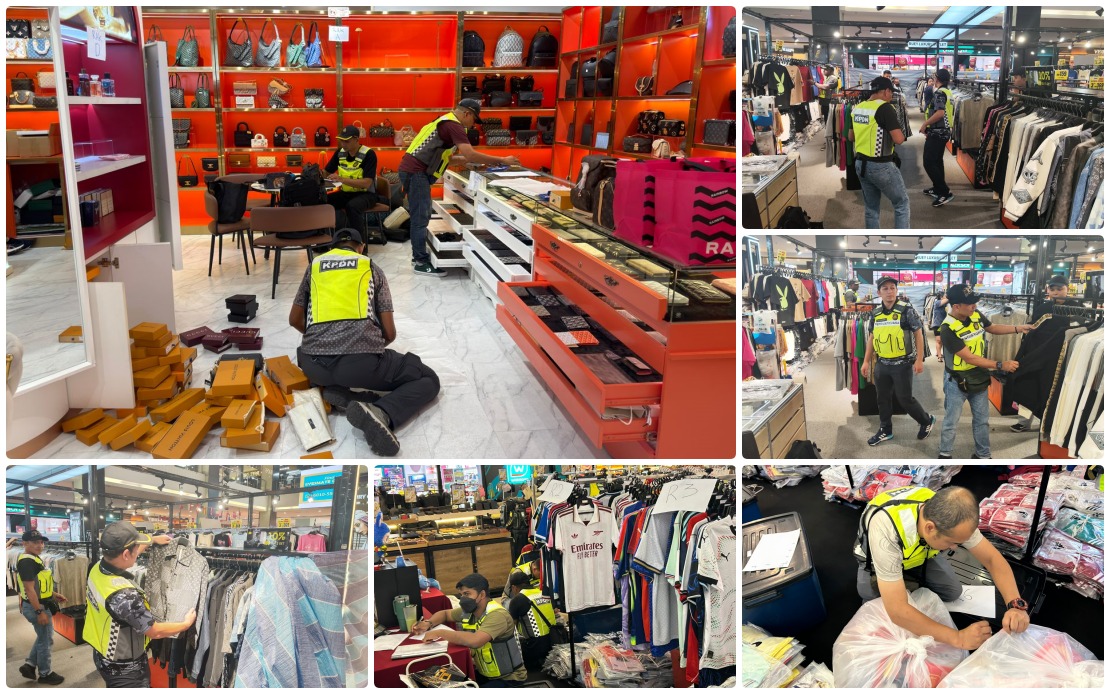
The Ministry of Domestic Trade and Cost of Living (KPDN) has intensified its war against intellectual property violations, conducting simultaneous raids on three commercial premises in Johor Bahru on June 15 that resulted in the seizure of counterfeit merchandise valued at RM600,000. The coordinated operation, executed through the Putrajaya Enforcement Division, represents a significant escalation in efforts to protect consumers and legitimate trademark holders from fraudulent trading practices that have long plagued Malaysia's retail sector.
According to enforcement director-general Datuk Azman Adam, the raids targeted traders who had been operating at major supermarket locations while simultaneously supplying counterfeit stock to other retailers across the region. The investigation revealed a sophisticated distribution network that extended beyond simple point-of-sale violations, suggesting an organized supply chain dedicated to shifting fake branded merchandise. This operational model is particularly concerning as it indicates that counterfeit goods were reaching consumers through mainstream retail channels rather than being confined to informal markets.
The seized inventory encompassed a diverse range of luxury items, including designer clothing, handbags, wallets, belts, and perfumes—all displaying unauthorized replicas of well-known international trademarks. By targeting multiple product categories simultaneously, the enforcement team demonstrated that the operation was comprehensive rather than opportunistic. Supporting documentation recovered during the raids has provided investigators with crucial evidence linking the premises to broader distribution networks, suggesting that further charges may be laid against accomplices not yet apprehended.
Four individuals, including the premises owner and caretaker, have been detained to facilitate ongoing investigations. The involvement of managerial staff indicates that the counterfeit operation was not a marginal or underground activity but rather an established business with structured operations and defined roles. This suggests the traders had developed systematic processes for sourcing, storing, and distributing fake goods—a level of organization that distinguishes professional counterfeiting from casual infringement.
The allegations fall under Section 102(1)(c) of the Trademark Act 2019, which specifically addresses the possession, custody, or control of goods bearing wrongly applied trademarks for the purpose of sale or distribution. This statutory framework reflects Malaysia's commitment to aligning its intellectual property protections with international standards and regional trade agreements. The provision carries substantial penalties calibrated to deter both individual entrepreneurs and corporate entities from engaging in counterfeit operations.
For individual offenders convicted on first-time charges, penalties include fines of up to RM10,000 per counterfeit item or imprisonment for three years, or both. Subsequent convictions carry significantly harsher sentences, with fines reaching RM20,000 per item and imprisonment extended to five years. Corporate entities face even steeper penalties, with initial convictions resulting in fines of RM15,000 per item, escalating to RM30,000 for repeat offenses. The escalating penalty structure reflects legislative intent to make counterfeiting economically unviable for organized operations while allowing judicial discretion for less culpable individual traders.
The month-long intelligence operation preceding the June 15 raids highlights the resource-intensive nature of combating sophisticated counterfeiting networks. Rather than relying solely on consumer complaints or random inspections, KPDN invested substantial investigative capacity in tracking trading patterns, identifying distribution channels, and establishing the scale of the operation. This intelligence-led approach yields higher-quality enforcement actions that target wholesalers and distributors rather than merely removing goods from retail shelves—a strategy that disrupts supply chains rather than merely treating symptoms.
For Malaysian consumers, the ramifications of such counterfeiting extend beyond financial loss from purchasing overpriced fake goods. Counterfeit products, particularly in categories like perfumes and skincare items, may pose health and safety risks due to the absence of quality control standards. Furthermore, the presence of fakes at major supermarket locations undermines consumer confidence in retail channels and necessitates increased vigilance even when purchasing at established retailers.
International trademark holders have long lobbied Malaysian enforcement agencies to strengthen action against counterfeiting, particularly in high-traffic retail environments where consumers might reasonably expect authenticity. The Johor operation demonstrates responsiveness to these concerns and signals that KPDN is prepared to pursue major retailers and distributors rather than focusing exclusively on street-level vendors. This approach aligns with international best practices and increases the deterrent effect by targeting the most profitable nodes in counterfeiting networks.
Datuk Azman Adam's statement that KPDN will not compromise with counterfeiters reflects institutional commitment to sustained enforcement. However, the sustainability of such operations depends on adequate funding, trained personnel, and intelligence-sharing protocols across enforcement agencies and with international partners. The Johor operation's success should be leveraged to build institutional capacity for similar operations in other states, particularly in high-traffic commercial zones where counterfeit goods have historically concentrated.
The broader context of counterfeiting in Southeast Asia reveals that Malaysia's commitment to enforcement positions the nation more stringently than some regional peers. Countries with lax trademark protection often become transhipment points for counterfeit goods destined for more developed markets, creating incentive structures that encourage local production. By maintaining robust enforcement frameworks and operational capacity, Malaysia protects not only its own consumers and legitimate businesses but also its reputation as a region with credible intellectual property protections—a factor increasingly important for attracting legitimate foreign investment.
Looking forward, this enforcement action should catalyze complementary regulatory strategies, including enhanced due diligence requirements for supermarkets procuring branded merchandise directly from suppliers. Retailers themselves have financial incentive to prevent counterfeit goods from entering their supply chains, given reputational risks and potential legal liability. Public-private partnerships between KPDN and major retailers could establish rapid-response verification protocols that catch fake goods before they reach shelves.
The RM600,000 seizure represents substantial economic impact on the counterfeiting operation, though the true significance lies in the disruption of distribution channels and the signal sent to other would-be traders that profitable counterfeiting carries concrete enforcement risk. As Malaysia continues integrating into global supply chains and positioning itself as a consumer-friendly business environment, maintaining credible trademark protection serves both ethical imperatives and strategic economic interests.