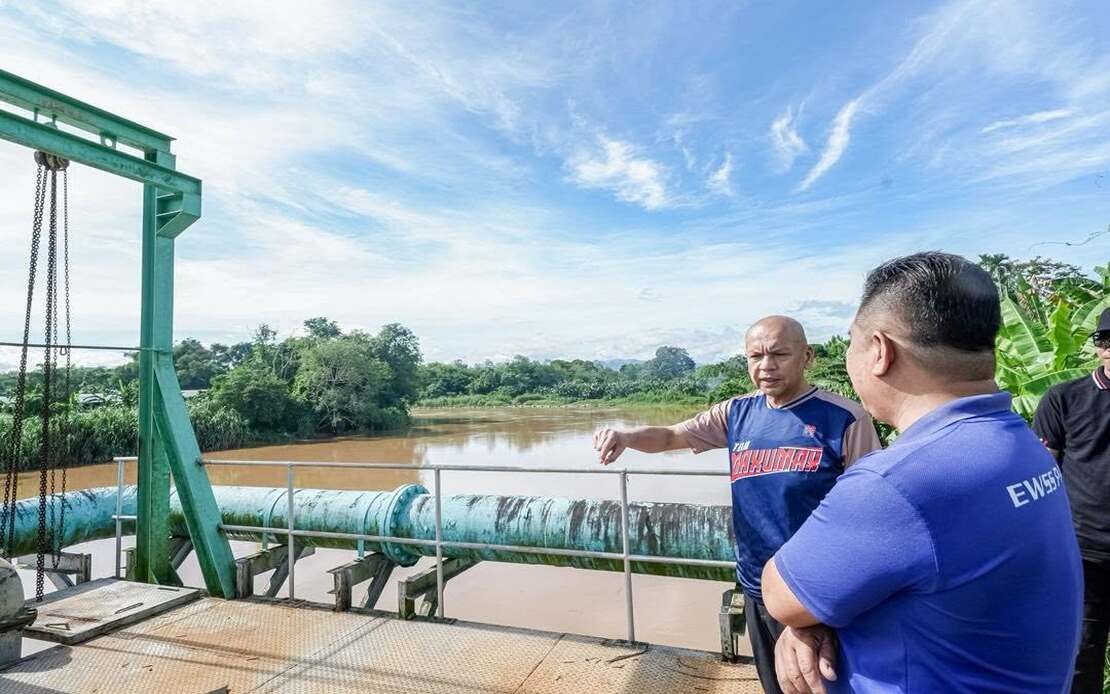
Domestic Trade and Cost of Living Minister Datuk Armizan Mohd Ali conducted an on-site inspection of water supply infrastructure projects in Papar on June 19, reaffirming the government's commitment to resolving longstanding water availability challenges in the district. The visit came days after a focused meeting on June 15 to assess implementation progress, signalling heightened ministerial attention to infrastructure delays that have periodically affected the local population.
Two major expansion initiatives form the cornerstone of Papar's water security strategy. The Kogopon Water Treatment Plant is undergoing a significant upgrade designed to nearly double its output capacity from 40 million litres per day to 80 million litres per day, while concurrent work targets the Kampung Kabang intake facility. These complementary projects address a fundamental challenge: Papar's water infrastructure, built to meet historical demand levels, struggles to keep pace with population growth and increased consumption across the district.
The timing of Armizan's inspection proved particularly pertinent, as both the EWSS Plant and JETAMA Limbahau Plant had recently experienced operational shutdowns. These closures stemmed from elevated nephelometric turbidity unit (NTU) readings in raw water supplies, a technical measure indicating suspended particles and sediment levels that exceed acceptable treatment thresholds. When NTU values spike, treatment plants must cease operations temporarily until water quality stabilizes, creating supply gaps that directly impact consumers relying on piped water services.
Raw water turbidity fluctuations represent a persistent vulnerability in Papar's water supply chain, particularly during seasons of heavy rainfall or when upstream catchment conditions deteriorate. While treatment plants possess the technical capacity to manage these variations, extended disruptions reveal the fragility of relying on single-source or limited-redundancy systems. The disruptions occurring within the same week underscore how closely interconnected the district's water infrastructure components function, meaning problems at one facility ripple through the broader network.
Armizan's emphasis on direct field assessment reflects a broader strategic shift towards hands-on ministerial oversight of infrastructure delivery. Rather than relying solely on written progress reports, the minister sought to observe conditions firsthand and engage with technical teams managing the facilities. This approach enables identification of bottlenecks or resource constraints that may not surface in standard reporting channels, and communicates to staff that accountability mechanisms extend beyond headquarters to operational sites.
The scale of proposed capacity expansion suggests planners anticipate continued growth in Papar's water demand trajectory. Doubling the Kogopon facility's output to 80 million litres daily represents significant capital investment and reflects confidence in the district's economic and demographic trajectory. However, such projections carry implicit assumptions about population growth, commercial development patterns, and consumption behaviours that warrant periodic validation against actual trends.
Beyond infrastructure engineering, the minister's inspection highlighted the operational dimension of water supply reliability. Treatment plants must navigate competing objectives: maximizing output to meet demand, maintaining stringent quality standards to protect public health, and managing cost efficiency. When raw water quality deteriorates, operators face difficult choices between maintaining supply continuity through suboptimal conditions or implementing protective shutdowns that temporarily worsen shortages.
For Malaysian consumers accustomed to reliable piped water systems in major urban centres, periodic disruptions in areas like Papar expose the differential maturity of water infrastructure across regions. While Kuala Lumpur and other metropolitan zones benefit from redundant systems and advanced treatment capabilities, smaller towns depend on aging facilities operating near capacity limits. Investment announcements such as the Kogopon upgrade represent efforts to reduce these disparities, though implementation timelines remain critical variables affecting public satisfaction.
The Papar situation also illustrates broader Southeast Asian water management challenges. Rapid urbanization frequently outpaces infrastructure development, while climate variability increasingly affects raw water quality and seasonal availability. Malaysia's relatively advanced institutional capacity provides advantages compared to some regional peers, yet even here, gaps persist between infrastructure demand and supply.
Moving forward, the success of Papar's stabilization programme hinges on timely project completion, quality construction standards, and integrated management of both supply-side expansion and demand-side considerations. Armizan's visible engagement suggests ministerial awareness that water security constitutes a public service priority capable of generating rapid political consequences if unresolved. The inspection therefore serves dual purposes: operational assessment and political commitment-signalling to constituents anxious about supply reliability.