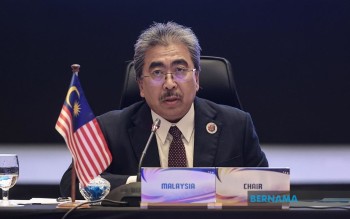
Malaysia's Investment, Trade and Industry Minister Datuk Seri Johari Abdul Ghani has warned that the World Trade Organization must fundamentally reshape itself to remain meaningful in a dramatically altered global economic landscape. Speaking at the 39th Asia-Pacific Roundtable in Kuala Lumpur, Johari underscored the tension between the WTO's founding principles and the complex realities facing policymakers today, suggesting that without meaningful evolution, the multilateral trade body risks becoming increasingly irrelevant to its member states.
When the WTO was established, its architects envisioned trade liberalisation and expanded market access as the cornerstones of prosperity and international stability. That vision, born from post-Cold War optimism about borderless commerce, shaped decades of trade negotiations and regulatory frameworks across the Asia-Pacific and beyond. Yet the operating environment has shifted dramatically. Johari emphasised that contemporary economic policymaking is no longer principally preoccupied with dismantling tariffs and opening markets, but rather with ensuring national resilience, technological sovereignty, supply chain stability and strategic autonomy in critical sectors.
This conceptual pivot reflects deeper geopolitical anxieties that transcend traditional trade theory. Countries increasingly view certain industries and supply chains through a strategic lens, weighing not just comparative advantage but vulnerability. The shift is evident across the region: Southeast Asian governments have begun re-evaluating dependency on single suppliers for semiconductors, pharmaceuticals and other critical goods. Taiwan's dominance in chip manufacturing, China's control of rare earth processing, and bottlenecks exposed by the pandemic have all crystallised how interconnected modern supply chains create both economic opportunity and national risk. The WTO, designed for an era when such concerns were peripheral, now confronts an international system where they sit at the centre of policy debate.
Johari's remarks also address a broader legitimacy challenge facing the institution. The WTO's dispute settlement mechanism has been paralysed for years by the refusal of the United States to allow the appointment of appellate judges, creating a vacuum that undermines the organisation's primary function as an arbiter of trade conflicts. Simultaneously, major economies have increasingly resorted to unilateral and bilateral measures—tariffs, subsidies, export controls—that circumvent the multilateral system entirely. For Malaysia and other mid-sized traders heavily dependent on open markets, this fragmentation is deeply troubling, yet the WTO has proven incapable of responding effectively.
The minister's call for adaptation extends to the rules governing emerging issues barely contemplated when the WTO was founded. Digital trade, data flows, labour standards, environmental protection and the strategic use of technology are now critical to international commerce, yet the organisation's frameworks remain fragmentary. Without clear multilateral rules in these domains, powerful economies have exploited regulatory gaps, creating uncertainty that disadvantages smaller economies with fewer resources to navigate bilateral negotiations. For Malaysia, a nation whose prosperity depends on seamless integration into global value chains, regulatory clarity through modernised WTO frameworks would offer meaningful protection and predictability.
Parallel to updating rules is the imperative to preserve the WTO's core function: preventing trade disputes from metastasising into geopolitical conflict. Johari stressed that as strategic competition intensifies, particularly between major powers in the Asia-Pacific, the role of credible multilateral institutions becomes more, not less, critical. When countries can invoke WTO rules to contest discriminatory practices, they have a peaceful channel for grievance rather than resorting to retaliatory measures that can spiral unpredictably. This is not academic theory but a pressing practical concern for the region, where rising tensions between the United States and China have already disrupted established trading patterns and prompted countries to navigate increasingly complex geopolitical alignments.
Malaysia's reaffirmation of support for multilateralism, despite Johari's critique of the WTO, reflects a pragmatic calculation. The country benefits enormously from open markets and transparent rules; protectionism would harm Malaysian exporters far more than it would protect domestic producers. Yet Malaysia also recognises that it operates in a world where strategic considerations now permeate trade policy. The challenge is not to abandon the WTO but to reform it sufficiently that it addresses legitimate security and resilience concerns whilst maintaining the fundamental discipline of rules-based trade that sustains regional prosperity.
The timing of these comments, delivered at the Asia-Pacific Roundtable organised by the Institute of Strategic and International Studies Malaysia, carries significance for the broader region. The conference brings together senior policymakers, diplomatic figures and strategic thinkers to examine geopolitical, economic and security challenges affecting Asia-Pacific states. Johari's intervention signals that trade reform is no longer a technical issue confined to specialist negotiators but a fundamental question about institutional design and international relations in an age of great power competition.
Addressing discriminatory trade practices, as Johari emphasised, is particularly salient for Southeast Asia. The region has witnessed rising concerns about non-tariff barriers, intellectual property disputes, and unequal treatment by larger trading partners. Without a functioning WTO with credibility and reach, smaller economies struggle to contest practices that advantage larger or more strategically important nations. Thus the stakes of WTO reform extend beyond abstract principle to concrete material interests that affect employment, investment decisions and regional economic integration.
The broader lesson from Johari's remarks is that international institutions, however carefully designed, must evolve or die. The WTO was built for twentieth-century problems in a twenty-first-century world. Whether its member states, particularly those wielding greatest power, possess the political will to undertake genuine reform remains uncertain. What is clear is that for nations like Malaysia with deep exposure to global supply chains and limited ability to coerce trading partners, the question of whether the WTO adapts is not merely an institutional concern but a matter of national economic interest and regional stability.

