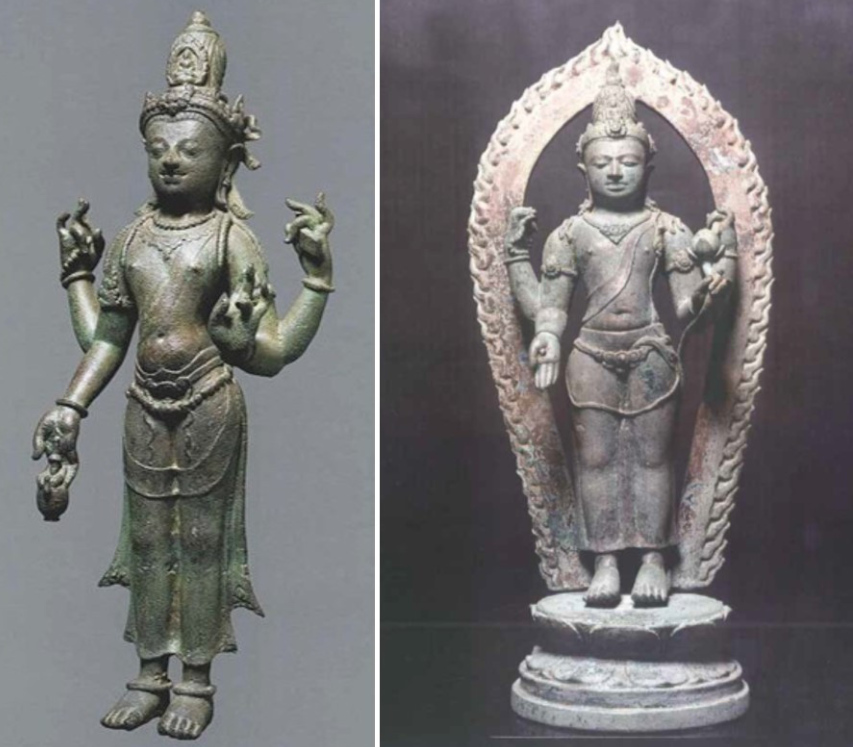
The United States has completed the repatriation of two eighth-century bronze Buddhist statues that were looted from Indonesia decades ago and trafficked through the illicit antiquities network of Douglas Latchford, a British dealer whose decades-long career became synonymous with the plundering of Southeast Asian cultural treasures. The sculptures were handed over during a formal ceremony at the Indonesian Consulate in New York, marking another significant victory in the ongoing effort to recover stolen heritage across the region.
The two bronze works depict Avalokiteshvara, the four-armed bodhisattva venerated in Buddhist traditions as an embodiment of compassion and mercy. Investigators believe the statues were taken from archaeological sites within Indonesia sometime in the distant past, though the specific locations where they were excavated remains undetermined. After being removed from their original context, the pieces entered the hands of Latchford, who operated primarily from Bangkok and became one of the world's most prolific dealers in looted Khmer and Southeast Asian art over a forty-year period.
Douglas Latchford's rise to prominence in the antiquities world paralleled the systematic looting of Southeast Asia's cultural heritage. The British-born dealer became a Thai citizen during the 1960s and built a reputation as a leading authority on Khmer art, working extensively to supply wealthy private collectors and major international museums with objects of purported historical significance. His enterprise flourished largely unchecked until 2019, when United States prosecutors formally indicted him on charges of orchestrating a decades-spanning criminal scheme to traffic and sell looted antiquities from Cambodia and across the broader Southeast Asian region. Latchford consistently denied all allegations against him, but the investigation that followed his indictment would uncover one of the most extensive networks of cultural property trafficking in recent history.
The two Indonesian statues began their documented journey into the black market between 2003 and 2007, when Latchford sold them to a American collector along with numerous other Southeast Asian antiquities. Prosecutors have established that Latchford deliberately concealed the illicit origins of these objects by withholding historical documentation and misrepresenting their provenance to the collector, thereby enabling stolen cultural property to circulate through legitimate international art markets. This practice of falsifying records to obscure a work's criminal history was a systematic feature of Latchford's operations, allowing him to launder looted artefacts into respectable collections and museum holdings.
Latchford's death in 2020 removed him from further criminal prosecution, but the investigation into his trafficking network continued with considerable momentum. A crucial breakthrough came in 2021 when an American collector who had purchased antiquities from Latchford voluntarily surrendered thirty-four pieces of Cambodian and Southeast Asian origin, including the two Indonesian bronze statues. This cooperative gesture provided federal authorities with extensive evidence regarding Latchford's operations and enabled the recovery of culturally significant objects that might otherwise have remained lost to their countries of origin.
US Attorney Jay Clayton, speaking at the repatriation ceremony, emphasized his office's commitment to combating the illicit trade in stolen cultural property. Clayton acknowledged the critical partnership between American law enforcement and Homeland Security Investigations in disrupting trafficking networks and preventing wealthy collectors from profiting through the acquisition of looted artefacts. He specifically praised the American collector's voluntary decision to return the antiquities, highlighting how cooperation between law enforcement and private individuals can advance the recovery of stolen heritage.
The recovery of these Indonesian statues reflects broader progress in repatriating Southeast Asian cultural property that was systematically removed during decades of exploitation. Following Latchford's indictment, his daughter agreed to return his entire collection, valued at more than fifty million US dollars, to Cambodia. Subsequently, museums and private collectors across the United States, Europe, and Australia have initiated repatriations of Khmer artefacts connected to the dealer's network, while Cambodian authorities continue their efforts to locate and recover the country's dispersed cultural heritage.
Indonesia itself has benefited from multiple repatriation efforts originating in the United States. Beyond the latest return, American authorities recovered and repatriated three Indonesian artefacts in 2024 valued at approximately 6.5 billion rupiah, including a stone relief from the Majapahit period, a seated bronze Buddha, and a standing bronze sculpture of Vishnu. These objects were recovered during investigations into a separate international trafficking network involving Indian-American dealer Subhash Kapoor and American antiquities merchant Nancy Wiener, who operated the Manhattan-based Art of the Past gallery.
The Kapoor investigation has proven extraordinarily productive in terms of artifact recovery. Between 2011 and 2023, investigators from the Manhattan District Attorney's Office and the US Department of Homeland Security recovered more than twenty-five hundred antiquities allegedly trafficked by Kapoor and his associates, with a combined estimated value surpassing one hundred and forty-three million dollars. The investigation also led to the recovery of twenty-seven Cambodian artefacts, demonstrating the interconnected nature of antiquities trafficking networks that typically operate across multiple countries and source regions throughout Southeast Asia.
These successive repatriations signal an important shift in how American law enforcement and the international art market are treating looted cultural property. The voluntary returns suggest growing awareness among collectors that acquiring objects with problematic provenances carries significant legal and reputational risks. For Southeast Asian nations like Indonesia and Cambodia, which have experienced the systematic removal of cultural heritage during colonial and post-colonial periods, these recoveries represent tangible progress in the long-term effort to restore national patrimony.
The recovery of looted antiquities remains far from complete, however. Thousands of objects taken from Southeast Asian archaeological sites continue to circulate in private collections and museum storage facilities worldwide, their illicit origins obscured by falsified documentation and incomplete records. The cases involving Latchford and Kapoor have illuminated how sophisticated trafficking networks operate, but they represent only a fraction of the broader problem affecting the region's cultural heritage. Continued cooperation between Southeast Asian governments, American law enforcement agencies, and international cultural organizations will be essential to identifying and recovering additional stolen artefacts.
For Indonesia specifically, the return of these eighth-century Buddhist statues carries symbolic significance beyond their individual artistic and historical value. These pieces represent tangible connections to Indonesia's rich Buddhist heritage, a period of the archipelago's history that is less visibly present in contemporary cultural consciousness than Hindu-Buddhist elements from later periods. Their recovery and homecoming contribute to a more complete understanding of Indonesia's pre-Islamic religious and artistic traditions, helping to restore cultural narratives that were fragmented by theft and dispersal.

