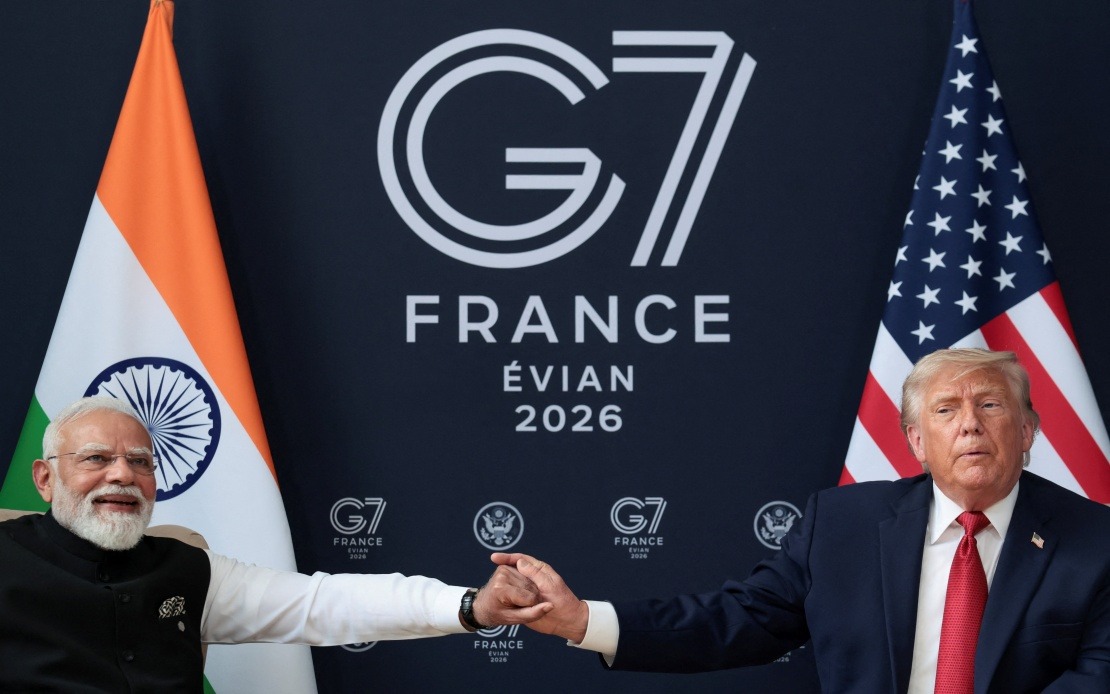
Negotiations between India and the United States toward a comprehensive bilateral trade agreement have reached a pivotal stage, with both nations announcing "significant progress" following high-level discussions at the Group of Seven summit in Evian, France. Prime Minister Narendra Modi and President Donald Trump met on the margins of the gathering to discuss the stalled trade talks, a matter that has occupied both governments for over two years. India's External Affairs Ministry formally acknowledged the breakthrough, stating that leaders expressed "particular satisfaction" with how negotiations have progressed and directed their respective teams to pursue a "balanced, mutually beneficial, and commercially meaningful" accord without further delay.
The timing of this announcement carries weight in the context of broader US-India strategic alignment. Both nations have sought to deepen their partnership as a counterbalance to Chinese influence in the Indo-Pacific region, and a substantive trade agreement would solidify economic ties underpinning this geopolitical approach. The interim accord reached in February already demonstrated willingness to compromise, with Washington reducing its tariff rate on Indian goods to 18 per cent from initial demands. However, broader structural differences in how each side views reciprocal market access have prolonged negotiations, requiring sustained commitment from both capitals to resolve outstanding issues.
Trump's characterisation of Modi as "one of the toughest" negotiators reflects the complexity of reaching agreement with New Delhi. The US president's observation that the Indian leader appears "like an angel" but operates "as tough as a killer" underscores how India has refused to accept terms perceived as unfavourable simply to conclude a deal. This hardline approach reflects domestic political pressures within India, where agricultural constituencies and small manufacturers have expressed concern about sudden liberalisation without adequate transition support. Modi's government must balance international commitments with protecting vulnerable domestic sectors, a calculation that has slowed the pace of commerce negotiations despite both sides recognising mutual benefit.
The broader context of US-India trade relations has grown more fraught since Trump's return to office. In 2025, Washington imposed 25 per cent tariffs on Indian exports and an additional 25 per cent tariff specifically targeting India's purchase of Russian oil, a critical energy source for the Indian economy. These protectionist measures created substantial friction and raised questions about whether meaningful agreement remained possible. The new momentum announced during the G7 meeting therefore represents a genuine diplomatic effort to reset relations and prevent tit-for-tat escalation that would damage both economies and complicate their strategic partnership.
US Trade Representative Jamieson Greer's planned visit to India in the coming week signals that substantive negotiations will resume at senior official levels. Such visits typically involve detailed technical discussions on tariff schedules, rules of origin, intellectual property protections, and services market access—the intricate details that determine whether agreements truly deliver balanced outcomes. Greer's presence will demonstrate American commitment to closing gaps and would provide an opportunity for Indian negotiators to present their concerns directly to someone with authority to make binding commitments on behalf of Washington.
For Malaysia and other Southeast Asian nations, a US-India trade agreement holds indirect but meaningful implications. Stronger India-US economic integration could reshape regional supply chains as multinational corporations consider how tariff relationships factor into manufacturing decisions. An agreement might also influence how other nations approach trade talks with Washington, particularly regarding the US willingness to negotiate rather than impose unilateral measures. Additionally, improved US-India ties reduce the risk of trade war spillovers that could destabilise the broader Indo-Pacific economy from which Malaysian exporters derive substantial revenue.
The path forward remains subject to genuine uncertainties. Both sides have multiple domestic constituencies whose support they need, and satisfying all simultaneously presents genuine difficulty. Agricultural interests in India, technology companies in the US, and manufacturing sectors in both countries have competing interests that negotiators must somehow reconcile. The fact that both leaders felt compelled to announce progress publicly suggests they recognise that continued stalemate would reflect poorly on both governments and undermine the strategic relationship they claim to value.
Reaching a comprehensive agreement would mark a significant diplomatic achievement for both Modi and Trump, demonstrating their capacity to advance major policy goals despite substantial differences in approach and priority. It would also restore momentum to broader US-India strategic engagement at a time when both nations face mounting regional security challenges and economic pressures. The commitment to pursue a "commercially meaningful" agreement acknowledges that symbolic accords without real economic substance would serve neither country's interests and might actually damage confidence between the two governments.

%22%2F%3E%3C%2Fpattern%3E%3C%2Fdefs%3E%3Crect%20width%3D%22100%25%22%20height%3D%22100%25%22%20fill%3D%22url(%23ph21o2sg)%22%2F%3E%3Crect%20width%3D%22100%25%22%20height%3D%22100%25%22%20fill%3D%22url(%23ph21o2sp)%22%2F%3E%3Ctext%20x%3D%2250%25%22%20y%3D%2250%25%22%20text-anchor%3D%22middle%22%20dominant-baseline%3D%22central%22%20fill%3D%22rgba(255%2C255%2C255%2C0.95)%22%20font-family%3D%22Georgia%2C%20'Times%20New%20Roman'%2C%20serif%22%20font-weight%3D%22700%22%20font-size%3D%22170%22%20letter-spacing%3D%22-0.02em%22%3EGabungan%3C%2Ftext%3E%3C%2Fsvg%3E)