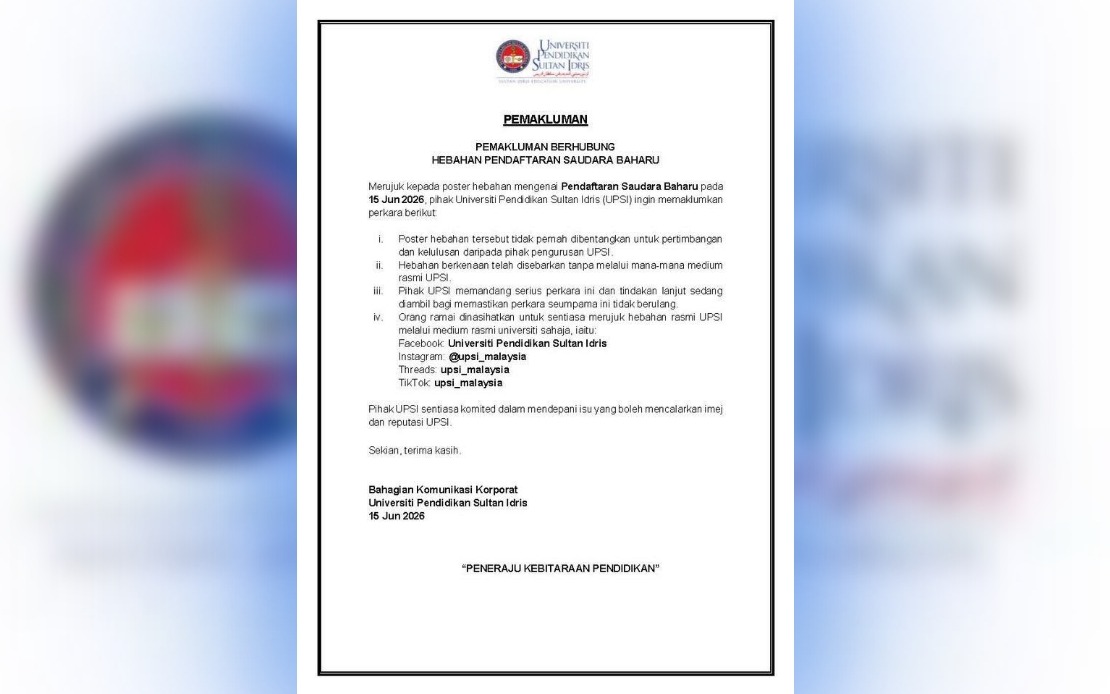
Universiti Pendidikan Sultan Idris (UPSI) has moved swiftly to deny any institutional involvement in a poster about registering 'saudara baharu' or newly converted Muslims that recently gained traction across social media platforms. The university's clarification came through official announcements released on its social media channels, addressing public concern over the viral material and its potential association with the institution.
The contentious poster, which carried a date of June 15, never underwent the university's formal administrative approval process, according to UPSI's statement. The institution emphasised that the document was not presented to its leadership for consideration and was not disseminated via any of UPSI's officially sanctioned communication channels. This distinction is significant in Malaysia's institutional landscape, where university pronouncements typically carry considerable weight and official endorsement.
The spread of the poster without institutional authorisation has raised questions about how misinformation can be attributed to educational establishments through informal channels. Universities in Malaysia function under established protocols for public-facing communications, and departures from these procedures can create confusion among stakeholders and the general public about official positions. UPSI's response underscores the growing challenge institutions face in controlling their narrative when content circulates beyond their regulatory frameworks.
UPSI stated that it views the matter with considerable seriousness and pledged to implement further measures to prevent similar incidents in the future. The university's commitment to addressing the situation reflects broader institutional concerns about reputational management in an era where social media can rapidly amplify content regardless of its official status. Educational institutions across Southeast Asia have increasingly grappled with the challenge of distinguishing between authorised and unauthorised communications bearing their names.
The university has urged members of the public to rely exclusively on announcements distributed through its official mediums when seeking authentic information about institutional matters. This guidance represents a standard practice among Malaysian universities seeking to maintain clear communication boundaries. UPSI's emphasis on official channels underscores the importance of media literacy among audiences who encounter content claiming institutional affiliation.
The incident highlights the vulnerability of large organisations to attribution of content they did not produce or endorse. In the Malaysian context, where educational institutions occupy positions of social influence, the uncontrolled circulation of materials seemingly bearing institutional authority can carry particular weight. UPSI's proactive denial demonstrates institutional awareness of how such associations, even when unfounded, can influence public perception and institutional standing.
For Malaysian universities navigating the intersection of traditional institutional governance and digital communication, the episode offers instructive lessons about the speed at which unvetted materials can be attributed to organisations. The ease with which content can be shared across social media platforms means that institutional reputation management now requires constant vigilance and rapid response capabilities. UPSI's swift clarification reflects this new institutional reality.
The controversy also raises broader questions about the authenticity verification mechanisms that social media users employ when encountering institutional announcements. Consumers of online content frequently struggle to distinguish between official communications and materials that merely invoke institutional names or aesthetics. This phenomenon affects not only universities but extends across government agencies, corporations, and civil society organisations throughout the region.
UPSI's situation is emblematic of challenges facing major educational establishments in Malaysia that must maintain clear institutional voices while operating in information environments where control is increasingly diffuse. The university's reiteration of its commitment to tackling issues affecting its image or reputation signals that institutional leadership recognises the stakes involved in allowing misattribution to persist unchallenged. For readers and stakeholders, the episode serves as a reminder of the importance of verifying institutional communications through official channels before treating them as authoritative.

%22%2F%3E%3C%2Fpattern%3E%3C%2Fdefs%3E%3Crect%20width%3D%22100%25%22%20height%3D%22100%25%22%20fill%3D%22url(%23ph21o2sg)%22%2F%3E%3Crect%20width%3D%22100%25%22%20height%3D%22100%25%22%20fill%3D%22url(%23ph21o2sp)%22%2F%3E%3Ctext%20x%3D%2250%25%22%20y%3D%2250%25%22%20text-anchor%3D%22middle%22%20dominant-baseline%3D%22central%22%20fill%3D%22rgba(255%2C255%2C255%2C0.95)%22%20font-family%3D%22Georgia%2C%20'Times%20New%20Roman'%2C%20serif%22%20font-weight%3D%22700%22%20font-size%3D%22170%22%20letter-spacing%3D%22-0.02em%22%3EGabungan%3C%2Ftext%3E%3C%2Fsvg%3E)