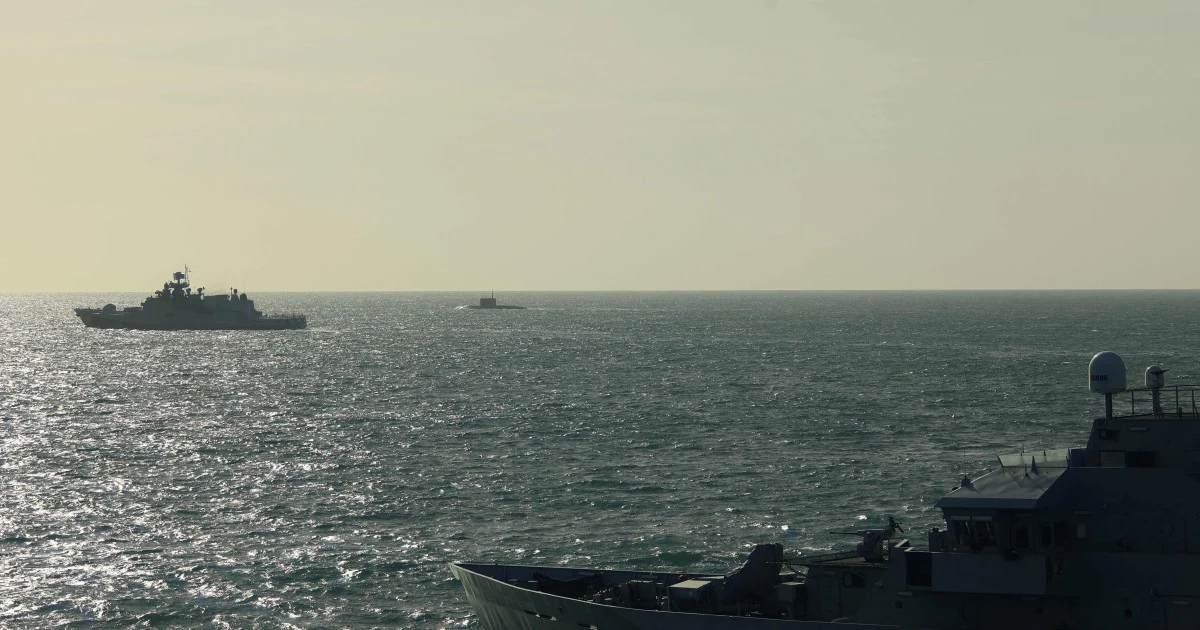
British Prime Minister Keir Starmer sought to draw a careful distinction on Wednesday when addressing an incident involving a Russian warship that discharged warning shots near a private vessel operating in the English Channel. Rather than characterizing the action as a deliberate provocation, Starmer chose the language of negligence, describing the naval encounter as "reckless" while explicitly rejecting suggestions that it constituted an intentionally sinister manoeuvre. This measured framing reflects the delicate diplomatic balance the United Kingdom is attempting to maintain as tensions between NATO allies and Russia continue to simmer at sea.
The incident itself represents merely the latest in a series of at-sea encounters that have punctuated relations between Britain and Russia in recent months. These naval encounters occur against a backdrop of heightened geopolitical friction stemming from Russia's invasion of Ukraine and the broader strategic competition between Moscow and Western nations in European waters. The English Channel, one of the world's busiest maritime corridors connecting the North Sea to the Atlantic, has become an increasingly fraught zone where military forces from rival blocs maintain close proximity and heightened vigilance.
Starmer's decision to employ the term "reckless" rather than "sinister" carries significant interpretive weight in international relations discourse. The designation suggests that while the Russian warship's actions were dangerous and demonstrated poor judgment, they may not have been motivated by intentional aggression or calculated hostility. This distinction allows the British government to lodge formal protest and express serious concern whilst leaving diplomatic channels open for de-escalation. It also serves to prevent the incident from being weaponized as evidence of a deliberate policy shift toward more aggressive Russian naval operations in Western waters.
The firing of warning shots across the bow of a civilian vessel represents a serious breach of maritime protocol and international law. Such actions create immediate physical danger to the crew aboard the targeted vessel and can have profound psychological effects on maritime traffic. The incident raises questions about Russian naval commanders' interpretation of rules of engagement and decision-making processes on the ground. These concerns are particularly acute given that civilian vessels transiting international waters possess clear rights to passage and should never be subjected to weapons fire regardless of the stated justification.
For Malaysia and other Southeast Asian nations closely watching geopolitical developments in Europe, this pattern of Russian naval assertiveness carries indirect but meaningful implications. The behaviour of major powers in distant waters often establishes precedents that ripple across global maritime norms and international law. Should Russia successfully establish a pattern of aggressive naval conduct in European waters without severe consequences, it may embolden similar actions elsewhere. This is particularly relevant to Southeast Asia, where maritime territorial disputes and competing claims persist, and where both Russia and China maintain naval interests.
The English Channel serves as a crucial artery in global commerce, with thousands of vessels transiting daily. The safety and security of these sea lanes depend fundamentally on respect for international maritime law and established protocols governing naval operations. Any degradation of these norms threatens not merely bilateral British-Russian relations but the broader international legal framework that undergirds freedom of navigation worldwide. Malaysian shipping interests, like those of most trading nations, depend critically on the stability and predictability of these international maritime pathways.
Starmer's calibrated language suggests British policymakers are attempting to avoid escalation whilst maintaining a firm position on maritime rights. By avoiding characterizations that might be interpreted as accusations of deliberate malice, the British government creates negotiating space for resolution without backing down from the substance of its complaint. This approach reflects lessons learned from previous incidents and a recognition that maritime confrontations in contested waters can quickly spiral if either side perceives itself as having lost face or being compelled toward further aggressive posturing.
The incident also underscores the challenge facing NATO and its allies in managing relations with Russia across multiple domains simultaneously. British forces operate in the English Channel and surrounding waters with the understanding that Russian naval assets may be present. The balance between defending maritime rights and avoiding unnecessary military confrontation requires constant recalibration. Starmer's response suggests Britain views this particular incident as concerning but not as requiring a dramatic escalation in its own naval posture or rhetoric.
Russian naval operations in Western waters have become increasingly frequent and sophisticated in recent years, reflecting Moscow's determination to project power and challenge Western military dominance in traditionally NATO-dominated areas. The English Channel represents a particularly sensitive area, as it lies between Britain and continental Europe and carries immense symbolic and strategic significance. Russian vessels regularly operate in international waters throughout the region, a practice that generates ongoing friction with British and allied naval forces but remains technically lawful under international maritime law.
The incident reflects broader questions about how nations should respond when military forces operating legally in international waters nonetheless behave in ways that violate customary standards of conduct. Warning shots across a civilian vessel's bow, for example, may technically constitute a lawful warning if executed at sea and not striking the vessel, but it nonetheless represents a dramatic escalation of naval conduct that violates accepted maritime norms. Starmer's framing appears designed to condemn the behaviour whilst leaving space for Russia to adjust course without requiring either side to claim victory in a confrontation.
Moving forward, the incident will likely influence British naval operations in the Channel and surrounding waters. Heightened vigilance and enhanced safety protocols for civilian vessels operating in areas where Russian warships are active will probably become standard practice. The British government will also need to consider how to coordinate responses with allied navies, particularly those of France and other European nations whose vessels operate in the same waters and face similar risks from aggressive Russian naval conduct.
For observers in Malaysia and throughout Southeast Asia, this European maritime confrontation serves as a reminder that naval tensions and freedom of navigation challenges are not unique to Asian waters. These principles and problems are universal, reflecting fundamental questions about how nations coexist in shared maritime spaces and how international law can govern state behaviour when interests diverge. The measured British response provides one model for managing such tensions without allowing them to metastasize into broader conflict.

%22%2F%3E%3C%2Fpattern%3E%3C%2Fdefs%3E%3Crect%20width%3D%22100%25%22%20height%3D%22100%25%22%20fill%3D%22url(%23ph21o2sg)%22%2F%3E%3Crect%20width%3D%22100%25%22%20height%3D%22100%25%22%20fill%3D%22url(%23ph21o2sp)%22%2F%3E%3Ctext%20x%3D%2250%25%22%20y%3D%2250%25%22%20text-anchor%3D%22middle%22%20dominant-baseline%3D%22central%22%20fill%3D%22rgba(255%2C255%2C255%2C0.95)%22%20font-family%3D%22Georgia%2C%20'Times%20New%20Roman'%2C%20serif%22%20font-weight%3D%22700%22%20font-size%3D%22170%22%20letter-spacing%3D%22-0.02em%22%3EGabungan%3C%2Ftext%3E%3C%2Fsvg%3E)