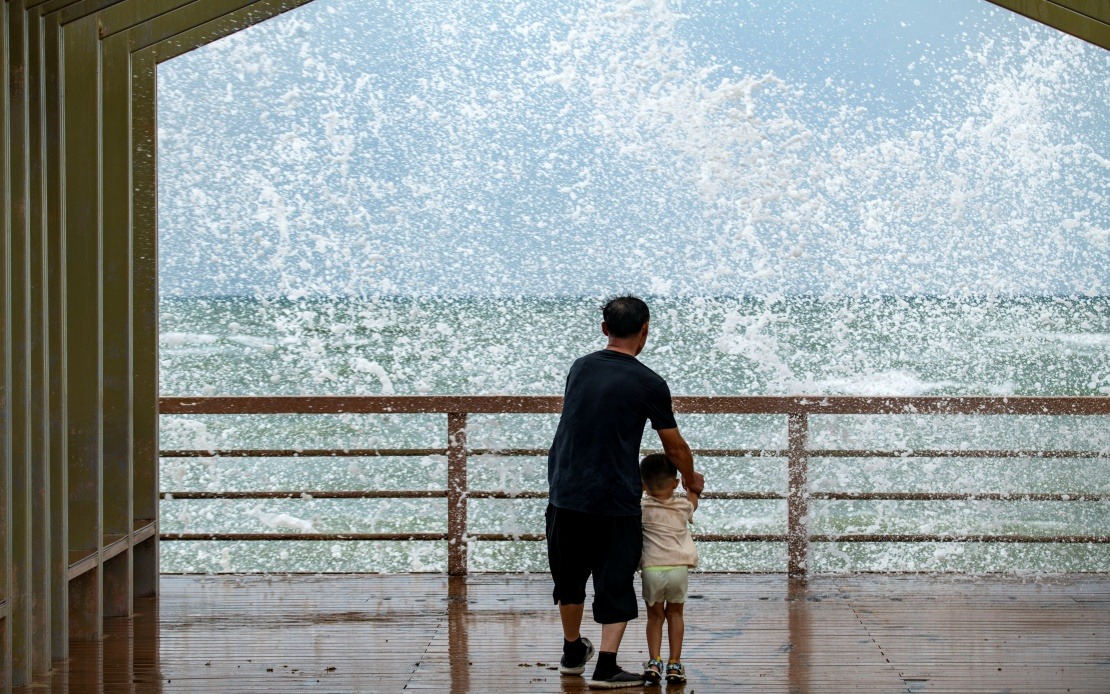
Typhoon Maysak slammed into Hainan Province on Friday evening as the tenth cyclone of 2020, bringing widespread disruption to transportation networks and prompting authorities to close schools across affected regions. The storm made landfall at approximately 6.20 pm local time near Yelin Township in Lingshui Li Autonomous County, with peak winds near its centre measured at 23 metres per second according to the Hainan provincial meteorological bureau.
The impact on Hainan's transport infrastructure was immediate and comprehensive. All train services operating to and from the island province were brought to a complete halt, with suspensions scheduled to remain in effect through both Friday and Saturday as the storm system moved through the region. This represents a significant disruption to the primary rail link connecting Hainan to mainland China, affecting both passenger and freight movements at a critical juncture for summer travel.
Air traffic into and out of the province ground to a standstill as Sanya Phoenix International Airport, one of the island's major aviation hubs, halted all flight operations beginning at 5 pm on Friday. The airport closure effectively isolated the southern tourism destination from regional air connections, stranding travellers and disrupting business operations that depend on regular connectivity to other parts of China and the broader Asia-Pacific region.
Maritime transport faced equally severe constraints, with ferry services across the Qiongzhou Strait—the vital waterway separating Hainan from Guangdong Province—suspended from 2 am on Friday. These ferries, which handle both passenger and vehicle traffic, are crucial for supply chains and population movement between the island and the mainland. Authorities anticipated the closure could persist for one to two days, contingent on whether weather conditions improved sufficiently to allow safe passage.
Beyond transport, the typhoon prompted the closure of educational institutions in vulnerable areas. Schools and child-care facilities throughout Sanya and Ledong Li Autonomous County were shuttered to protect students and staff from the severe weather, adding to the broader social and economic disruption caused by the storm system.
Meteorological forecasts indicated that Maysak would continue its path northwestward across Hainan, tracking through the municipalities of Baoting and Danzhou, as well as the autonomous counties of Wuzhishan and Baisha, before eventually entering the Beibu Gulf. This projected trajectory meant the storm would traverse significant population centres and infrastructure corridors, potentially extending damage and service disruptions beyond the initial landfall zone.
For Malaysian and Southeast Asian readers, the passage of Typhoon Maysak underscores the seasonal vulnerability of southern China to tropical cyclones and the critical importance of robust disaster preparedness in a region increasingly integrated through trade, tourism, and people-to-people connections. The rapid suspension of multiple transport modes demonstrates how quickly major weather events can cascade through interconnected regional supply chains and travel networks that many Southeast Asian businesses and individuals depend upon.
The storm's impact on Hainan holds particular relevance for Malaysia given the province's role as a major tourism and logistics hub within China. The suspension of ferry services across the Qiongzhou Strait, for instance, can affect goods and passengers transiting through mainland China bound for Southeast Asia, potentially creating bottlenecks that ripple through regional commerce. Similarly, disruptions to Sanya Phoenix International Airport—a key hub for tropical tourism—can influence visitor flows and aviation capacity across Southeast Asian destinations as travellers reroute or postpone journeys.
These weather-related disruptions also highlight the broader climate challenges facing the region. Southeast Asia itself faces increasing typhoon activity and weather volatility, and observing how Chinese authorities manage such events provides instructive lessons for the region's own preparedness and infrastructure resilience planning. The speed and scale of Hainan's response—closing entire transport networks preemptively—reflects a cautionary approach that many Southeast Asian countries are adopting as extreme weather events become more frequent and severe.
As Maysak continued its course through Hainan, the cascading effects of the shutdown became apparent. Every suspended flight, halted train, and closed ferry service represented disrupted business plans, delayed shipments, and stranded passengers. For the regional business community with interests in mainland China, such disruptions underscored the importance of supply chain diversification and contingency planning in an era of increasing climatic unpredictability.

