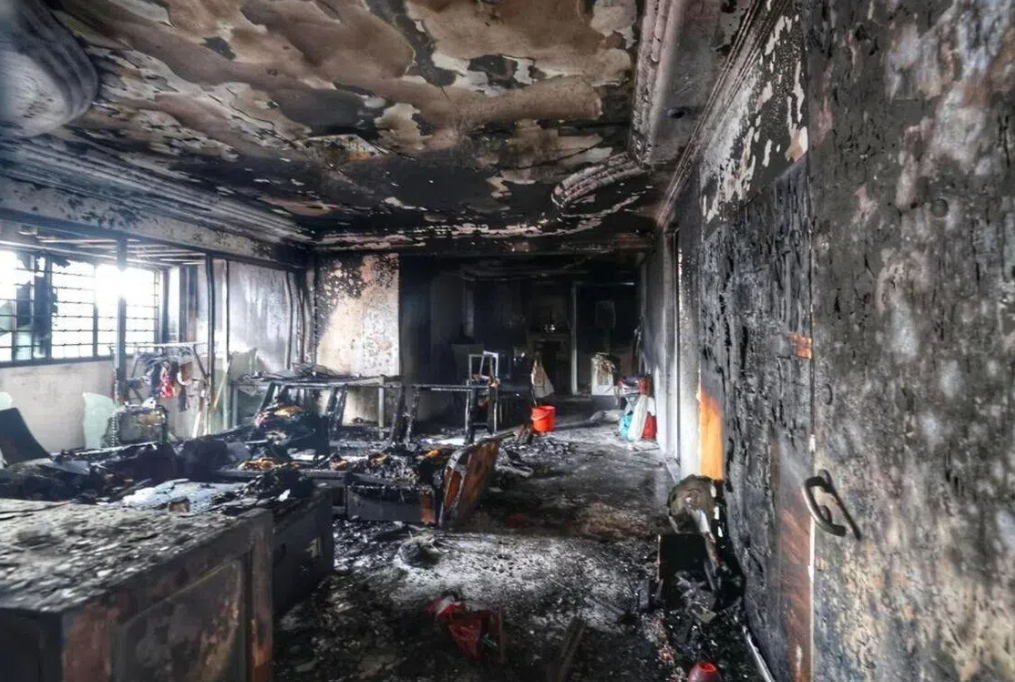
A domestic fire in Singapore's Jurong West during the early morning hours of June 17 prompted a swift emergency response that saw two residents rescued from a high-rise public housing unit, with dozens more evacuated as a precautionary measure. The Singapore Civil Defence Force received the alarm at approximately 3.35am after flames engulfed the living room of a unit on the 13th floor of Block 842 Jurong West Street 81. The rapid deployment of firefighting personnel proved crucial in containing and extinguishing the blaze using a water jet, preventing what could have been a far more serious incident in the densely populated residential block.
Preliminary investigations by the SCDF have centred on an electrical origin for the fire, with the living room identified as the point of ignition. The unit's interior suffered extensive damage, with walls and ceilings charred black and windows blown out from the heat and pressure of the flames, according to observations made by reporters from Lianhe Zaobao who visited the scene later that morning. A family of four from the affected unit, including those requiring rescue, was transported to Singapore General Hospital for treatment. Additionally, approximately 40 residents from neighbouring units were evacuated as a precaution, though no further injuries were reported among the wider building population.
The dramatic circumstances of the rescue came to light through interviews with residents conducted by local media. An 18-year-old neighbour occupying the unit directly above the burning flat played an instrumental role in alerting his family and authorities to the unfolding emergency. The student, who had been awake and gaming at the time, detected smoke wafting from the windows of the unit beneath his and decided to investigate further. Upon touching the door of the affected unit and discovering it was extremely hot, he realised the severity of the situation and began forcefully knocking on neighbours' doors to warn them of the danger.
The teenager's quick thinking and decisive action likely prevented casualties among residents who might otherwise have remained unaware of the escalating emergency. He rushed back to his own home to alert his family to evacuate immediately, after which his mother contacted emergency services. The student's account of events revealed the physical toll the fire had taken on those trapped inside: he observed one young woman from the affected unit coming to his door to request towels, her hair singed and face darkened with soot, and noted another person, apparently a male resident, with bright red burns covering his back and arms. These observations underscored how quickly and intensely the flames had spread through the living space.
The incident also illustrated the cascading awareness that develops through a residential community during such crises. A 12th-floor resident reported witnessing at least five fire engines positioned around the base of the block, a sight that conveyed the scale of the emergency response mobilised by the SCDF. This multi-unit presence reflects standard protocols for high-rise residential fires in densely populated Singapore, where the risk of rapid vertical flame spread and smoke propagation necessitates a robust and coordinated emergency deployment.
Following the incident, the SCDF has reiterated public safety guidance aimed at reducing the incidence of electrical fires in residential settings, a category of fire that remains a persistent concern across Singapore's housing stock. Residents are advised to refrain from overloading electrical outlets, a common practice that can lead to circuit overload and ignition. Equally important is the habit of switching off appliances when they are not in active use, a simple measure that can substantially reduce fire risk. The agency has stressed the importance of using only electrical devices and plugs certified with the Safety Mark, a credential awarded by Singapore's Consumer Product Safety Office and indicating compliance with established safety standards.
The SCDF has also highlighted the dangers associated with unattended charging of batteries and electronic devices, particularly overnight or during extended periods when no one is present to monitor them. This guidance has taken on added relevance given the proliferation of rechargeable devices in modern homes, from smartphones and laptops to cordless tools and portable power banks. Thermal runaway and battery degradation remain significant hazards when devices are left charging unsupervised, especially in confined spaces where heat cannot dissipate adequately.
The broader context for this incident emerges from the latest statistics released by the SCDF in February, which painted a concerning picture of fire trends across Singapore. The total number of fires recorded in 2025 reached 2,050, representing a three per cent increase from the 1,990 fires documented in 2024. More significantly, residential buildings accounted for roughly half of all fires during this period, with 1,051 incidents occurring in homes and apartment blocks. This data underscores that domestic fires remain a substantial public safety challenge in Singapore, despite decades of fire prevention campaigns and building code improvements.
The Jurong West fire exemplifies how quickly danger can materialise in high-density residential environments where numerous families live in close proximity within a single structure. The architectural characteristics of public housing blocks, while designed with fire safety features including compartmentalisation and sprinkler systems, cannot entirely eliminate the risk posed by electrical faults originating within individual units. The incident serves as a reminder that personal responsibility for electrical safety—through proper equipment selection, mindful usage patterns, and regular maintenance—constitutes the first line of defence against domestic fire emergencies.
For readers across Southeast Asia, particularly in Malaysia where rapid urbanisation has led to similar increases in high-rise residential living, the Singapore incident offers instructive lessons. As more families relocate to apartment blocks and condominiums, the shared responsibility model of fire safety becomes increasingly critical. Residents must remain vigilant about electrical safety within their own units while remaining alert to signs of danger originating from neighbouring homes. The willingness of the young neighbour to investigate unusual signs and take immediate action arguably prevented a tragedy that could have claimed lives. This human element of fire safety—awareness, prompt response, and community solidarity—may ultimately prove as important as any regulatory framework or technological safeguard.

%22%2F%3E%3C%2Fpattern%3E%3C%2Fdefs%3E%3Crect%20width%3D%22100%25%22%20height%3D%22100%25%22%20fill%3D%22url(%23ph21o2sg)%22%2F%3E%3Crect%20width%3D%22100%25%22%20height%3D%22100%25%22%20fill%3D%22url(%23ph21o2sp)%22%2F%3E%3Ctext%20x%3D%2250%25%22%20y%3D%2250%25%22%20text-anchor%3D%22middle%22%20dominant-baseline%3D%22central%22%20fill%3D%22rgba(255%2C255%2C255%2C0.95)%22%20font-family%3D%22Georgia%2C%20'Times%20New%20Roman'%2C%20serif%22%20font-weight%3D%22700%22%20font-size%3D%22170%22%20letter-spacing%3D%22-0.02em%22%3EGabungan%3C%2Ftext%3E%3C%2Fsvg%3E)