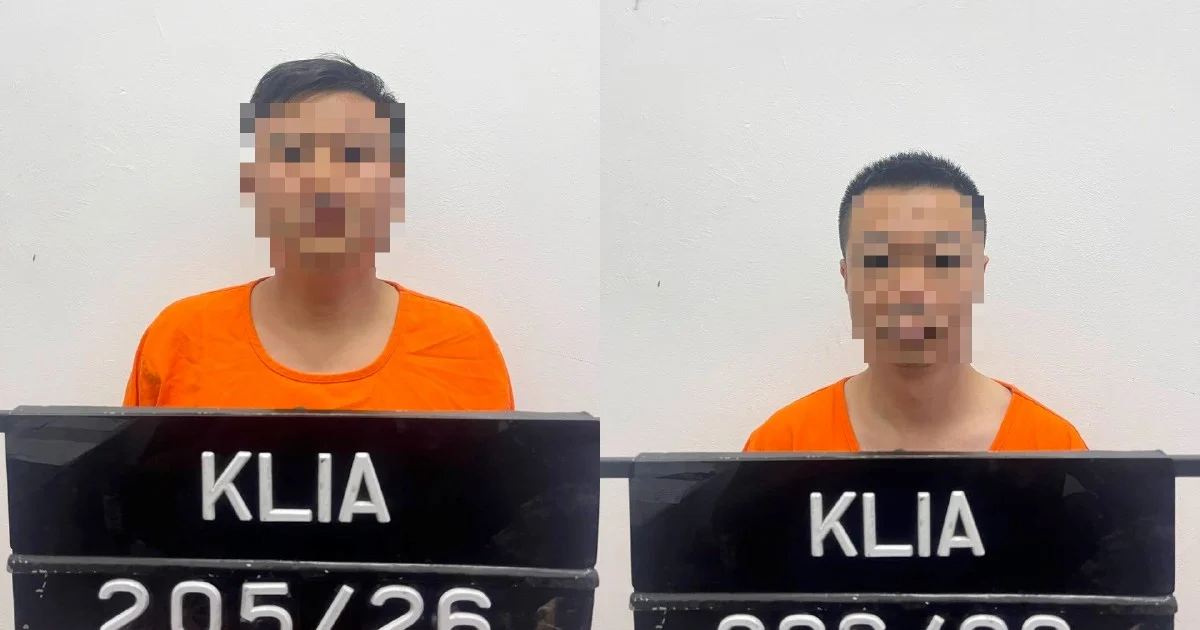
Two men from China have been remanded in custody for four days as police pursue investigations into what authorities allege was an attempted theft during a flight bound for Kuala Lumpur International Airport. The suspected incident occurred aboard an aircraft travelling from Dili in Timor-Leste, and the remand order was issued at Sepang, the jurisdiction covering KLIA and its surroundings.
Aircraft thefts and theft attempts represent an increasingly serious concern for aviation authorities across Southeast Asia, where busy international routes and passenger traffic create both opportunity and vulnerability. The incident highlights the challenges faced by flight crews and security personnel in managing passenger conduct at 35,000 feet, where interventions must be carefully calibrated to ensure safety while protecting passengers and crew. Mid-air confrontations carry heightened risks precisely because the confined environment and altitude limit response options that would be available in terrestrial settings.
The timing of this alleged incident underscores why Malaysia's aviation security protocols continue to evolve. KLIA, as one of the region's primary international hubs, processes hundreds of thousands of passengers monthly across numerous routes linking Southeast Asia with China, Europe, the Middle East, and beyond. The airport's significance as a transit point means that security breaches or criminal activity aboard inbound flights immediately trigger multi-agency responses involving customs, immigration, police, and airport authorities.
Though sparse details have been released about the alleged theft itself—including what items may have been targeted or whether any property was actually taken—the seriousness with which authorities are treating the matter is evident from the four-day remand extension. This timeframe permits investigators to conduct interviews, gather evidence from flight records and passenger statements, and coordinate with relevant international partners if needed. China and Malaysia maintain regular law enforcement cooperation, which may facilitate information sharing regarding the suspects' backgrounds and any potential connections to organized crime.
For ordinary travellers, such incidents are reminders of the security infrastructure operating invisibly around them. Airlines operating regional routes typically employ cabin crew trained in conflict de-escalation and security protocols, with procedures designed to manage unruly passengers while preserving the safety of everyone aboard. The Dili-Kuala Lumpur corridor, served by several carriers including Malaysia Airlines and low-cost operators, represents a significant travel link between Malaysia and Timor-Leste, a nation with which Malaysia has strengthened economic and diplomatic ties in recent years.
The location of the alleged incident—Timor-Leste being the point of origin—is also noteworthy given the country's position in Southeast Asia's maritime and transport networks. Dili's Presidente Nicolau Lobato International Airport functions as the primary gateway to Timor-Leste, connecting it with regional hubs like Kuala Lumpur, Singapore, and Darwin. The route attracts business travellers, officials, and tourists, making it crucial that security standards remain robust and that any credible threats are investigated thoroughly.
Investigators will likely focus on establishing whether the alleged theft was opportunistic or premeditated, whether the two suspects acted alone or as part of a larger network, and what specific circumstances preceded the alleged incident. Flight attendant testimonies will be critical, as will passenger statements and any security footage captured by the aircraft's internal monitoring systems. Airlines increasingly deploy such systems precisely to document incidents and provide objective evidence that can support both criminal investigations and civil liability determinations.
The remand decision reflects Malaysian police's confidence in the sufficiency of preliminary evidence to justify holding the suspects for further questioning and investigation. The four-day period allows authorities to explore various investigative leads: reviewing the suspects' travel histories, checking for prior criminal records, examining their communications, and determining whether similar incidents may have occurred on previous flights. Cross-border cooperation may also be initiated to establish whether either suspect has involvement in transnational theft rings.
For Malaysia's tourism and aviation sectors, the incident represents a minor blip in an otherwise secure operational environment. Nevertheless, it underscores why passenger safety and security remain paramount concerns for all airlines and airports. The swift police response and remand order signal to would-be offenders that attempted crimes aboard Malaysian-bound flights will be pursued vigorously, regardless of the perpetrators' nationality.
The investigation's outcome will likely be determined within weeks as police complete their inquiries and determine whether sufficient evidence exists to prefer charges. If prosecuted, the suspects would face Malaysian criminal law, which carries serious penalties for theft and related offences. The case will also likely prompt review discussions among KLIA's operators and participating airlines regarding any procedural enhancements that might further deter or prevent such incidents.

%22%2F%3E%3C%2Fpattern%3E%3C%2Fdefs%3E%3Crect%20width%3D%22100%25%22%20height%3D%22100%25%22%20fill%3D%22url(%23ph21o2sg)%22%2F%3E%3Crect%20width%3D%22100%25%22%20height%3D%22100%25%22%20fill%3D%22url(%23ph21o2sp)%22%2F%3E%3Ctext%20x%3D%2250%25%22%20y%3D%2250%25%22%20text-anchor%3D%22middle%22%20dominant-baseline%3D%22central%22%20fill%3D%22rgba(255%2C255%2C255%2C0.95)%22%20font-family%3D%22Georgia%2C%20'Times%20New%20Roman'%2C%20serif%22%20font-weight%3D%22700%22%20font-size%3D%22170%22%20letter-spacing%3D%22-0.02em%22%3EGabungan%3C%2Ftext%3E%3C%2Fsvg%3E)