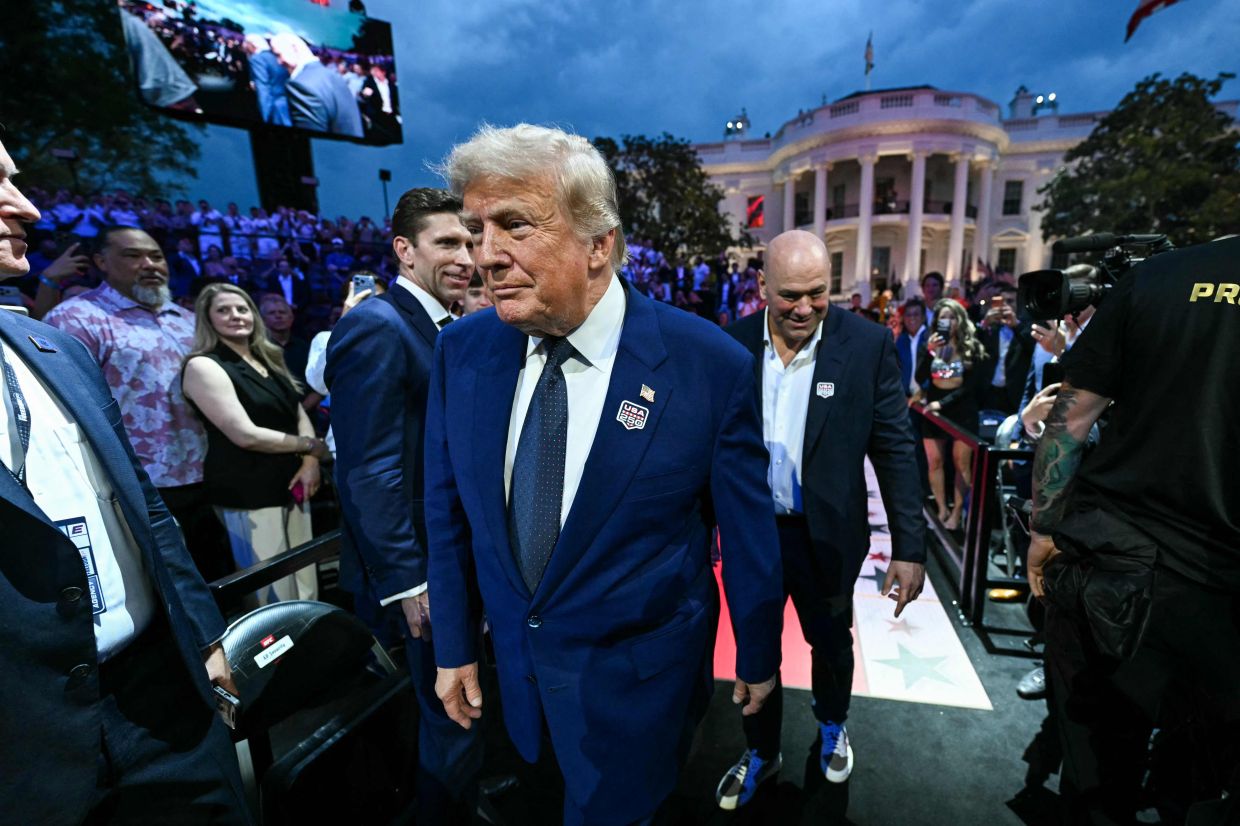
Donald Trump marked his 80th birthday with an unconventional celebration on Sunday evening, bringing the Ultimate Fighting Championship to the South Lawn of the White House in what stands as an unprecedented use of the presidential residence for a sporting spectacle. The event, which drew top business leaders and entertained military personnel worldwide, signals how the Trump administration intends to leverage popular entertainment and celebrity culture as central components of its early governance strategy.
The UFC card, organised by TKO Group Holdings Inc., commenced just before 8:30pm following a brief weather delay caused by lightning and thunder across Washington, DC. Trump and UFC President Dana White walked through the executive mansion to reach the arena, setting the tone for what would become one of the most heavily discussed White House events in recent memory. The nearly 100-foot-tall structure, referred to as the "Claw," towered over the South Lawn with its distinctive design and housed 4,300 seats for the main arena, while an additional 120,000 spectators gathered on the nearby Ellipse with complimentary lottery-distributed tickets.
The guest list reflected Trump's existing coalition of technology entrepreneurs, military figures, and media personalities who have aligned with his administration. Mark Zuckerberg, CEO of Meta Platforms Inc., and David Ellison, head of Paramount Skydance Corp., attended alongside Treasury Secretary Scott Bessent and various Trump family members. Podcast host Joe Rogan, whose audience skews young and male—a key demographic in Trump's 2024 election victory—provided live commentary throughout the matches. The broadcast notably included shots of watch parties at military installations globally, including one in Okinawa, Japan, emphasising the event's symbolic reach beyond American shores.
The staging drew heavily on ceremonial and patriotic symbolism befitting the administration's broader narrative around celebrating America's 250th anniversary. Medal of Honor recipients and first responders escorted fighters into the arena, while military servicemembers filled the audience. The pre-event press conference, held at the Lincoln Memorial, situated the occasion within America's historical consciousness. Michael Chandler, one of the featured fighters, framed his participation in explicitly patriotic terms, promising to showcase "the best version" of himself "on the White House lawn for America's 250th birthday."
Financially, the undertaking represented a substantial investment. The UFC reported spending over US$60 million to stage the event, with the company assuming all costs while the White House maintained that more than seven federal agencies allocated significant resources and manpower to facilitate the spectacle. Sponsorship partnerships included Crypto.com and Dodge's Ram truck brand, demonstrating how the event functioned as a commercial platform for companies seeking alignment with Trump's political brand. The Trump family venture World Liberty Financial contributed an additional US$250,000 bonus for the top two fighters, further intertwining personal business interests with presidential activities.
Though positioned as entertainment, the event generated substantial legal and political opposition. The Public Integrity Project filed a lawsuit characterising the White House fights as a "volcano of corruption," arguing that the scale of federal resources deployed and the commercial nature of the spectacle constituted improper use of government infrastructure. The case proved unsuccessful in stopping the event, but public opinion data suggested considerable reservation among ordinary Americans. A YouGov poll released on June 5 indicated 51% of respondents disapproved of the White House fights, with only 27% expressing approval.
The selection of the UFC as a vehicle for presidential celebration reflects deliberate alignment between Trump's political interests and the sport's demographic composition. The UFC's young, male audience proved instrumental to Trump's 2024 election victory, and his administration has reciprocated with institutional support. The State Department and Federal Bureau of Investigation have both signed partnership deals with the organisation, demonstrating governmental embrace of the enterprise. Dana White, a longtime Trump ally and UFC president, has made clear his personal enjoyment of the sport and framed the White House event as Trump's own conceptual initiative.
The choice of venues for preparatory activities underscored how the administration intended to connect contemporary entertainment spectacle with historical American sites. Beyond the Lincoln Memorial press conference, locker rooms were established on White House grounds, including within the Indian Treaty Room, a space ordinarily reserved for formal diplomatic and governmental functions. This repurposing of spaces traditionally associated with serious state business to accommodate entertainment infrastructure represented a symbolic inversion of conventional White House protocols that previous administrations had maintained.
The scale of the structure itself prompted discussion about permanence and future uses of the presidential grounds. Trump suggested in a June 2 TikTok video that the nearly 100-foot-tall Claw, which he compared in grandeur to the Eiffel Tower, might remain in place permanently. However, court filings subsequently indicated the structure would be disassembled beginning at 10am Monday. Trump himself characterised the permanence suggestion as humorous, though the comment nonetheless illustrated how the event reflected broader questions about redefining the symbolic role of presidential spaces.
The timing positioned the event as a prelude to Trump's departure for France to attend a Group of Seven leaders' meeting, with the UFC reportedly providing him a championship belt to transport. This sequencing—a domestic celebration of entertainment and commercial partnership followed by international diplomatic engagement—encapsulates how the administration appears positioned to blend entertainment culture with traditional statecraft, a significant departure from predecessors' demarcation between these spheres. The event thus extends beyond birthday celebration or sporting spectacle, functioning as a statement about how contemporary presidential power intends to operate at the intersection of entertainment, commercial partnerships, and political symbolism.
%22%2F%3E%3C%2Fpattern%3E%3C%2Fdefs%3E%3Crect%20width%3D%22100%25%22%20height%3D%22100%25%22%20fill%3D%22url(%23ph21o2sg)%22%2F%3E%3Crect%20width%3D%22100%25%22%20height%3D%22100%25%22%20fill%3D%22url(%23ph21o2sp)%22%2F%3E%3Ctext%20x%3D%2250%25%22%20y%3D%2250%25%22%20text-anchor%3D%22middle%22%20dominant-baseline%3D%22central%22%20fill%3D%22rgba(255%2C255%2C255%2C0.95)%22%20font-family%3D%22Georgia%2C%20'Times%20New%20Roman'%2C%20serif%22%20font-weight%3D%22700%22%20font-size%3D%22170%22%20letter-spacing%3D%22-0.02em%22%3EGabungan%3C%2Ftext%3E%3C%2Fsvg%3E)