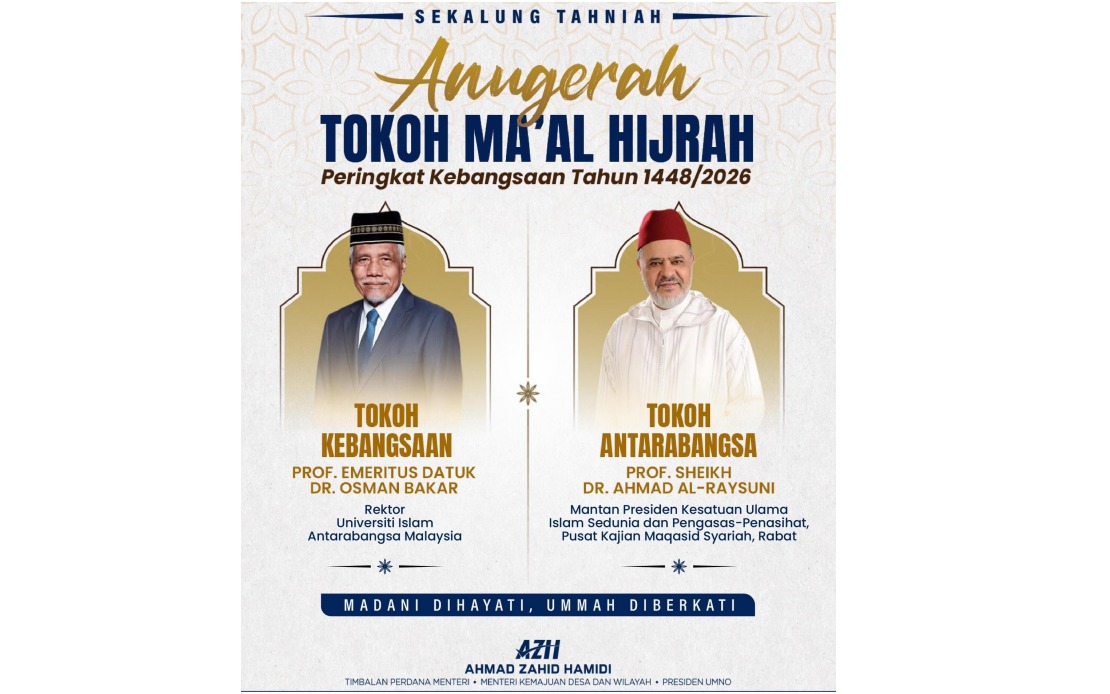
Malaysia's Deputy Prime Minister Datuk Seri Dr Ahmad Zahid Hamidi has urged the nation's Muslim population to take inspiration from this year's Tokoh Maal Hijrah award recipients, emphasising that their recognition should galvanise broader commitment to knowledge-seeking, community welfare and the advancement of Islamic civilization. Speaking at the national-level Maal Hijrah celebration held at Masjid Putra in Putrajaya, Ahmad Zahid highlighted how the honoured recipients exemplify the values that should define contemporary Muslim engagement with society.
The National Tokoh Maal Hijrah Award was conferred upon Prof Emeritus Datuk Dr Osman Bakar, whilst Prof Sheikh Dr Ahmad Al-Raysuni of Morocco received the International recognition. Both awards were formally presented by the Sultan of Perak, Sultan Nazrin Shah, who also distributed cash prizes alongside trophies and certificates of appreciation to the awardees. The selection of these two scholars underscores Malaysia's continued emphasis on honouring intellectual and spiritual leadership within the Islamic world.
Ahmad Zahid's statement reflected deeper themes about what these awards represent beyond mere ceremonial recognition. He contended that the accomplishments of Osman and Al-Raysuni — encompassing their work in community empowerment, elevation of scholarly standards, and dissemination of Islamic values centred on compassion and wisdom — should catalyse similar aspirations among Malaysia's broader Muslim population. The Deputy Prime Minister positioned the awards not as celebrations of individual achievement alone, but as benchmarks for collective Muslim endeavour.
The concept of Maal Hijrah itself carries profound significance in Islamic history and contemporary Muslim thought. Grounded in Prophet Muhammad's migration from Mecca to Medina, the tradition transcends simple historical commemoration. For Ahmad Zahid and fellow government leaders, it represents an enduring framework through which Muslims should evaluate their commitments to positive transformation. The annual awards programme thus functions as an institutional mechanism for connecting historical Islamic principles with modern nation-building imperatives.
Fellow Deputy Prime Minister Datuk Seri Fadillah Yusof amplified these themes in his own statement, broadening the relevance beyond Muslim-specific audiences to encompass all Malaysians. Fadillah stressed that the recognition accorded to the awardees should motivate citizens across religious communities to persist in serving and advancing the nation's collective interests. This framing reflects Malaysia's constitutional framework, which recognises Islam's special position whilst acknowledging the multiethnic, multireligious character of the federation.
Fadillah's interpretation of Maal Hijrah emphasised the migration narrative's lessons about sacrifice, communal cohesion, perseverance and purposeful change. Rather than treating Hijrah as a remote historical event confined to Islamic studies curricula, he positioned it as an active guide for contemporary nation-building. This reading resonates particularly within Malaysian political discourse, where appeals to unity and shared developmental goals frequently invoke historical and religious precedent to legitimate present-day policy directions.
The selection of international recipient Al-Raysuni, an expert in Islamic jurisprudence from Morocco, signals Malaysia's aspiration to position itself as a central node within transnational Islamic intellectual networks. By honouring a non-Malaysian scholar of considerable standing, the awards programme demonstrates engagement with the broader Muslim world whilst simultaneously asserting Malaysia's capacity to identify and celebrate excellence in Islamic thought and practice. This approach reinforces Malaysia's self-conception as a moderate, knowledge-oriented Muslim nation.
For Malaysian readers, the awards carry implications extending beyond ceremonial significance. They highlight ongoing governmental investment in recognising scholarly and community-oriented contributions to Islamic life. In an era when debates over Islam's role in Malaysian society often become polarised, the awards programme offers space for celebrating intellectual rigour, ethical conduct and service-oriented leadership as central to Islamic identity. The emphasis on knowledge-seeking aligns with broader national development narratives that position education and expertise as foundational to progress.
The timing and venue of the ceremony — at Masjid Putra during formal national observances — underscore official commitment to integrating Islamic observance with state institutions and structures. The Sultan's personal role in conferring awards adds monarchical endorsement to the selected recipients' contributions, embedding recognition within Malaysia's constitutional framework where rulers hold significant ceremonial and symbolic authority over Islamic affairs in their respective states.
Ahmad Zahid's call for Muslims to continue contributing to ummah development and national advancement reflects broader governmental framing of Islamic identity as fundamentally compatible with, and indeed essential to, the Malaysian nation-building project. Rather than presenting religious commitment and civic participation as competing claims on identity, the Deputy Prime Minister positioned them as mutually reinforcing. This rhetorical move carries particular significance in Malaysian politics, where managing relationships between Islamic institutions, Muslim majority populations and the secular constitutional order remains an ongoing negotiation.
The awards themselves represent one mechanism through which Malaysian authorities attempt to shape contemporary Islamic discourse by elevating particular models of scholarship and service. By selecting figures associated with intellectual sophistication, ethical conduct and communal welfare, the government effectively endorses a vision of Islamic engagement that prioritises knowledge production, measured interpretation and developmental contribution. This stands in contrast to other possible models that might emphasise activism, doctrinal purity or oppositional consciousness.
For the broader Southeast Asian context, Malaysia's Tokoh Maal Hijrah programme sits within a wider landscape of how Muslim-majority nations construct institutional frameworks recognising Islamic excellence. The programme's international dimension, reflected in Al-Raysuni's inclusion, suggests Malaysia's efforts to participate in and shape transnational conversations about Islamic scholarship and practice. Such participation carries implications for Malaysia's regional standing and its influence within Islamic intellectual circles extending beyond national boundaries.

%22%2F%3E%3C%2Fpattern%3E%3C%2Fdefs%3E%3Crect%20width%3D%22100%25%22%20height%3D%22100%25%22%20fill%3D%22url(%23ph21o2sg)%22%2F%3E%3Crect%20width%3D%22100%25%22%20height%3D%22100%25%22%20fill%3D%22url(%23ph21o2sp)%22%2F%3E%3Ctext%20x%3D%2250%25%22%20y%3D%2250%25%22%20text-anchor%3D%22middle%22%20dominant-baseline%3D%22central%22%20fill%3D%22rgba(255%2C255%2C255%2C0.95)%22%20font-family%3D%22Georgia%2C%20'Times%20New%20Roman'%2C%20serif%22%20font-weight%3D%22700%22%20font-size%3D%22170%22%20letter-spacing%3D%22-0.02em%22%3EGabungan%3C%2Ftext%3E%3C%2Fsvg%3E)