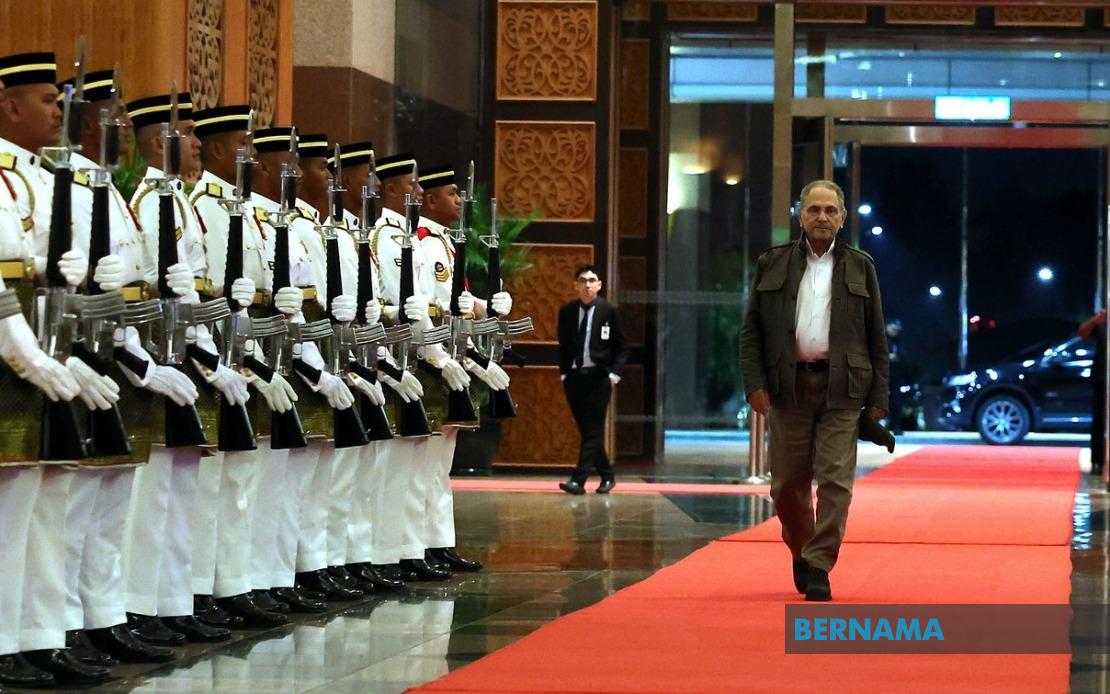
Timor-Leste President Jose Ramos-Horta departed Malaysia early on June 17 following a five-day special visit designed to deepen bilateral relations and advance regional cooperation. The Nobel Peace Prize laureate boarded a Batik Air flight at Kuala Lumpur International Airport Terminal 1 at 2.15 am, concluding what officials on both sides described as a productive engagement between the two Southeast Asian neighbours. His departure was marked by a formal Guard of Honour ceremony at the airport's Bunga Raya Complex, underlining the diplomatic significance attached to the visit at government level.
During his time in Malaysia, Ramos-Horta articulated a notably warm assessment of the relationship between Dili and Kuala Lumpur, characterizing bilateral ties as "exceptionally good" during a dialogue session titled "A Changing World, Enduring Values" held on June 15. His public remarks went beyond conventional diplomatic pleasantries, specifically commending Malaysia's demonstrated achievements across security, democratic governance, and economic development—areas where Timor-Leste, as a younger nation still consolidating its institutions, has much to learn. This framing positions Malaysia not merely as a peer but as a model of successful regional integration and state-building that Timor-Leste aspires to emulate.
A central theme of Ramos-Horta's engagement was recognition of Malaysia's historical role in supporting Timor-Leste's trajectory toward statehood and sovereignty. The President specifically acknowledged Malaysia's backing during the critical 1999 peacekeeping period, when international intervention was essential following the violence that accompanied Timor-Leste's break from Indonesian rule. More recently, he credited Malaysia with instrumental support for Timor-Leste's application for full ASEAN membership, a goal achieved when the country formally became the bloc's 11th member on October 26, 2025. This acknowledgment reflects the strategic importance both nations attach to Timor-Leste's integration into regional institutions as a stabilizing force in Southeast Asia.
Looking ahead, Ramos-Horta expressed confidence in Timor-Leste's capacity to host ASEAN's annual summit in 2029, signaling that infrastructure development and institutional readiness are proceeding according to plan. The hosting of this high-profile regional gathering would represent a significant demonstration of Timor-Leste's maturation as a functional member of the regional club, with implications for how other Southeast Asian nations perceive its political and administrative capabilities. The compressed timeline for preparation underscores the government's determination to showcase progress to ASEAN peers and the international community.
Economic cooperation emerged as a priority area during high-level discussions, with Ramos-Horta directly appealing to Malaysian business interests to consider investment opportunities in Timor-Leste's infrastructure sector. His pitch emphasizes distinctive advantages: the nation maintains comparatively low sovereign debt levels, possesses a substantial sovereign wealth fund derived from petroleum revenues, and benefits from support from multilateral development institutions. For Malaysian investors accustomed to mature ASEAN markets, Timor-Leste represents frontier opportunities with relatively lower competition and government encouragement for foreign capital participation in large-scale projects.
Prime Minister Datuk Seri Anwar Ibrahim hosted a formal luncheon at Seri Perdana in honour of Ramos-Horta, where both leaders explored avenues for expanded cooperation across multiple sectors. Trade, investment, human capital development, education, and technical training were identified as domains where Malaysia and Timor-Leste can deepen their engagement. These discussions reflect a holistic approach to bilateral relations that extends beyond transactional commerce to encompass capacity-building and institutional knowledge transfer—areas where Malaysia's relative advancement offers concrete value to its partner.
Current trade figures reveal an asymmetrical but developing commercial relationship. In 2024, bilateral trade reached USD18.72 million (RM85.68 million), with Malaysian exports of USD18.37 million (RM84.06 million) substantially outweighing imports from Timor-Leste, which totalled merely USD0.35 million (RM1.62 million). This imbalance suggests limited manufacturing or export capacity in Timor-Leste, reflecting the early stage of its economic development. However, the figures also indicate untapped potential—trade volumes remain minuscule compared to Malaysia's commercial relationships with other ASEAN neighbours, suggesting significant room for growth as Timor-Leste's economy expands and diversifies beyond petroleum extraction.
The visit carries broader implications for Southeast Asian regionalism. Timor-Leste's full integration into ASEAN represents the near-completion of the bloc's expansion across the maritime and mainland regions of Southeast Asia. Malaysia's role in facilitating this process, particularly during its ASEAN chairmanship, reinforces Kuala Lumpur's position as a respected advocate for inclusive regional architecture. For Timor-Leste, securing partnership commitments from established economies like Malaysia provides essential ballast as the country navigates the transition from conflict-affected state to functioning regional member.
The high-level nature of the visit—featuring multiple formal engagements with the Prime Minister and prominent dialogue forums—signals that Malaysia regards Timor-Leste as more than a peripheral concern. Rather, it reflects recognition that Timor-Leste's stability and successful economic development serve Malaysia's strategic interests by preventing power vacuums in the eastern reaches of ASEAN and sustaining a stable regional order. This perspective aligns with Malaysia's broader investment in regional stability, a principle that has guided its foreign policy approach to Southeast Asian affairs for decades.

%22%2F%3E%3C%2Fpattern%3E%3C%2Fdefs%3E%3Crect%20width%3D%22100%25%22%20height%3D%22100%25%22%20fill%3D%22url(%23ph21o2sg)%22%2F%3E%3Crect%20width%3D%22100%25%22%20height%3D%22100%25%22%20fill%3D%22url(%23ph21o2sp)%22%2F%3E%3Ctext%20x%3D%2250%25%22%20y%3D%2250%25%22%20text-anchor%3D%22middle%22%20dominant-baseline%3D%22central%22%20fill%3D%22rgba(255%2C255%2C255%2C0.95)%22%20font-family%3D%22Georgia%2C%20'Times%20New%20Roman'%2C%20serif%22%20font-weight%3D%22700%22%20font-size%3D%22170%22%20letter-spacing%3D%22-0.02em%22%3EGabungan%3C%2Ftext%3E%3C%2Fsvg%3E)