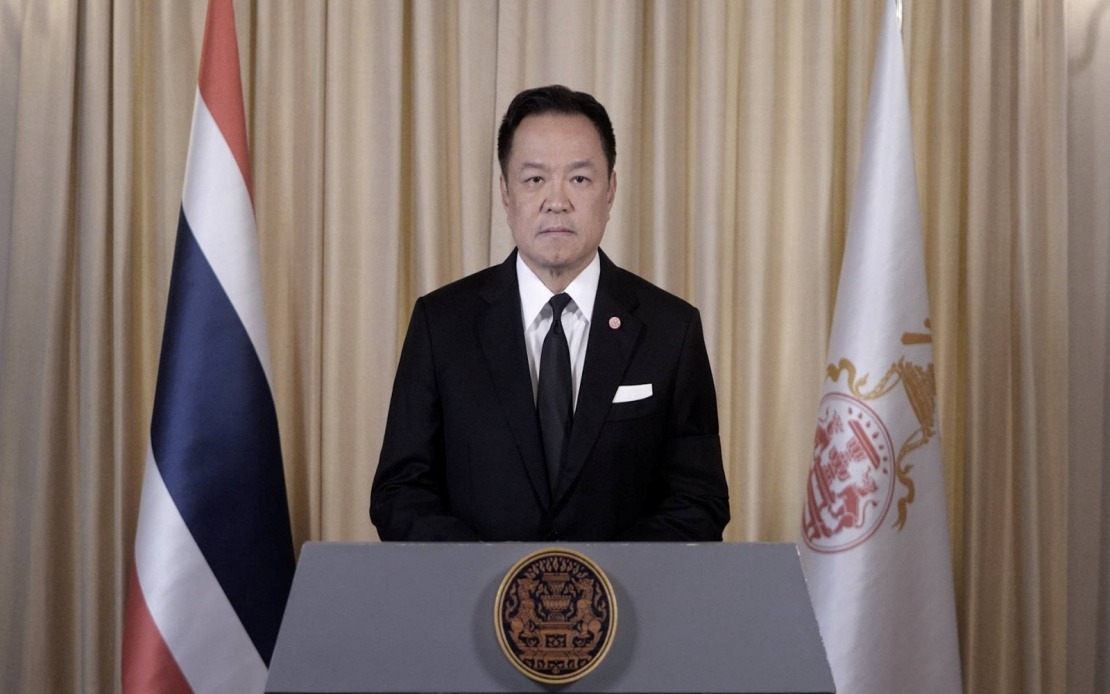
Thailand stands ready to absorb the fallout from ongoing geopolitical turbulence, according to Prime Minister Anutin Charnvirakul, who on Monday signalled strong optimism that reports of a breakthrough between Washington and Tehran could unlock broader economic benefits for the kingdom and the wider region. Speaking from Government House in Bangkok, Anutin characterised any resolution to tensions in West Asia as a watershed moment that would help defuse multiple interconnected crises and bolster the fragile stability underpinning global markets.
The Thai leader's upbeat assessment followed an announcement from US President Donald Trump on Sunday confirming that a final agreement with Iran had been struck. Trump indicated he would authorise the reopening of the Strait of Hormuz, one of the world's most critical maritime chokepoints, and lift a US naval blockade that has severely constrained Iranian commerce and oil exports. These moves, if implemented, would represent a dramatic reversal of the confrontational posture that has defined US-Iran relations for decades and would immediately reshape energy markets worldwide.
For a trade-dependent nation like Thailand, which operates in an intricate web of global supply chains, such geopolitical de-escalation carries tangible implications. Anutin stressed that Bangkok has already demonstrated considerable adaptability in navigating disruptions to international logistics networks and that the government's approach rests on sophisticated long-term strategic planning rather than improvised reactions to daily developments. This measured philosophy suggests Thai policymakers view the current environment not as a crisis requiring emergency measures but as a manageable challenge within their existing framework.
Deputy Prime Minister and Finance Minister Ekniti Nitithanprapas expanded on these themes, emphasising that halting the conflict would generate immediate gains for both global economic health and Thailand's own growth trajectory. His remarks highlighted a particular concern for energy prices, which have been volatile and elevated amid regional tensions. A lasting ceasefire, by reopening supply channels and reducing geopolitical risk premiums embedded in crude oil valuations, could compress energy costs substantially. For Thailand, a nation heavily reliant on imported petroleum and liquefied natural gas, such relief would trickle through the entire economy, lowering transportation costs, manufacturing expenses, and utility bills that directly affect consumer purchasing power.
The potential for energy-driven deflation resonates especially keenly in Southeast Asia, where fuel expenses constitute a larger proportion of household budgets than in developed economies. Ekniti indicated that the government would intensify scrutiny of inflationary pressures and their corrosive effect on ordinary Thais and small enterprises, which typically lack the scale to absorb input cost increases. Should global conditions improve as he anticipates, Thailand's current economic growth projections could be substantially revised upward, offering relief to a nation that has weathered multiple headwinds in recent years.
Yet Ekniti struck a pragmatic note regarding Thailand's broader energy strategy. Despite expectations that a US-Iran accord would depress oil prices, the government intends to proceed unabated with its 200-billion-baht energy transition programme. This commitment reflects a sophisticated understanding that structural factors driving the shift toward renewable and alternative energy sources transcend short-term commodity price movements. Even if crude oil becomes cheaper in the near term, Thailand's fundamental vulnerabilities—heavy exposure to imported fuel, climate risks, and long-term resource scarcity—remain unchanged. The energy transition therefore represents not a cyclical adjustment but a permanent reorientation of the kingdom's economic foundations.
For Malaysia and other Southeast Asian nations, the implications of a genuine US-Iran ceasefire extend well beyond energy markets. A de-escalation in West Asia would reduce operational risks for shipping in regional waters, potentially lowering insurance premiums and transit costs for goods moving through Malacca Strait and beyond. Manufacturing hubs across Southeast Asia, including Malaysia, Thailand, and Vietnam, would benefit from cheaper inputs and more predictable supply chains, enhancing competitiveness against other global production centres. Investors spooked by geopolitical uncertainty might also redirect capital flows toward Southeast Asia, viewing the region as an increasingly stable alternative to conflict-adjacent markets.
Thailand's confidence in weathering external shocks, articulated by Anutin, stems partly from lessons learned through successive global crises. The 2008 financial crisis, the 2011 flooding disaster, and the disruptions caused by the COVID-19 pandemic forced Thai policymakers to develop more resilient institutional frameworks and more adaptive policy responses. The government's emphasis on strategic planning rather than crisis management reflects this accumulated experience. Bangkok has invested in economic diversification, expanded foreign reserves, and strengthened ties with multiple trading partners to reduce dependence on any single market or supply source.
The optimism expressed by Thai officials should, however, be tempered by recognition that a US-Iran ceasefire, while significant, remains only one variable in a complex global equation. Other geopolitical flashpoints persist, trade tensions between major powers continue to simmer, and climate-related disruptions to agriculture and water resources pose mounting challenges for Thailand and the entire region. Nevertheless, the removal of one major source of uncertainty would provide breathing room for Southeast Asian economies to focus on structural reforms and long-term investments that drive sustainable growth.
For Malaysian readers, the broader lesson emerging from Bangkok's response is that even smaller nations can position themselves to benefit from major geopolitical shifts by maintaining economic flexibility, diversifying partnerships, and investing in strategic resilience. Thailand's willingness to pursue energy transition despite potentially lower oil prices exemplifies this approach, suggesting that true economic security rests not on playing short-term commodity cycles but on fundamental repositioning toward sustainable, diversified models. As West Asia tensions potentially ease, Southeast Asia has an opportunity to consolidate gains and accelerate the structural transformations necessary to thrive in an increasingly multipolar world.

%22%2F%3E%3C%2Fpattern%3E%3C%2Fdefs%3E%3Crect%20width%3D%22100%25%22%20height%3D%22100%25%22%20fill%3D%22url(%23ph21o2sg)%22%2F%3E%3Crect%20width%3D%22100%25%22%20height%3D%22100%25%22%20fill%3D%22url(%23ph21o2sp)%22%2F%3E%3Ctext%20x%3D%2250%25%22%20y%3D%2250%25%22%20text-anchor%3D%22middle%22%20dominant-baseline%3D%22central%22%20fill%3D%22rgba(255%2C255%2C255%2C0.95)%22%20font-family%3D%22Georgia%2C%20'Times%20New%20Roman'%2C%20serif%22%20font-weight%3D%22700%22%20font-size%3D%22170%22%20letter-spacing%3D%22-0.02em%22%3EGabungan%3C%2Ftext%3E%3C%2Fsvg%3E)