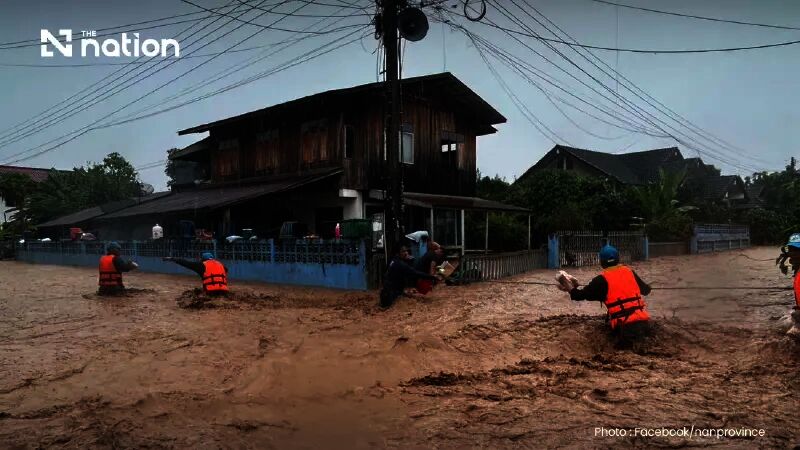
Thailand's government has officially declared Nan province in the north a disaster zone as the region grapples with severe flooding triggered by persistent heavy rainfall. Two neighbouring provinces—Phayao and Lamphun—have been placed on alert status as authorities brace for further deterioration in weather conditions. The declaration came on Wednesday as flood waters blocked critical transportation routes and prompted the evacuation of residents from vulnerable areas throughout the region.
Prime Minister Anutin Charnvirakul is overseeing the disaster response from Australia, where he is attending official engagements, demonstrating the gravity with which the government treats the flooding emergency. Government spokesperson Rachada Dhnadirek announced that Anutin has mobilised an unprecedented coordinated response across all government agencies, including the armed forces, to deliver relief and support to affected communities. Despite being thousands of kilometres away, the prime minister has maintained direct oversight of operations and continues to issue directives to response teams on the ground.
The prime minister's instructions prioritise rapid deployment of emergency response teams and heavy machinery to zones identified as high-risk. A particular emphasis has been placed on actively managing water drainage from areas with a documented history of recurrent flooding, reflecting lessons learned from previous disaster cycles in Thailand's northern region. This proactive approach signals a shift towards interventionist disaster management rather than purely reactive responses after flooding occurs.
Anutin has explicitly instructed that protection of human life and personal safety takes precedence over all other considerations. The directive specifically identifies elderly residents, bedridden patients, and young children as priority populations requiring expedited assistance and relocation from danger zones. He has also ordered swift assessment of all affected communities to identify vulnerable individuals and infrastructure, coupled with round-the-clock monitoring of rainfall accumulation and water level fluctuations to enable early warning systems.
The meteorological picture across Thailand presents a concerning outlook for the coming days. The Thai Meteorological Department has issued warnings of thunderstorm activity, locally intense rainfall, and strong gusty winds throughout northern, north-eastern, and central regions through Friday. These conditions create substantial risk of flash floods developing rapidly in low-lying areas, overland water runoff from hillsides, and the breaching of riverbanks in regions where water systems are already saturated from earlier precipitation.
Deputy Prime Minister Yodchanan Wongsawat, who carries direct responsibility for coordinating flood response operations in the northern zone, has issued an urgent directive to provincial governors in Nan, Phayao, and Lamphun demanding comprehensive preparedness measures. The order underscores the government's recognition that the next 48 to 72 hours represent a critical window during which flooding could intensify significantly. Governors have been instructed to verify that evacuation plans are in place, emergency shelters are stocked and operational, and communication systems are functioning to coordinate between local and regional authorities.
The meteorological forecast for August issued by Thailand's weather agency anticipated the current situation, predicting thunderstorms and heavy localised rainfall that could generate the exact cascade of flooding hazards now unfolding. The forecast warned of conditions conducive to sudden flash flooding, channelled overland runoff, and swollen rivers exceeding normal capacity. This advance warning provided authorities with several days to prepare response infrastructure, yet the scale and intensity of the current flooding has nonetheless forced the declaration of a full disaster zone.
For the broader Southeast Asian region, Thailand's flooding situation underscores the climate-related vulnerabilities facing mainland countries during monsoon and pre-monsoon periods. The northern provinces of Thailand, like neighbouring Myanmar and Laos, experience seasonal weather patterns that can transition from manageable to catastrophic within hours. Regional meteorological cooperation has improved, yet the capacity of individual nations to manage sudden-onset flooding across multiple provinces simultaneously remains strained, highlighting the need for cross-border disaster management coordination.
The situation carries particular significance for Malaysia, where similar seasonal flooding patterns affect northern states and where rapid urbanisation in flood-prone zones has increased vulnerability. Thailand's multi-agency response model, including explicit coordination between civilian and military resources, offers insights into scaling disaster response capacity. Malaysian authorities monitoring the situation can observe how Thailand deploys heavy machinery to manage water drainage in recurrently affected areas, a technique increasingly relevant as Malaysian cities densify and climate patterns become more variable.
The declared disaster zone status in Nan will unlock government resources and expedite administrative procedures that might normally face bureaucratic delays. This classification enables rapid mobilisation of national reserves, streamlined procurement of emergency supplies, and activation of mutual aid agreements between provinces. It also provides legal framework for compelling private sector cooperation and requisitioning of equipment needed for rescue and water management operations.
As Thailand navigates the immediate emergency, the broader context involves adapting long-term infrastructure and urban planning to accommodate increasingly unpredictable rainfall patterns. The government's emphasis on draining water from chronically flooded areas suggests recognition that some locations face recurring seasonal inundation that requires permanent structural solutions rather than repeated emergency interventions. This longer-term perspective, balanced with urgent immediate response, reflects maturation in how the Thai government approaches flood management across the northern region.

