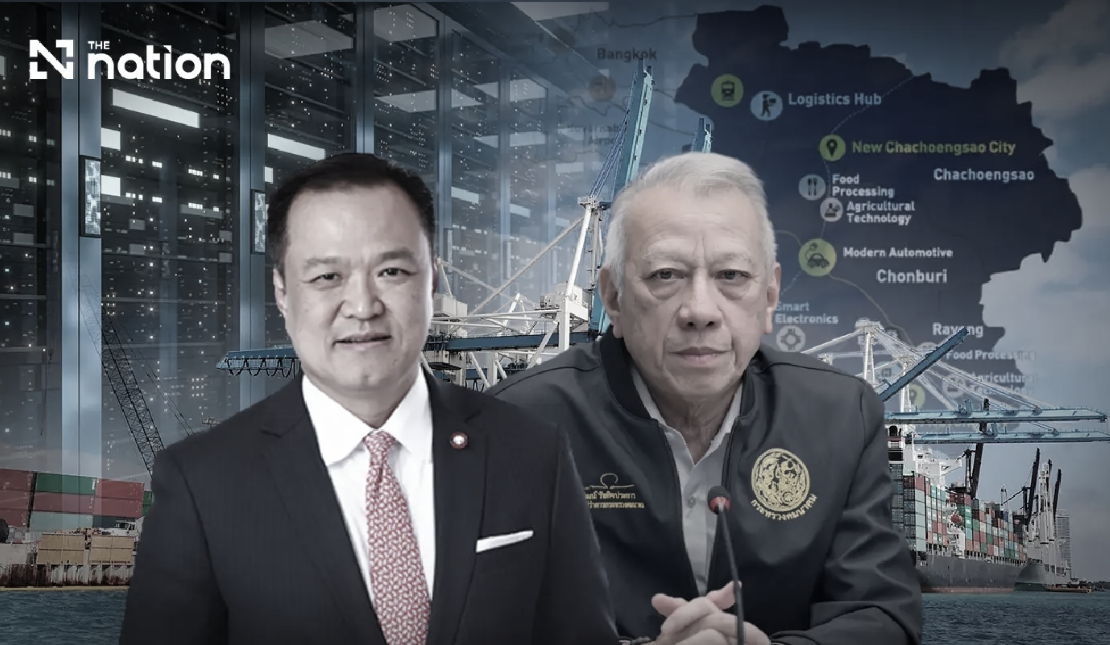
Thailand's Prime Minister Anutin Charnvirakul has reasserted direct control over the Eastern Economic Corridor, withdrawing the portfolio from Deputy Prime Minister and Transport Minister Phiphat Ratchakitprakarn to spearhead what officials describe as a fundamental repositioning of the region's investment appeal. The move, formalised through Cabinet-approved Prime Minister's Office orders signed on June 15, marks a significant strategic recalibration for one of Southeast Asia's most ambitious regional development initiatives, with the government now framing the EEC as a platform for addressing global food security challenges rather than relying solely on its traditional heavy industrial base.
According to Government House officials, Anutin's decision to reclaim direct oversight followed discussions with Phiphat and was framed as a collaborative adjustment rather than a dismissal, with sources indicating that the Deputy Prime Minister himself suggested the handover due to ongoing friction between the EEC Office and the Board of Investment. The explanation carries particular weight given that Phiphat was notably caught off-guard by the Cabinet announcement, having not been briefed in advance, yet he publicly denied any rift within his Bhumjaithai party or loss of standing. This choreography of apparent cooperation masking underlying tensions reflects the delicate coalition politics sustaining Thailand's current government structure, where maintaining public unity takes precedence over acknowledging bureaucratic reorganisations.
The strategic repositioning toward food security represents a calculated response to genuine resource constraints that have limited the EEC's traditional industrial expansion. Eastern Thailand's agricultural ecosystem—encompassing livestock operations, commercial fisheries, fruit cultivation, and horticultural production—now features prominently in government messaging as a competitive advantage that can attract international capital seeking to diversify supply chains away from geopolitical hotspots. This pivot aligns with broader global trends as nations worldwide grapple with food system vulnerabilities exposed during recent supply chain disruptions, creating genuine demand for investment in stable, regionally-integrated agricultural infrastructure and value-added processing facilities.
The data centre component of the revised EEC strategy addresses both immediate market opportunity and long-term structural needs. Thailand has emerged as an increasingly attractive location for regional data centre development, particularly as companies seek alternatives to congested or geopolitically sensitive locations throughout Asia. The government's preparation of a new Type 9 electricity tariff category specifically for data centre operators acknowledges the sector's voracious power consumption while signalling willingness to accommodate infrastructure-intensive industries through flexible regulatory frameworks. However, this approach also reveals the underlying challenge prompting the EEC's reorientation—traditional heavy industry simply cannot expand further within the region's constrained water and electricity supply architecture, regardless of government commitment.
The electricity constraint issue deserves particular attention for Malaysian observers, as it illustrates a problem increasingly affecting industrial development across Southeast Asia. Thailand's eastern region, despite proximity to significant energy infrastructure, faces procurement costs for additional power capacity that render traditional heavy manufacturing expansion economically marginal. Data centres, by contrast, represent higher-value-density operations that generate substantial returns per unit of electricity consumed, making them economically viable even within tighter resource constraints. This efficiency calculation explains why the government is willing to implement premium tariff structures for data centre operators—the sector's profitability can absorb higher input costs that would cripple conventional manufacturing.
The reported questioning of Phiphat regarding a proposed Disneyland project within the EEC suggests that Anutin intends to maintain tighter strategic discipline over corridor development. The Prime Minister's inquiry about feasibility studies and return-on-investment calculations for the theme park proposal implies skepticism about infrastructure megaprojects lacking rigorous economic justification, a stance that contrasts with Thailand's historical tendency toward grandiose development schemes. This reorientation toward demonstrable financial viability rather than headline-grabbing scale could signal genuine technocratic governance, though observers familiar with Thai politics might interpret it as Anutin establishing personal oversight precisely to control which projects receive government endorsement and thereby which constituencies secure associated benefits.
The reshuffle also provides political cover regarding the long-contentious high-speed rail project connecting Don Mueang, Suvarnabhumi, and U-Tapao airports through Asia Era One, the private partner entity linked to CP Group. Phiphat had maintained a firm stance against amending the original contract terms, particularly resisting pressure to shift from a build-then-pay model to a pay-as-you-build arrangement that would expose the government to significantly greater financial risk. By repositioning the EEC under his direct supervision, Anutin implicitly signals that high-speed rail contract decisions will henceforth reflect his personal judgment rather than appearing to emerge from the EEC development committee, thereby insulating himself from blame should the project continue languishing in contractual limbo. Government House sources deny any connection between the EEC transfer and high-speed rail disputes, yet the timing and administrative structure of the announcement suggest otherwise.
For Malaysian and broader Southeast Asian stakeholders, Thailand's EEC repositioning carries implications for regional competition for foreign investment capital. Malaysia's own economic corridors and special economic zones will increasingly compete with a Thai development strategy explicitly targeting food security-conscious international investors and data centre operators. The shift also demonstrates how resource constraints—whether electricity, water, or skilled labour—force developing economies to specialise and differentiate their investment pitches rather than pursuing undifferentiated manufacturing expansion. Malaysia's advantage in petrochemicals, semiconductors, and advanced manufacturing may appear more durable when contrasted with Thailand's forced pivot toward food security and digital infrastructure, suggesting that Southeast Asian nations with more abundant energy resources possess structural advantages in attracting capital-intensive industries.
The practical significance of Anutin's personal stewardship extends beyond symbolic political control to the actual mechanics of investor relations and project approval. A Prime Minister-led development initiative can potentially expedite permitting processes, secure cross-agency coordination, and provide foreign investors with direct access to top-level decision makers—genuine advantages when navigating Thailand's complex bureaucratic landscape. Conversely, concentrating EEC authority under the Prime Minister's direct office creates a potential bottleneck should Anutin become distracted by other governance priorities or political crises, a not insignificant risk in Thai politics. The sustainability of this arrangement thus depends partly on whether Anutin maintains sufficient political stability and policy focus to justify the administrative recentralisation.
The government's framing of this reorganisation as a strategic recalibration rather than a political adjustment reflects broader patterns in Thai policymaking where substantive governance decisions become entangled with coalition management and internal power dynamics. Whether the refocused EEC strategy around food security and data centres proves genuinely transformative or devolves into another iteration of ambitious planning without execution remains uncertain. What is clear is that traditional heavy industrialisation within Thailand's eastern region has reached practical limits, and policymakers are attempting to chart a different course. The success of this reorientation will significantly influence whether the EEC remains a flagship development platform or gradually fades into the background of Thai economic policy, much like several earlier generation development schemes that promised transformative impact but delivered modest returns.
Regional observers will watch closely how international investors respond to Thailand's repositioned EEC narrative. Food security hub status and data centre infrastructure appeal to genuinely distinct investor cohorts than traditional manufacturing clusters, requiring different regulatory frameworks, infrastructure specifications, and talent recruitment strategies. The government's willingness to invest political capital in this repositioning suggests confidence that sufficient investor appetite exists to justify the strategic shift. However, successful execution requires sustained commitment, effective cross-agency coordination, and sustained availability of the necessary infrastructure—water, electricity, and digital connectivity—that currently constrain the region's industrial expansion. Without addressing these underlying resource constraints, even the most carefully crafted investment pitch risks foundering on the bedrock reality of limited supply capacity.

%22%2F%3E%3C%2Fpattern%3E%3C%2Fdefs%3E%3Crect%20width%3D%22100%25%22%20height%3D%22100%25%22%20fill%3D%22url(%23ph21o2sg)%22%2F%3E%3Crect%20width%3D%22100%25%22%20height%3D%22100%25%22%20fill%3D%22url(%23ph21o2sp)%22%2F%3E%3Ctext%20x%3D%2250%25%22%20y%3D%2250%25%22%20text-anchor%3D%22middle%22%20dominant-baseline%3D%22central%22%20fill%3D%22rgba(255%2C255%2C255%2C0.95)%22%20font-family%3D%22Georgia%2C%20'Times%20New%20Roman'%2C%20serif%22%20font-weight%3D%22700%22%20font-size%3D%22170%22%20letter-spacing%3D%22-0.02em%22%3EGabungan%3C%2Ftext%3E%3C%2Fsvg%3E)