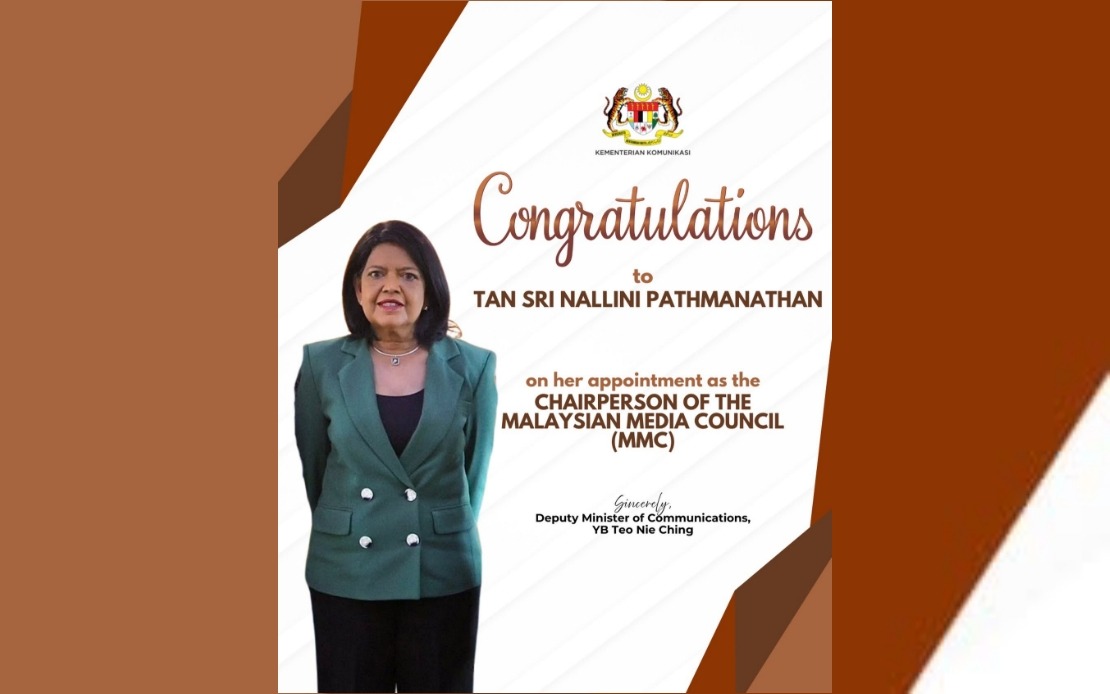
Former Federal Court judge Tan Sri Nallini Pathmanathan has been appointed chairperson of the Malaysian Media Council (MMC), drawing endorsement from Deputy Communications Minister Teo Nie Ching, who has publicly lauded the jurist's track record on constitutional matters and press freedom. The appointment, unanimously approved by MMC Board members on May 26, marks a significant milestone for Malaysia's media landscape as the country finally establishes a formal self-regulatory framework after decades of consultation and advocacy.
Teo's confidence in Nallini rests partly on the former judge's dissenting opinions in high-profile cases that have tested the boundaries of constitutional interpretation and judicial protection of fundamental liberties. Most notably, Teo highlighted Nallini's compassionate stance in a 4-3 split decision concerning citizenship rights for a child born to a Malaysian father and foreign mother. Rather than adhering to strict textual readings, Nallini's dissent championed a purposive approach to constitutional law—one that accommodates humanitarian concerns alongside legal precision. This jurisprudential philosophy suggests she may bring a similarly protective lens to media regulation and the assertion of editorial independence.
Equally significant was Nallini's position in a landmark case involving an online news portal's liability for user-generated comments. Her dissenting judgment ruled that the portal should not be held accountable for remarks posted by subscribers, a stance that foreshadows support for structural protections that encourage digital journalism without exposing publishers to excessive legal jeopardy. Such reasoning reflects a mature understanding of how modern media ecosystems function and the practical barriers that excessive liability can impose on smaller outlets and independent voices.
The establishment of the Malaysian Media Council itself represents a watershed moment for the country's information landscape. Enshrined under the Malaysian Media Council Act 2025, the body emerged from half a century of persistent calls from industry stakeholders, civil society organisations, and media practitioners for a mechanism that could self-police the industry while remaining insulated from direct government influence. The delay in creating such an institution underscores the sensitivities surrounding media regulation in Malaysia, where concerns about state interference have repeatedly stalled progress.
Teo's public statement emphasises precisely this tension. She argues that journalists constitute Malaysia's fourth estate—a structural pillar of democracy charged with holding power to account. Because of this unique constitutional role, any regulatory regime imposed from above carries inherent risk of appearing coercive or undermining press freedom. Self-regulation, by contrast, allows the industry to maintain editorial autonomy while demonstrating collective commitment to professional standards, accuracy, and ethical conduct. This distinction matters enormously for Malaysia's international standing and domestic confidence in institutions.
Nallini's appointment signals an attempt to bridge the gap between robust media accountability and genuine independence. A chairperson with her judicial pedigree and demonstrated sensitivity to constitutional protections may persuade skeptics—both within newsrooms and among press advocacy groups—that the MMC can function as a credible arbiter without becoming a tool of political control. Her background on the bench also suggests familiarity with complex evidentiary standards, reasoned deliberation, and the careful articulation of principle that self-regulatory bodies require.
The timing of the MMC's formalisation carries implications beyond Malaysia itself. Regional democracies including Indonesia, Thailand, and the Philippines have grappled with similar questions about how to foster responsible media without inviting authoritarian capture. Malaysia's choice to vest regulatory authority in an industry-led body staffed by respected legal minds may offer a model that other Southeast Asian nations consider as they refine their own approaches to media governance. Conversely, the effectiveness of Nallini's leadership will be closely watched by international press freedom monitors and regional journalism networks.
Teo's articulation of the principle underlying self-regulation also reflects evolving thinking about media accountability in digital environments. When online publications and citizen journalism blur the lines between professional outlets and informal commentary, prescriptive rules imposed externally often prove difficult to enforce fairly. A self-regulatory body led by someone with Nallini's judicial temperament might navigate these murky territories with greater sophistication—distinguishing between legitimate editorial judgment and harmful conduct, or between robust criticism and defamatory falsehoods.
The board's unanimous endorsement of Nallini suggests a broad consensus within the media industry about the need for leadership that commands respect across ideological lines. Her appointment also represents an opportunity to demonstrate that the MMC will operate with genuine authority and credibility rather than serving as a rubber stamp for government preferences or industry incumbents seeking to silence competitors. The coming months and years will test whether this institutional design lives up to its promise, particularly as the council confronts contentious cases involving political speech, religious sensitivities, and corporate interests.
Looking ahead, Nallini's leadership of the MMC will likely focus on establishing procedural credibility, building relationships with international media freedom organisations, and developing complaint mechanisms that journalists and the public can trust. Her judicial experience suggests she understands that legitimacy depends on transparent reasoning, impartiality, and the principled application of published standards rather than ad hoc decision-making. If she can translate these judicial virtues into the media regulatory sphere, the MMC may succeed in filling a long-standing institutional gap while preserving the editorial independence that underpins Malaysia's democratic discourse.

%22%2F%3E%3C%2Fpattern%3E%3C%2Fdefs%3E%3Crect%20width%3D%22100%25%22%20height%3D%22100%25%22%20fill%3D%22url(%23ph21o2sg)%22%2F%3E%3Crect%20width%3D%22100%25%22%20height%3D%22100%25%22%20fill%3D%22url(%23ph21o2sp)%22%2F%3E%3Ctext%20x%3D%2250%25%22%20y%3D%2250%25%22%20text-anchor%3D%22middle%22%20dominant-baseline%3D%22central%22%20fill%3D%22rgba(255%2C255%2C255%2C0.95)%22%20font-family%3D%22Georgia%2C%20'Times%20New%20Roman'%2C%20serif%22%20font-weight%3D%22700%22%20font-size%3D%22170%22%20letter-spacing%3D%22-0.02em%22%3EGabungan%3C%2Ftext%3E%3C%2Fsvg%3E)