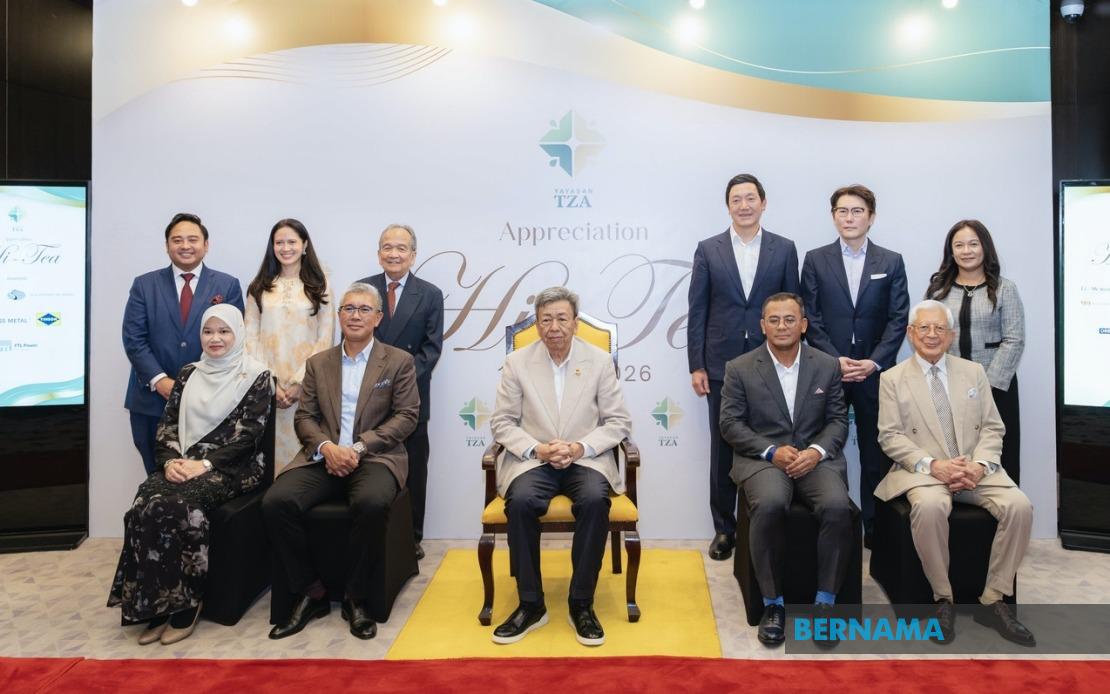
The Sultan of Selangor, Sultan Sharafuddin Idris Shah, lent his patronage to the Yayasan TZA (YTZA) Appreciation Hi-Tea Ceremony in Kuala Lumpur on June 18, underscoring the royal family's commitment to supporting educational and community development initiatives across the state. His arrival at the event was marked by formal receptions from senior foundation officials, reflecting the ceremonial importance placed on the occasion and the foundation's standing within Selangor's social development landscape.
The ceremony brought together a constellation of state and federal leadership, with Selangor Menteri Besar Datuk Seri Amirudin Shari and Education Minister Fadhlina Sidek among those in attendance. This convergence of political heavyweights signals growing policy alignment around targeted educational support for disadvantaged populations, a priority that has gained momentum in Malaysia's broader development agenda over recent years.
Addressing the assembled guests, YTZA advisor Tengku Datuk Seri Zafrul Abdul Aziz articulated the foundation's overarching philosophy, emphasizing that its programmes transcend immediate charitable relief to foster sustainable empowerment. He outlined a multifaceted approach encompassing academic support, environmental sustainability, grassroots community engagement, and celebration of cultural heritage among marginalised communities. This comprehensive framing reflects a contemporary understanding that poverty alleviation requires simultaneous interventions across educational, environmental, and social dimensions rather than isolated assistance.
Central to YTZA's educational thrust is the ACE SPM initiative, a specially designed intervention targeting Form Five candidates from bottom 40 percent (B40) household backgrounds. The programme addresses a critical bottleneck in Malaysia's education system: while access to secondary schooling has improved dramatically, quality preparation for major examinations remains unevenly distributed across socioeconomic groups. Tengku Zafrul reported that in 2025 alone, ACE SPM directly benefited 467 students spanning ten Selangor schools, whilst complementary digital initiatives extended programme reach to over 4,000 learners. These figures underscore both the programme's growing scale and the pivotal role of technology in democratizing educational access across dispersed populations.
The foundation's expansion trajectory holds particular relevance for Malaysian policymakers grappling with educational equity challenges. Regional disparities in examination performance correlate strongly with household income, with B40 students systematically underperforming their wealthier peers in public examinations. By concentrating resources on SPM preparation, YTZA targets the credentials gateway that determines tertiary education access and, consequently, labour market mobility. This intervention model offers lessons for government education agencies considering how public resources might be amplified through strategic partnerships with philanthropic organisations.
The financial commitments announced during the ceremony underscore private sector appetite for education-focused philanthropy. Kuok Brothers Sdn Bhd pledged RM1 million whilst YTL Power International Berhad contributed RM300,000, with His Royal Highness presiding over the presentation of these cheques. Such donations indicate that Malaysian corporations increasingly view educational support for disadvantaged groups as aligned with broader corporate social responsibility frameworks, particularly where programmes demonstrate measurable impact on examination outcomes and community wellbeing.
Beyond academic initiatives, YTZA unveiled Larian KITA@Klang, a community fun run scheduled for October 10 that will coincide with the Sultan of Selangor's Silver Jubilee celebrations. This represents the fourth iteration of the Larian KITA series, which deliberately integrates inclusivity principles, community bonding, and celebration of local cultural and culinary heritage. The strategic timing alongside the royal jubilee elevates the run's profile whilst anchoring it within Selangor's broader commemorative calendar. For Malaysian communities, particularly those with limited access to recreational facilities, such events offer rare opportunities for organised physical activity and intergenerational social interaction.
The convergence of royal patronage, ministerial participation, and private corporate funding evident in this ceremony reflects evolving governance approaches in Malaysia where public and private institutions increasingly coordinate around social development goals. Rather than viewing education and community welfare as exclusively state responsibilities, this model distributes accountability and resource mobilisation across multiple stakeholders. For regions like Selangor with sophisticated private sectors and engaged royal leadership, such collaborative frameworks have potential to supplement government budgets stretched across competing priorities.
Tengku Zafrul's gratitude to sponsors, donors, partners and volunteers highlights the labour-intensive nature of grassroots programme implementation. Beyond financial contributions, successful community interventions depend on sustained volunteer engagement, coordination logistics, and relationship maintenance across dispersed constituencies. This implicit acknowledgment that impact requires extensive human capital investment reminds policymakers that scaling successful programmes demands not merely replicating models but rebuilding the relational and organisational infrastructure supporting them.
The foundation's trajectory also illuminates how philanthropic institutions position themselves relative to government initiatives. Rather than duplicating services already provided by public education authorities, YTZA concentrates on supplementary preparation, digital innovation, and community celebration. This complementary positioning prevents duplication whilst maintaining distinct programmatic identity. For donors and participants, this clarity reduces confusion about institutional roles whilst maximising collective impact.
Looking ahead, YTZA's announced intention to expand ACE SPM's geographic and demographic reach speaks to recognition that educational inequality within Selangor remains substantial. The state's significant low-income populations, particularly in fringe areas and informal settlements, continue experiencing examination disparities despite living within Malaysia's wealthiest federal territory. Scaling interventions from 467 to substantially larger cohorts would require expanded funding, volunteer networks, and coordination with school authorities—challenges that royal endorsement and corporate partnerships help address but cannot entirely resolve without concurrent policy reforms in school-based examination preparation.
Ultimately, the ceremony exemplified how Malaysian civil society, particularly through foundations with sophisticated governance and strategic focus, mobilises to address educational equity. The confluence of royal prestige, government policy alignment, and private capital investment creates enabling conditions for scaling programmes with demonstrated impact. For similar initiatives across Southeast Asia confronting comparable educational inequality challenges, the YTZA model offers instructive lessons about leveraging institutional diversity and stakeholder complementarity towards coherent equity objectives.

%22%2F%3E%3C%2Fpattern%3E%3C%2Fdefs%3E%3Crect%20width%3D%22100%25%22%20height%3D%22100%25%22%20fill%3D%22url(%23ph21o2sg)%22%2F%3E%3Crect%20width%3D%22100%25%22%20height%3D%22100%25%22%20fill%3D%22url(%23ph21o2sp)%22%2F%3E%3Ctext%20x%3D%2250%25%22%20y%3D%2250%25%22%20text-anchor%3D%22middle%22%20dominant-baseline%3D%22central%22%20fill%3D%22rgba(255%2C255%2C255%2C0.95)%22%20font-family%3D%22Georgia%2C%20'Times%20New%20Roman'%2C%20serif%22%20font-weight%3D%22700%22%20font-size%3D%22170%22%20letter-spacing%3D%22-0.02em%22%3EGabungan%3C%2Ftext%3E%3C%2Fsvg%3E)