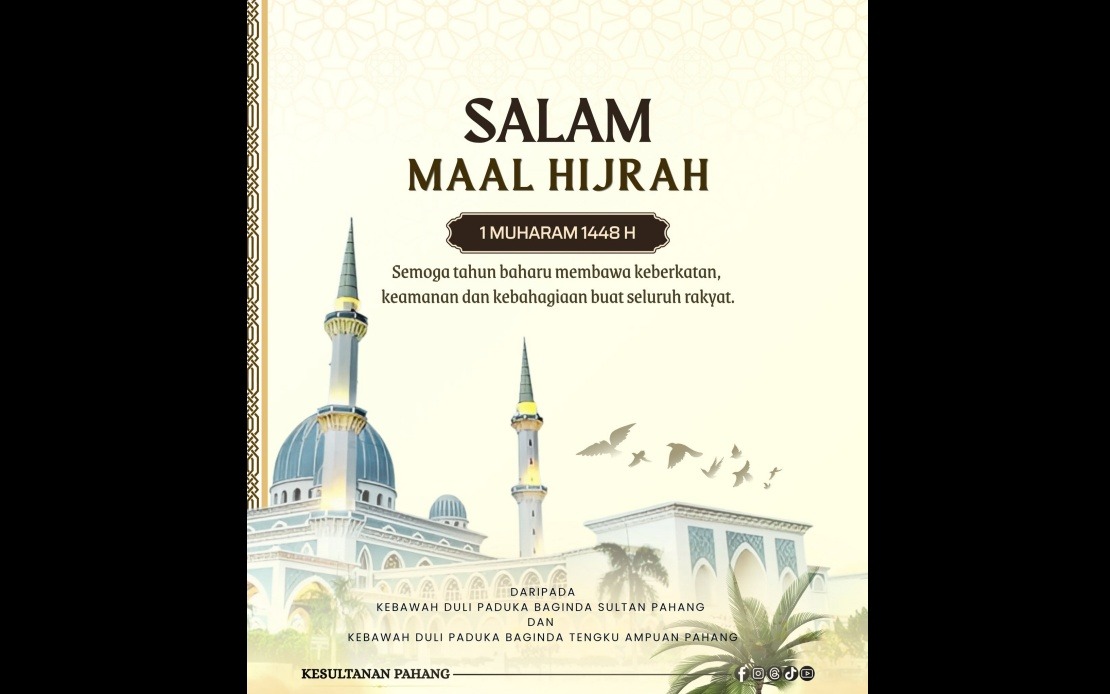
The Sultan of Pahang, Al-Sultan Abdullah Ri'ayatuddin Al-Mustafa Billah Shah, and the Tengku Ampuan of Pahang, Tunku Azizah Aminah Maimunah Iskandariah, have extended formal greetings marking Maal Hijrah 1448H to the Muslim population of Pahang, reinforcing the religious and cultural significance of the Islamic new year across the state.
Through an official announcement posted on the Kesultanan Pahang's Facebook page, the royal couple articulated their hope that the occasion would usher in a period defined by divine blessings, tranquility, and contentment for all residents of the state, regardless of background. The timing and nature of such pronouncements reflect the monarchy's role as custodian of Islamic values within Malaysia's constitutional framework, particularly in states like Pahang where the Sultan holds both temporal and spiritual authority.
Paralleling the palace's message, Pahang Menteri Besar Datuk Seri Wan Rosdy Wan Ismail released his own statement positioning Maal Hijrah as a moment for introspection and recommitment among the faithful. His framing emphasized the new Islamic year as an inflection point where Muslims might reassess their spiritual obligations, deepen their connection to Islamic teachings, and intensify their philanthropic engagement with communities in need.
The Menteri Besar's remarks drew an explicit connection between the historical Hijrah—the Prophet Muhammad's migration from Mecca to Medina in 622 CE—and contemporary aspirations for positive transformation. By invoking this foundational Islamic narrative, he contextualized calls for personal and collective improvement within a framework that resonates deeply across Muslim-majority societies. The invocation served to link individual moral development with broader state-building initiatives.
Wan Rosdy articulated a vision in which Maal Hijrah becomes a catalyst for institutional and social renewal. His statement advocated for the strengthening of communal bonds, the deliberate cultivation of integrity as a guiding principle, and a redoubling of effort toward advancing Pahang's development agenda while simultaneously enhancing living standards for ordinary citizens. This dual emphasis on moral improvement and material progress reflects a governance philosophy that sees spiritual and economic dimensions as mutually reinforcing rather than competing.
The invocation of unity in both messages carries particular salience in Malaysia's contemporary context. In a nation navigating questions of interfaith relations, political polarization, and regional disparities, statements from senior officials and royalty emphasizing cohesion and shared purpose serve multiple functions—they affirm Islamic identity within the constitutional monarchy framework, they provide occasions for ritual recommitment to collective values, and they create symbolic space for renewed commitment to national unity.
For Pahang specifically, such pronouncements hold additional weight. As one of Malaysia's larger states by area and home to significant economic interests spanning agriculture, tourism, and resource extraction, the state government's invocation of spiritual values serves to frame development initiatives within a moral vocabulary. The appeal to divine mercy and blessing implicitly positions state endeavors as aligned with Islamic principles of stewardship and community welfare.
The circulation of these messages through social media platforms, particularly Facebook, reflects the modernization of traditional royal communication. Where such greetings might once have been confined to formal ceremonies or media broadcasts, their posting on accessible digital platforms extends their reach to ordinary citizens who engage with public figures through these channels. This democratization of access does not diminish the formality of the messages but rather amplifies their circulation and invites broader participation in the sentiments expressed.
Maal Hijrah observance across Malaysia typically involves heightened religious activity, community gatherings, and public reflection on Islamic values. While not a public holiday in most states, it carries cultural and spiritual weight that finds expression through official statements, mosque sermons, community programs, and family discussions. The decision by Pahang's leadership to issue coordinated messages demonstrates institutional recognition of the occasion's significance for the Muslim-majority population.
The timing of such communications also reflects governance strategy. By publicly reaffirming commitment to values such as integrity, unity, and community welfare at moments of collective religious significance, leaders attempt to align political authority with moral legitimacy grounded in Islamic tradition. For citizens who observe the Islamic calendar and mark its significant moments, such statements from respected figures provide occasions for contemplating both personal faith and collective civic obligations.
Beyond the immediate context of Pahang, these messages exemplify how Malaysia's constitutional monarchy and federal structure accommodate religious leadership within broader governance frameworks. The Sultan's role as head of Islam in Pahang finds expression not through legislative or executive decree but through such declarations of principle and spiritual guidance. This mode of religious authority—advisory, inspirational, and ceremonial rather than coercive—has characterized Malaysian Islamic governance since independence.
For Southeast Asian observers more broadly, the Pahang leadership's Maal Hijrah statements illustrate patterns visible across the region's Muslim-majority nations, where state institutions, religious authorities, and political figures coordinate messaging around Islamic occasions. Such coordination reflects both genuine commitment to Islamic values and pragmatic recognition that religious occasions provide platforms for reinforcing social cohesion and political legitimacy.

%22%2F%3E%3C%2Fpattern%3E%3C%2Fdefs%3E%3Crect%20width%3D%22100%25%22%20height%3D%22100%25%22%20fill%3D%22url(%23ph21o2sg)%22%2F%3E%3Crect%20width%3D%22100%25%22%20height%3D%22100%25%22%20fill%3D%22url(%23ph21o2sp)%22%2F%3E%3Ctext%20x%3D%2250%25%22%20y%3D%2250%25%22%20text-anchor%3D%22middle%22%20dominant-baseline%3D%22central%22%20fill%3D%22rgba(255%2C255%2C255%2C0.95)%22%20font-family%3D%22Georgia%2C%20'Times%20New%20Roman'%2C%20serif%22%20font-weight%3D%22700%22%20font-size%3D%22170%22%20letter-spacing%3D%22-0.02em%22%3EGabungan%3C%2Ftext%3E%3C%2Fsvg%3E)