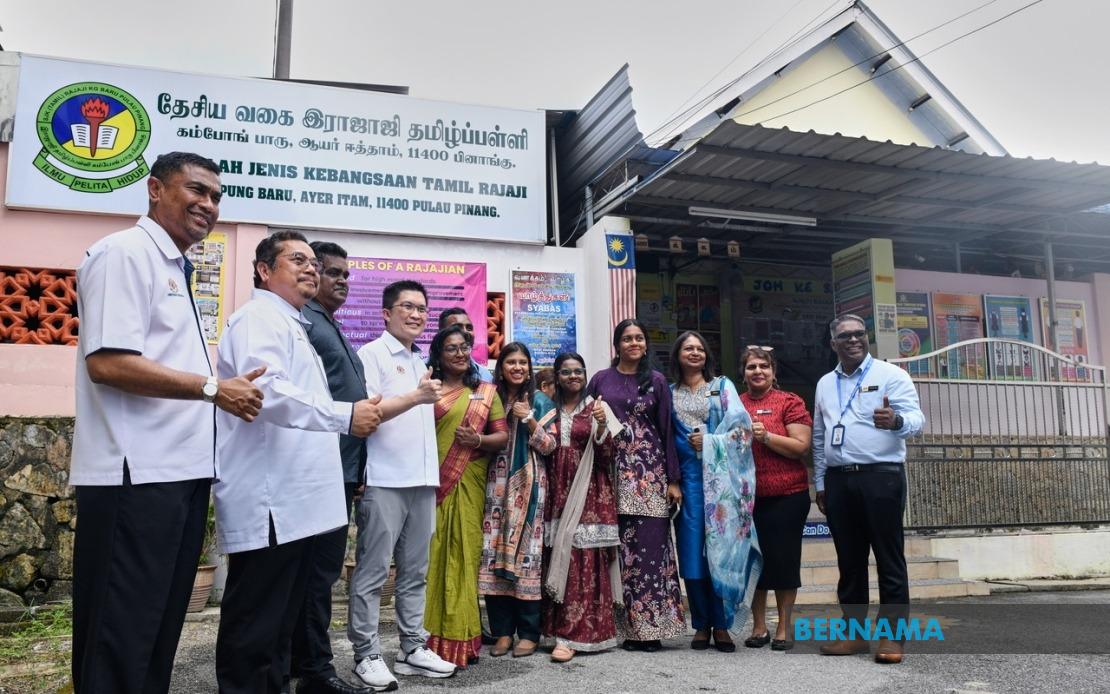
The Education Ministry has approved a RM8 million construction project to build a new campus for Sekolah Jenis Kebangsaan Tamil (SJKT) Rajaji in George Town, marking a major investment in Tamil-medium education infrastructure in Penang. Deputy Education Minister Wong Kah Woh announced the approval after presenting the official letter to school representatives, describing the initiative as essential relief for an institution that has operated in severely constrained circumstances for the better part of three-quarters of a century.
SJKT Rajaji, now 76 years old, currently struggles to serve its approximately 100 pupils within a facility that has long exceeded its practical capacity. The existing campus, located in the heart of George Town, represents an increasingly untenable situation where spatial limitations restrict everything from classroom comfort to recreational opportunities and modern learning amenities. This cramped environment has persisted as an ongoing challenge for the school's management and teaching staff, who have worked within these constraints without the resources needed for meaningful expansion at the original location.
The new campus will occupy a 2.3-acre plot in Farlim, roughly 500 metres distant from the current premises, within the Bandar Baru Ayer Itam area. The Penang state government originally approved this relocation site in 2022, recognising the urgent need to provide Tamil schools with better physical infrastructure. The school's board of governors formally applied to the Education Ministry last year, initiating a process that required coordination with local authorities and resolution of various administrative and land-related matters before final approval could be granted.
Construction timelines indicate that work will span approximately 18 months from commencement, positioning the new facility to commence operations no later than the 2029 academic session. This phased approach allows the school community adequate time to prepare for the transition while enabling contractors to complete the project to proper specifications without rushing the construction process. The timeline also provides parents, teachers, and students with sufficient notice to plan their engagement with the relocated institution.
A particularly noteworthy aspect of this development is the funding mechanism. The Education Ministry has secured partnership with a private developer who will finance the entire RM8 million project through its corporate social responsibility programme. This arrangement exemplifies growing collaboration between government educational bodies and the private sector, where businesses contribute meaningfully to social infrastructure while fulfilling their CSR obligations. Such models reduce direct financial burden on state budgets while enabling worthwhile educational improvements to proceed at scale.
Penang's broader landscape of Tamil-medium education reveals an expanding portfolio of development initiatives. The state currently operates 28 Tamil national-type schools, many of which are undergoing planned upgrades and facility improvements. S. Sundarajoo, the State Housing and Environment Committee chairman and convenor of the Penang Tamil Schools Special Committee, indicated that at least three additional SJKT projects will hold groundbreaking ceremonies during the current year. These parallel efforts demonstrate sustained commitment to ensuring Tamil schools receive equitable attention within the state's educational development agenda.
Beyond immediate construction, several longer-standing initiatives are being revived and accelerated. SJKT Sungai Bakap and SJKT Juru, among others, are receiving renewed focus and resource allocation following periods of stalled progress. This revival strategy suggests a deliberate effort to clear backlogs in Tamil school infrastructure projects while simultaneously advancing new facilities like SJKT Rajaji. The cumulative effect positions Penang as a state taking substantive action to address historic underinvestment in Tamil-medium institutions.
The broader significance of this development extends beyond Penang's borders. Tamil schools across Malaysia frequently operate within inherited facilities designed for smaller student populations or built decades ago without provision for contemporary educational technology and pedagogical approaches. The SJKT Rajaji project provides a template for how strategic partnerships between state authorities, the federal Education Ministry, and private sector organisations can catalyse facility improvements. Other states facing similar pressures on Tamil school infrastructure may look toward this Penang experience as a potential model for mobilising resources and accelerating construction timelines.
Educational equity considerations underpin this initiative. Tamil national-type schools serve as vital institutions preserving linguistic and cultural heritage while delivering comprehensive national education. When these schools operate from inadequate facilities, the disadvantage extends to students' learning outcomes, teacher morale, and community confidence in the education system. Addressing infrastructure deficits therefore constitutes not merely a matter of facility management but of ensuring Tamil-medium students access learning environments comparable to their counterparts in other vernacular systems and national-type schools.
The relocation also carries implications for Penang's housing and urban development narrative. The Farlim location, within Bandar Baru Ayer Itam, situates the school within a growing residential area, potentially serving an expanding pupil population as the neighbourhood develops. This strategic siting reflects forward-looking planning that anticipates demographic shifts rather than simply recreating the existing institution in a new location. Educational infrastructure investments thus become integrated with broader urbanisation and community development trajectories.
For Tamil parent communities in Penang, this announcement addresses long-standing frustrations regarding educational infrastructure parity. The concrete timeline, secured funding, and government approval provide tangible evidence that their concerns about school facilities have reached policy-making levels and triggered responsive action. Such visibility reinforces community trust in the education system and legitimises Tamil-medium schooling as a valued component of Malaysia's diverse educational ecosystem.
Moving forward, the SJKT Rajaji project will require careful monitoring of construction progress, completion timelines, and eventual operational readiness. The 18-month construction window demands rigorous project management to ensure the 2029 academic session deadline remains achievable. Successful completion would vindicate the public-private partnership approach while delivering meaningful improvement to the school community's educational environment and demonstrating that infrastructure investment in Tamil schools remains viable and achievable within Malaysia's current policy framework.

%22%2F%3E%3C%2Fpattern%3E%3C%2Fdefs%3E%3Crect%20width%3D%22100%25%22%20height%3D%22100%25%22%20fill%3D%22url(%23ph21o2sg)%22%2F%3E%3Crect%20width%3D%22100%25%22%20height%3D%22100%25%22%20fill%3D%22url(%23ph21o2sp)%22%2F%3E%3Ctext%20x%3D%2250%25%22%20y%3D%2250%25%22%20text-anchor%3D%22middle%22%20dominant-baseline%3D%22central%22%20fill%3D%22rgba(255%2C255%2C255%2C0.95)%22%20font-family%3D%22Georgia%2C%20'Times%20New%20Roman'%2C%20serif%22%20font-weight%3D%22700%22%20font-size%3D%22170%22%20letter-spacing%3D%22-0.02em%22%3EGabungan%3C%2Ftext%3E%3C%2Fsvg%3E)