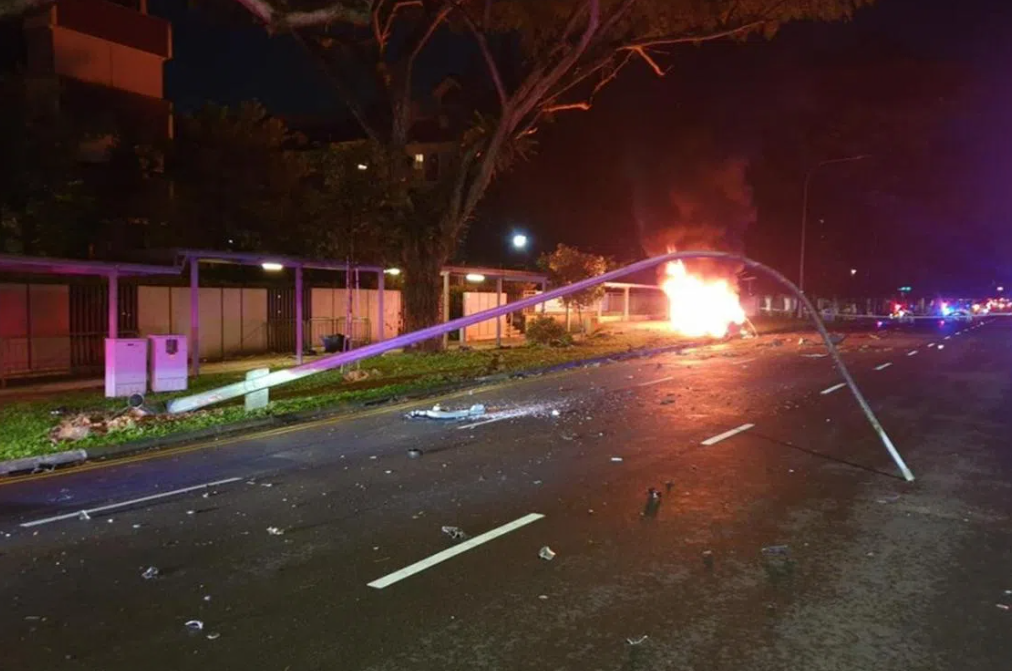
A 29-year-old Singaporean man has been formally charged with multiple traffic offences following a reckless driving incident that endangered the lives of schoolchildren and left a vehicle engulfed in flames. The March 6, 2024 episode unfolded across multiple locations in Singapore's western regions, involving drink-driving, dangerous manoeuvres, and a high-speed chase that only concluded when the vehicle collided with infrastructure and caught fire.
Aaron Tan Yao Cong faced the courts on Thursday, June 18, with prosecutors laying five separate counts against him: drink-driving, dangerous driving causing hurt, leaving a vehicle in a hazardous position, refusing to comply with a breathalyser test, and driving in the wrong direction against traffic flow. The charges reflect the escalating severity of his actions throughout the incident and the deliberate nature of certain decisions he made. Court documents reveal that Tan declined to submit to a breathalyser examination upon arrest, a refusal that carries its own legal consequences, yet subsequent testing identified approximately 148 milligrams of alcohol per 100 millilitres of his blood—substantially exceeding Singapore's legal threshold of 80 milligrams.
The incident commenced at approximately 5.50am along Cavenagh Road, where Tan disregarded a traffic sign mandating straight-ahead movement. Instead, he negotiated a left-hand turn and steered his vehicle directly into oncoming traffic on the two-lane road. However, rather than maintaining this dangerous trajectory, he came to a halt on the left side of Cavenagh Road, momentarily pausing before resuming his journey. This initial phase of the incident demonstrated reckless indifference to other road users, setting the stage for the more catastrophic events that would follow minutes later.
Police accounts document that as officers approached the stationary vehicle at 6am, Tan abruptly accelerated and fled the scene. Over the next sixteen minutes, he traversed Bukit Timah Road toward Upper Bukit Timah Road, driving at an average velocity of 114 kilometres per hour while aggressively weaving between vehicles during morning rush-hour conditions. The high-speed pursuit saw him navigate hazardously between Coronation Road and Anamalai Avenue, presenting a clear and immediate danger to every motorist and pedestrian he encountered.
The ramifications of his dangerous driving materialised at the junction of Sixth Avenue at approximately 6.16am. Tan approached a red traffic light signal and failed to reduce speed or halt. Instead, he drove directly into the path of a private bus executing a U-turn, resulting in a violent collision. The impact sent his vehicle hurtling into a nearby lamp post, the force sufficient to rupture fuel lines and ignite the vehicle's interior. Within moments, flames consumed the automobile, though Tan and three passengers travelling with him managed to evacuate before the fire became inescapable.
The collision claimed victims beyond Tan's own vehicle. The bus driver and two young passengers—aged nine and ten—were transported to hospital for treatment of injuries sustained in the crash. Both children required medical attention, a concerning reminder that Tan's recklessness extended beyond his own immediate circle to vulnerable road users, particularly minors who bore no responsibility for the incident. All individuals involved in the collision, including those in Tan's vehicle, underwent hospital evaluation and treatment for their injuries.
This is not Tan's first encounter with traffic law enforcement. Court records indicate a previous conviction in 2019 for drink-driving and driving without due care and attention—convictions that suggest a pattern of behaviour rather than an isolated lapse in judgment. The 2024 incident therefore represents a serious escalation and potential indication of an entrenched disregard for road safety regulations and the wellbeing of the driving public.
The legal consequences facing Tan are substantial. If convicted on the drink-driving charge as a repeat offender, he faces imprisonment of up to two years combined with a fine reaching $20,000. The dangerous driving charge carries potential imprisonment of up to two years and fines to $10,000, with enhanced penalties for repeat offenders reaching $20,000 and two years' imprisonment. Additional charges carry progressively lighter sentences: three months' imprisonment or $1,000 fine for the hazardous vehicle positioning; up to six months' imprisonment or $5,000 fine for refusing the breathalyser test, with repeat-offender penalties extending to one year's imprisonment and $10,000 fines; and three months' imprisonment or $1,000 fine for wrong-direction driving, escalating to six months and $2,000 for repeat offenders.
Tan is scheduled to return to court on July 16 for further proceedings. He has not yet indicated whether he intends to enter guilty pleas to any of the five charges, meaning the case may proceed to trial. The severity of the charges and the concrete evidence documented by police through charge sheets and witness statements suggest prosecutors have constructed a robust case. Tan's prior convictions will likely influence sentencing considerations should he be found guilty, as courts typically take previous infractions into account when determining appropriate penalties.
This incident carries particular significance for Southeast Asian readers as it exemplifies vulnerabilities in road safety enforcement across the region. Singapore, despite possessing robust legal frameworks and efficient law enforcement, continues to grapple with repeat offenders who persist in dangerous driving despite prior convictions. The involvement of young schoolchildren underscores how individual lapses in judgment cascade through communities, affecting innocent parties and traumatising families. The case also illustrates the intersection between impaired driving, deliberate traffic violations, and the critical importance of immediate police response in curtailing dangerous behaviour before catastrophic outcomes occur.

%22%2F%3E%3C%2Fpattern%3E%3C%2Fdefs%3E%3Crect%20width%3D%22100%25%22%20height%3D%22100%25%22%20fill%3D%22url(%23ph21o2sg)%22%2F%3E%3Crect%20width%3D%22100%25%22%20height%3D%22100%25%22%20fill%3D%22url(%23ph21o2sp)%22%2F%3E%3Ctext%20x%3D%2250%25%22%20y%3D%2250%25%22%20text-anchor%3D%22middle%22%20dominant-baseline%3D%22central%22%20fill%3D%22rgba(255%2C255%2C255%2C0.95)%22%20font-family%3D%22Georgia%2C%20'Times%20New%20Roman'%2C%20serif%22%20font-weight%3D%22700%22%20font-size%3D%22170%22%20letter-spacing%3D%22-0.02em%22%3EGabungan%3C%2Ftext%3E%3C%2Fsvg%3E)