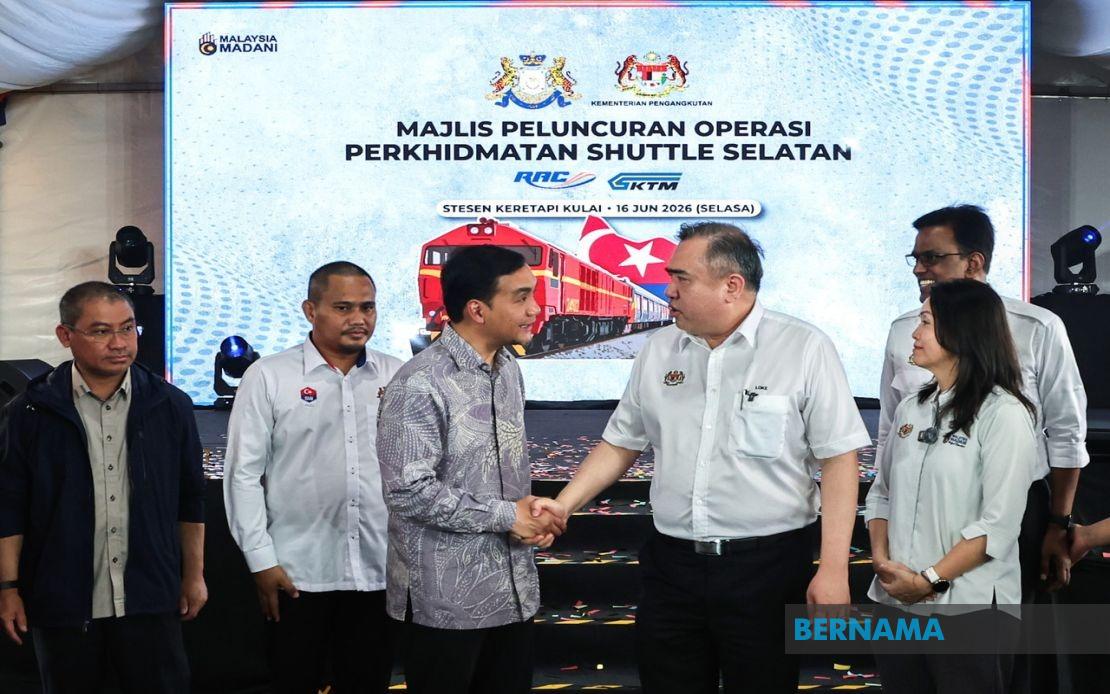
The Shuttle Selatan rail service began operations today, marking a significant step forward in Johor's public transportation infrastructure as authorities seek to manage mobility challenges across the state's rapidly expanding population centres. Transport Minister Anthony Loke unveiled the service at Kulai KTM station, positioning the initiative as a critical response to congestion and the need for reliable transit options linking residential zones with commercial and industrial hubs. The launch brings together the Ministry of Transport, Keretapi Tanah Melayu Berhad (KTMB), and the Railway Assets Corporation (RAC) in a coordinated effort to reshape commuter patterns in one of Malaysia's most economically dynamic regions.
Initially, Shuttle Selatan will operate along two primary corridors designed to address existing gaps in the transport network. The Kulai-JB Sentral-Kulai route and the Kempas Baru-Pasir Gudang-Kempas Baru service establish foundational connections between these key nodes, with journey times of 40 to 45 minutes. These timeframes represent a substantial improvement over conventional road-based alternatives, particularly during peak hours when congestion regularly adds significant delays to commutes across the southern Johor corridor. The dual-route structure reflects careful planning to maximise coverage across densely populated and commercially important areas.
Looking beyond the immediate rollout, government planners have outlined an ambitious expansion strategy that would substantially extend the network's reach across the region. A future phase envisions connecting Paloh through to Kulai via intermediate stations including Kluang, Renggam, and Layang-Layang, effectively creating a more cohesive transport spine across southern Johor. Additionally, three new stations—Taman Daya, Bandar Baru Sri Alam, and Pasir Putih—are under consideration to ensure that residents from a broader geographic area can access rail-based connectivity. This incremental expansion approach allows authorities to assess demand and operational performance while building toward a more comprehensive network.
To bridge the critical first- and last-mile problem that often discourages public transport use, the government has implemented a suite of supporting mechanisms working in concert with the main shuttle service. Feeder bus routes, coordination with the Bas.My platform, dedicated shuttle connectivity at Kempas Baru, and park-and-ride facilities at AEON Bandar Dato' Onn create multiple pathways for residents to access the rail system. This ecosystem approach acknowledges that seamless public transport adoption requires solving the connectivity puzzle beyond the primary transit corridor—addressing how commuters reach stations and complete journeys after alighting.
A particularly innovative measure involves the Commuter MADANI Shuttle Selatan Card, a subsidised travel instrument distributed free to early adopters in Johor. The RM50 card permits unlimited rides during a specified period, with RAC allocating over RM150,000 in incentive funding to encourage the public to transition from private vehicles to rail-based options. This financial incentive represents a deliberate policy choice to accelerate ridership during the critical launch phase, when established commuting habits and public confidence in new services remain uncertain. By removing price barriers for early users, authorities aim to build momentum and demonstrate the service's practical value.
Johor's transport challenges have intensified alongside the state's economic growth trajectory. As a major centre for industrial manufacturing, port operations, educational institutions, and regional trade, the state has attracted sustained investment and population inflows that existing infrastructure struggles to accommodate. Transport Minister Loke emphasised that Shuttle Selatan directly responds to this reality, strengthening connectivity between residential developments, urban centres, and the industrial zones that generate substantial employment. Without adequate public transport alternatives, the state risks reinforcing dependence on private vehicles that exacerbate congestion and environmental pressures.
The initiative carries particular significance for Malaysia's broader transport transformation agenda. Southeast Asian cities increasingly recognise that managing sprawl and supporting economic productivity depends on shifting commuters from road-based to rail-based systems. Johor's scale—serving more than two million people across the three initial coverage areas—makes Shuttle Selatan a testing ground for policies that could extend to other rapidly developing Malaysian regions. The service's performance metrics, ridership patterns, and operational efficiency will inform future transit planning elsewhere.
For residents across Kulai, JB Sentral, and Pasir Gudang, the service offers tangible benefits beyond convenience. Reduced reliance on personal vehicles lowers household transportation costs, particularly significant for lower-income commuters who spend disproportionate shares of earnings on mobility. Environmental benefits flow from decreased vehicular emissions across the corridor. Time savings from predictable rail schedules create productivity gains that ripple through the economy. These distributed advantages accumulate into meaningful improvements in quality of life and economic participation.
The coordinated involvement of multiple government agencies and statutory bodies underscores the administrative complexity of launching integrated transport systems. KTMB's operational expertise, RAC's asset management capabilities, and the Ministry of Transport's policy leadership had to align around shared objectives despite distinct institutional interests. This coordination represents both a success in this instance and a standing challenge for Malaysian public transport development, where fragmented responsibility and inconsistent funding have historically hampered service quality.
Government officials, including Johor Menteri Besar Datuk Onn Hafiz Ghazi and the Public Works, Transport, Infrastructure and Communications Committee chairman Mohamad Fazli Mohamad Salleh, emphasised commitment to sustained investment in the transport ecosystem. Their presence at the launch signals political prioritisation at both federal and state levels, suggesting that Shuttle Selatan will receive ongoing support rather than suffering the resource constraints that have undermined other transit initiatives. Sustained funding and consistent policy commitment will prove essential as the service matures and expansion phases proceed.
The weeks and months ahead will reveal whether Shuttle Selatan achieves its adoption targets and justifies the investment in expansion phases. Early usage patterns and passenger satisfaction metrics will shape policy discussions around rail-based transport across Johor and potentially influence similar initiatives in other Malaysian states. Success would validate the approach of combining infrastructure investment, targeted subsidies, and integrated first-mile connectivity to shift commuting behaviour. Conversely, disappointing uptake would prompt reassessment of service design, pricing, and the broader strategy for managing mobility in rapidly growing regions.

%22%2F%3E%3C%2Fpattern%3E%3C%2Fdefs%3E%3Crect%20width%3D%22100%25%22%20height%3D%22100%25%22%20fill%3D%22url(%23ph21o2sg)%22%2F%3E%3Crect%20width%3D%22100%25%22%20height%3D%22100%25%22%20fill%3D%22url(%23ph21o2sp)%22%2F%3E%3Ctext%20x%3D%2250%25%22%20y%3D%2250%25%22%20text-anchor%3D%22middle%22%20dominant-baseline%3D%22central%22%20fill%3D%22rgba(255%2C255%2C255%2C0.95)%22%20font-family%3D%22Georgia%2C%20'Times%20New%20Roman'%2C%20serif%22%20font-weight%3D%22700%22%20font-size%3D%22170%22%20letter-spacing%3D%22-0.02em%22%3EGabungan%3C%2Ftext%3E%3C%2Fsvg%3E)