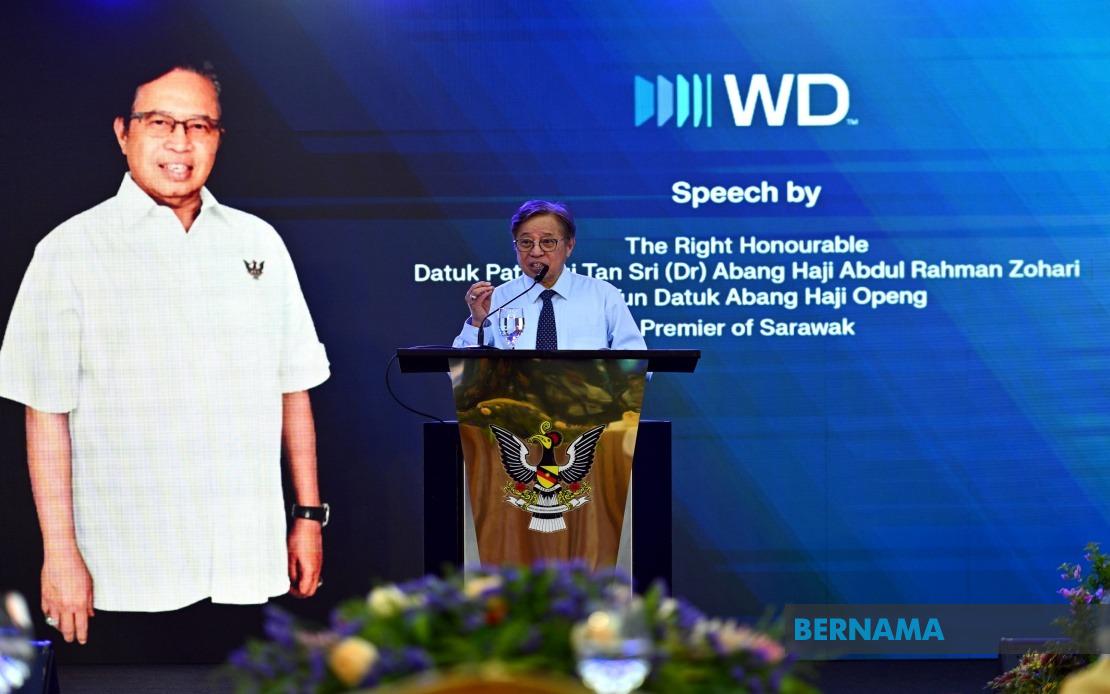
Sarawak's leadership has adopted a pragmatic stance towards securing a larger special grant from Kuala Lumpur, signalling receptiveness to increases while acknowledging the constraints facing federal finances. During remarks made in Kuching on July 2, Premier Tan Sri Abang Johari Tun Openg outlined his state's position: any boost to the grant under Article 112D of the Federal Constitution hinges on whether the central government possesses the fiscal wherewithal to fund it. The measured tone reflects both Sarawak's aspirations for greater federal support and a realistic appraisal of Putrajaya's budgetary pressures.
The premier's comments follow recent discussions with Prime Minister Datuk Seri Anwar Ibrahim in Bintulu, where the matter was broached in general conversation rather than through formal negotiation channels. Abang Johari explicitly noted that no substantive, detailed talks have yet transpired regarding a concrete increase figure or timeline. This suggests that while the topic enjoys political attention at the highest levels, concrete progress remains nascent. The ambiguity underscores the complexity of fiscal federalism in Malaysia, where constitutional provisions grant states certain revenue entitlements that must be balanced against the broader needs of the nation.
Prime Minister Anwar had previously confirmed during parliamentary Question Time on June 30 that discussions surrounding Sarawak's special grant are proceeding in alignment with principles enshrined in the Malaysia Agreement 1963. The MA63, which governs the relationship between the federal centre and Sarawak and Sabah following their accession to Malaysia in 1963, remains a touchstone for state-level grievances and expectations regarding resource allocation and autonomy. For Sarawak, the constitutional grant represents not merely a financial matter but a substantive affirmation of the state's standing within the federation and recognition of its contributions to national development.
The fiscal constraints facing Malaysia's federal government add context to Abang Johari's cautious optimism. Post-pandemic debt levels, volatile commodity prices affecting revenue, and competing demands from multiple development priorities across the nation have squeezed the government's capacity for new spending commitments. Sarawak's willingness to frame its position around federal feasibility—rather than demanding an increase as a matter of constitutional entitlement—reflects sophisticated political messaging designed to maintain goodwill with Putrajaya without surrendering leverage in future negotiations.
Parallel to the grant discussions, Abang Johari has been articulating a forward-looking economic vision for Sarawak centred on high-technology industries rather than traditional resource extraction. His remarks at the New Horizon for Western Digital programme highlighted the state's three-decade partnership with the American technology giant in developing glass substrate-based data storage solutions. This alignment of political messaging with economic transformation initiatives suggests that Sarawak's leadership views the special grant not as an end in itself but as a foundation upon which to build modern, knowledge-intensive industries.
The premier emphasised that Sarawak's natural endowments—abundant renewable energy potential and plentiful water resources—have positioned the state as an attractive destination for technology-intensive investors requiring stable, sustainable power supplies. Data storage infrastructure, particularly technology capable of supporting artificial intelligence applications, represents a strategic sector where Sarawak believes it possesses competitive advantages. Western Digital's commitment to glass substrate recording technology, which enables substantially higher data storage capacity than conventional methods, aligns with the state's aspirations to transition from hydrocarbon dependence to a more diversified, technology-centric economy.
The framing of data as a future asset exceeding oil in value carries particular significance for Sarawak, whose economy has historically relied on petroleum and liquefied natural gas exports. As global energy markets transition and fossil fuel demand faces long-term headwinds, state leaders recognise the imperative to develop alternative economic pillars. Data storage and processing, coupled with renewable energy generation, could provide sustainable, durable sources of wealth creation and employment. This strategic pivot partly explains why Abang Johari has been receptive to federal negotiations: a higher special grant could theoretically fund infrastructure, workforce development, and research initiatives supporting this transformation.
Western Digital's statement regarding glass substrate technology's capacity to support rapidly expanding AI-driven digital infrastructure indicates that Sarawak's tech ambitions are not aspirational fantasies but responses to genuine market demand. Artificial intelligence applications are projected to drive exponential growth in data creation and processing requirements globally. Nations and regions positioning themselves as reliable, efficient data storage hubs stand to capture significant economic value. Sarawak's combination of energy advantages, relative geographic isolation from major seismic zones, and investor confidence offers genuine appeal to companies seeking dependable facilities for mission-critical infrastructure.
For Malaysian readers and observers, the negotiations symbolise the ongoing evolution of Malaysian federalism and the persistent tension between central authority and state autonomy. Sarawak's measured approach—accepting federal constraints while clearly articulating long-term development needs—represents a model of constructive engagement with Putrajaya. Unlike more confrontational state governments, Abang Johari's administration has generally cultivated collaborative relationships with the federal centre, positioning itself as a reliable partner in national development while carefully advancing Sarawak's interests.
The outcome of these grant discussions will likely influence broader federal-state relations and possibly set precedents for other resource-rich states seeking enhanced financial support. Sabah, which shares MA63 status with Sarawak, watches closely. Should Sarawak secure a materially increased grant, comparable demands from other states appear inevitable. Conversely, if federal constraints limit increases, this may temporarily dampen state-level expectations while galvanising longer-term pressure for comprehensive fiscal federalism reform.
Ultimately, Abang Johari's measured optimism reflects a state leadership confident in its strategic importance to Malaysia's future while soberly acknowledging national fiscal realities. The willingness to condition grant expectations on federal capacity, coupled with ambitious plans to transform Sarawak's economy through technology and renewable energy, suggests that state leaders view negotiating leverage as deriving not from confrontation but from demonstrated value creation. Whether this pragmatic approach yields tangible increases in the special grant remains to be seen, but it illustrates how Malaysian federalism continues to function through negotiation, mutual recognition of constraints, and long-term relationship building among political elites.

