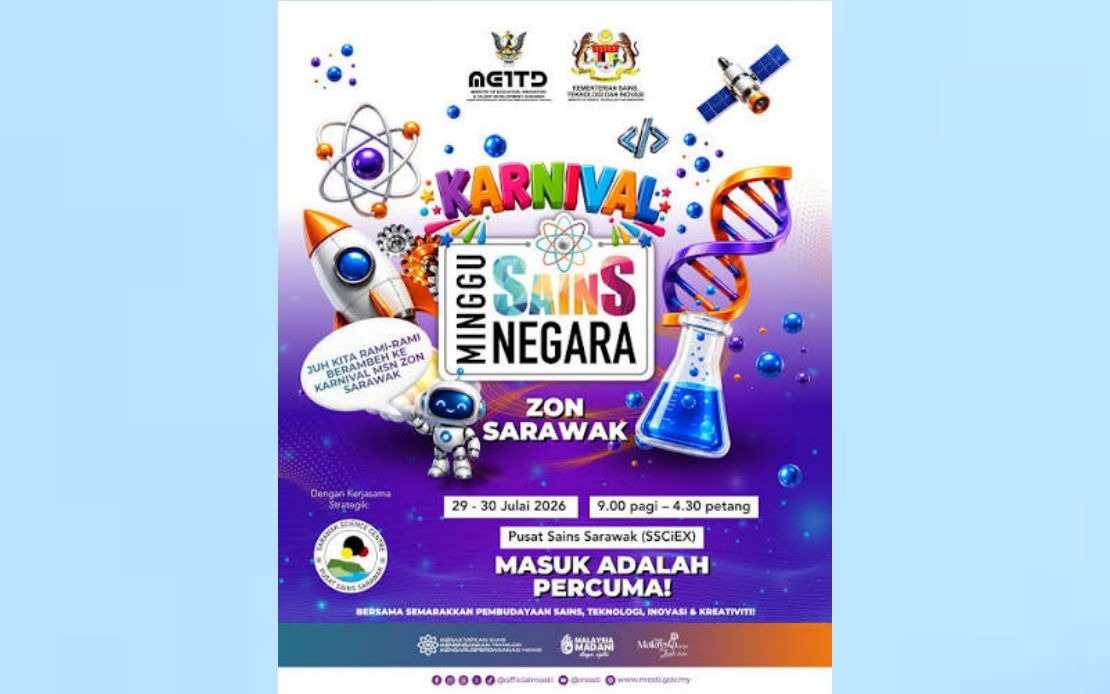
The Ministry of Science, Technology and Innovation (MOSTI) has formally inaugurated the National Science Week (MSN) Carnival 2026 for the Sarawak Zone, signalling a concerted push to democratise access to scientific knowledge across the state. Held at the Sarawak Science Centre in Kuching on July 30, the launch represents a strategic pivot in how Malaysia approaches science communication, moving beyond urban centres to reach the interior regions that have historically been underserved by such initiatives.
This year's carnival carries particular significance as it explicitly addresses one of Malaysia's persistent challenges: geographical disparities in access to science, technology, and innovation resources. The initiative recognises that building a knowledge-based economy requires nurturing scientific thinking and technological literacy across all demographics and geographies, not merely in developed urban areas. By embedding the carnival within the Sarawak Zone, MOSTI is acknowledging that interior and rural communities possess untapped potential that deserves institutional investment and engagement.
Datak Dr Nagulendran Kangayatkarasu, MOSTI's secretary-general, articulated the carnival as a cornerstone government effort to cultivate widespread appreciation for science and innovation. His remarks underscored that fostering a culture of STI extends beyond laboratories and universities—it requires public participation and community-level enthusiasm. This philosophy underpins a broader transformation in science policy, where engagement becomes as valuable as research output itself.
The programme's reach will be substantially amplified through the STEM Catalysts Programme, which targets school students in remote districts including Meradong, Bintulu, and Belaga. These areas, characterised by challenging terrain and dispersed populations, have historically faced obstacles in accessing quality science education. By deploying structured outreach activities directly into these communities, the carnival addresses a critical gap in Malaysia's educational infrastructure and demonstrates governmental commitment to inclusive development.
Minister of Education, Innovation and Talent Development of Sarawak Datuk Seri Roland Sagah Wee Inn presided over the launch, reflecting the event's importance within Sarawak's broader developmental agenda. The ministerial presence signals cross-level governmental alignment, with both federal and state authorities working in concert to advance science literacy. This coordination is essential for sustaining momentum and ensuring that initiatives do not remain isolated events but integrate into long-term educational strategies.
A particularly notable dimension of the carnival involves its nuclear technology advocacy component, which represents a deliberate attempt to reshape public discourse around nuclear science in Malaysia. By introducing nuclear technology within a carnival setting—an inherently positive and accessible environment—MOSTI is pursuing what can be termed "confidence-building" communication. This strategy recognises that public acceptance of nuclear technology hinges partly on familiarity and education, especially in communities where misconceptions may be entrenched.
The sainsrakyat.my portal represents an innovative infrastructure for citizen science, fundamentally expanding who can contribute to research and knowledge generation. Rather than confining science to professionals, this platform invites diverse community members to contribute real-world data that feeds into actual research initiatives. For rural communities in Sarawak, participation in citizen science generates tangible engagement with the scientific process, demonstrating that scientific contribution is not the exclusive domain of credentialed experts.
This democratisation of scientific participation carries profound implications for how Malaysians conceptualise their relationship with knowledge creation. When rural schoolchildren in Belaga or Meradong understand that their observations can contribute to genuine research, the psychological distance between themselves and science diminishes. Such shifts in perception, multiplied across hundreds or thousands of students, gradually reshape societal attitudes toward STI careers and scientific thinking more broadly.
For Southeast Asia more broadly, Sarawak's carnival model offers a replicable template for addressing the uneven distribution of scientific opportunity across the region. Many ASEAN nations grapple with similar challenges of connecting rural populations to innovation ecosystems. The Sarawak initiative demonstrates that this connection need not be prohibitively expensive or logistically insurmountable—it requires strategic design, ministerial coordination, and genuine commitment to inclusion.
The carnival's two-day structure, while modest in duration, carries significance as a pilot or proof-of-concept effort. Successful outcomes will likely encourage expansion, both geographically across additional Sarawak regions and temporally through repeat iterations. The data generated from student participation and citizen science contributions will inform future programming, creating feedback loops that improve targeting and effectiveness.
Integrating nuclear technology advocacy into a carnival environment also signals Malaysia's positioning within global energy transition discussions. As nations worldwide reassess nuclear power's role in decarbonisation, building domestic public familiarity and confidence becomes strategically important. Sarawak, with its significant hydroelectric capacity and growing energy demands, represents a logical location for such conversations, particularly given younger generations' increasing interest in climate solutions.
The initiative ultimately reflects recognition that technological advancement without inclusive participation creates fragmented societies where innovation benefits concentrate geographically and demographically. By deliberately extending science and technology engagement to interior Sarawak, MOSTI positions STI as genuinely national priority rather than urban luxury. Whether the carnival catalyses sustained shifts in student aspirations and community engagement with science will depend on follow-up programming and institutional persistence beyond the carnival's immediate conclusion.

