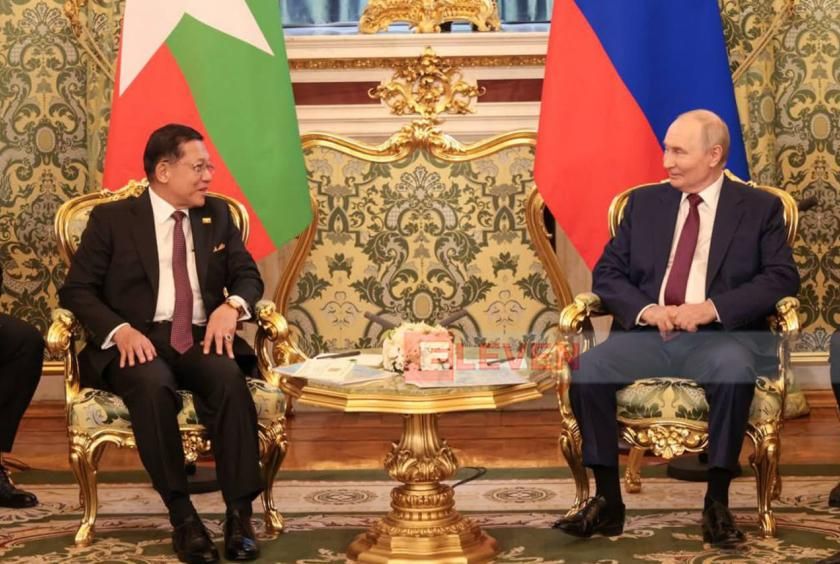
During a joint media appearance in Yangon on August 18, Russian President Vladimir Putin outlined an expansive vision for bilateral cooperation with Myanmar, emphasising the energy sector as a cornerstone of Russia-Myanmar relations. Putin indicated that Russian companies stand prepared to assist Myanmar in exploring and extracting natural resources across multiple domains, with particular emphasis on offshore oil and gas development—a sector that could significantly reshape Myanmar's economic landscape and regional geopolitical positioning in Southeast Asia.
The strategic partnership reflects deep historical roots. Putin highlighted how the Soviet Union invested substantially in Myanmar's infrastructure during the 1950s and 1960s, constructing hospitals, universities, and other facilities that continue serving the Myanmar population. This legacy forms the foundation of what both leaders describe as a relationship grounded in mutual respect and equitable benefit, distinguishing it from more transactional partnerships Myanmar might pursue with other powers. The continuity of this engagement across decades underscores Russia's sustained interest in maintaining influence within Myanmar's governance and development spheres.
Beyond immediate energy concerns, Putin outlined a comprehensive agenda spanning multiple economic sectors. Current and planned projects include coal-fired power stations and oil refineries already under construction, with discussions advancing on industrial facilities such as steel and fertiliser plants. Most ambitiously, the two nations aim to develop a deep-sea port facility in southern Myanmar—a project with profound implications for regional maritime commerce and military positioning. These infrastructure investments would substantially enhance Myanmar's productive capacity while simultaneously deepening Russian economic engagement within the country.
The nuclear power dimension represents a particularly significant commitment. Putin referenced an agreement signed in the previous year to construct a nuclear power plant in Myanmar, characterising this as a key initiative for both nations. Such technology transfer carries geopolitical weight, as nuclear development typically includes security considerations and long-term dependency relationships between supplier and recipient nations. For Myanmar, acquiring nuclear capabilities would elevate its energy independence and technological standing, though it would simultaneously bind the country more closely to Russian technical expertise and political interests.
Liquefied natural gas exports constitute another major pillar of Putin's proposed cooperation framework. He emphasised Russia's capacity to supply LNG to Myanmar for both domestic consumption and re-export to neighbouring markets. This arrangement would provide Myanmar with access to energy resources while creating revenue opportunities through regional energy trade. The proposal reflects Russia's strategic interest in establishing reliable energy markets in Asia amid ongoing Western sanctions and energy competition, particularly as traditional European markets become less accessible.
The diplomatic architecture supporting these commercial initiatives extends beyond governmental channels. Putin reported that foreign ministries maintain systematic communication, security councils conduct regular consultations, and parliamentary and political party-level discussions continue. Twelve memorandums of understanding were signed during President U Min Aung Hlaing's Moscow visit, demonstrating tangible progress on multiple fronts. This multi-layered engagement structure suggests commitment extending beyond rhetorical declarations to institutionalised mechanisms for sustained cooperation.
Development of human capital forms an important complementary dimension. Putin noted that approximately 400 Myanmar students currently study at Russian universities, with a cumulative total of 17,000 Myanmar graduates having completed education in Russia. Russian language instruction has expanded within Myanmar's tertiary and military educational institutions, facilitating knowledge transfer and creating networks of professionals with cultural and linguistic ties to Russia. This soft power element generates long-term influence through educational exchange and professional networks extending across decades.
Cultural and people-to-people engagement reinforates state-level partnerships. A visa-free arrangement enables scientists, young people, tourists, and athletes to travel between the two nations. Myanmar cultural and religious centres have been established in Russian cities including Moscow, Altai, and Kaluga. Approval for constructing a Russian Orthodox Christian church in Yangon, combined with the planned opening of a Myanmar consulate in Vladivostok, indicates expanding institutional presence in each other's territories. These initiatives create multiple channels for sustained engagement beyond formal governmental relations.
Military-technical cooperation represents a strategically sensitive dimension that Putin discussed forthrightly. Russia and Myanmar conduct frequent military exercises in Myanmar's territorial waters, while Russian naval vessels regularly visit Myanmar ports. This military dimension carries particular relevance given geopolitical tensions in Southeast Asia and the Indian Ocean, as Russian naval presence in Myanmar waters extends Moscow's power projection capabilities into a region where Western and Chinese interests compete intensely. Such cooperation simultaneously signals Myanmar's hedging strategy, maintaining relationships with multiple major powers to preserve strategic autonomy.
From Myanmar's perspective, deepening ties with Russia offers diversification of partnerships and access to capital, technology, and markets amid international sanctions constraints on traditional Western engagement. The offshore energy development potential addresses Myanmar's substantial energy requirements while the proposed deep-sea port could enhance maritime trade connectivity. However, these benefits come coupled with increased Russian political and strategic influence within Myanmar, potentially complicating Myanmar's balancing act between China, India, and Western nations already competing for influence.
For the broader Southeast Asian region, expanded Russia-Myanmar cooperation represents an eastward shift in Russian geopolitical engagement, compensating for reduced European opportunities. The energy partnerships, military coordination, and infrastructure investments collectively strengthen Russia's position within the region while potentially creating new dependencies that could influence Myanmar's positions on international issues and regional security matters. The comprehensive nature of proposed cooperation—spanning energy, defence, education, culture, and technology—indicates Russian intent to establish deep structural relationships transcending simple commercial transactions.
Putin's emphasis on shared opposition to interference in internal affairs and international organisations suggests implicit criticism of Western approaches to Myanmar governance, particularly regarding the 2021 coup and subsequent military rule. This diplomatic alignment provides Russia with a reliable Southeast Asian partner while offering Myanmar legitimacy from a permanent UN Security Council member amid international criticism. The calculated breadth of cooperation frameworks indicates both nations view this partnership as strategically consequential for their respective regional and global positions.

