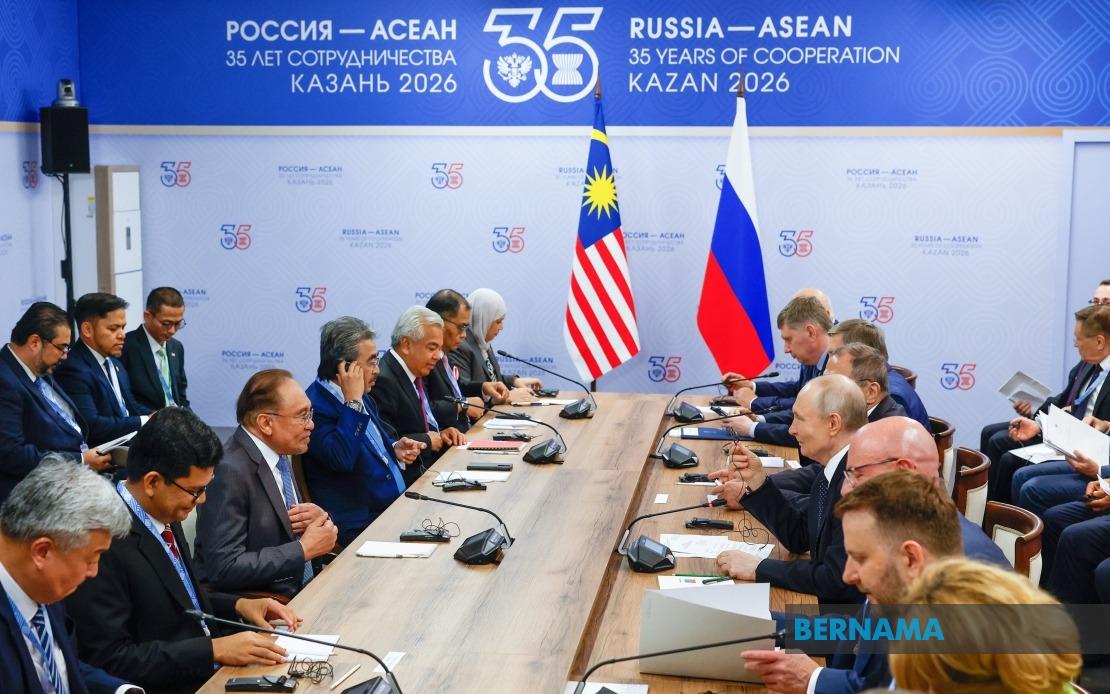
Russian President Vladimir Putin and Malaysian Prime Minister Datuk Seri Anwar Ibrahim have signalled strong momentum in bilateral relations, meeting on the sidelines of the ASEAN-Russia Commemorative Summit in Kazan to chart the course for deepening cooperation between their two nations. The timing of their engagement is significant, occurring as Russia and Malaysia approach their 60th anniversary of diplomatic relations in 2026—a milestone that Putin characterised as an opportunity to build upon decades of constructive engagement and mutual respect.
During their discussion, Putin emphasised that the two countries have constructed a robust foundation upon which to expand their partnership across multiple domains. He highlighted the "substantive positive experience" both nations bring to their bilateral relationship, underscoring that this historical depth provides confidence for pursuing more ambitious collaborative initiatives in the coming years. This framing reflects Moscow's broader strategic interest in maintaining and elevating its presence in Southeast Asia during a period of significant geopolitical realignment.
The economic dimension of the bilateral relationship is showing tangible momentum. Trade between Russia and Malaysia increased by 12.9 per cent during 2025, a growth trajectory that Putin specifically commended as a positive indicator of commercial dynamism between the two economies. This expansion occurs despite global sanctions pressures on Russia and broader trade uncertainties affecting the region, suggesting resilient demand for bilateral commerce and a mutual commitment to sustaining economic channels despite external constraints.
Beyond trade figures, Putin outlined the institutional architecture supporting bilateral cooperation. An intergovernmental commission overseeing economic, scientific, technical and cultural collaboration forms the operational backbone of joint projects, while regular contact channels between ministerial, agency and parliamentary representatives maintain diplomatic momentum. This multi-layered engagement structure demonstrates that both governments have institutionalised their relationship rather than allowing it to depend on episodic high-level meetings alone.
Education, science and technology partnerships feature prominently in Russia's stated priorities with Malaysia. Putin specifically identified these sectors, alongside tourism and humanitarian exchange, as areas deserving expanded attention and investment. For Malaysian policymakers, such cooperation offers pathways to technology transfer and knowledge-sharing in fields where Russia maintains recognised expertise, while creating reciprocal opportunities for Malaysian contributions in areas where the country possesses comparative advantage.
Malaysia's regional leadership within ASEAN has particular relevance to Russia's strategic calculations. Putin explicitly acknowledged Malaysia's tenure as ASEAN chair and welcomed the country's continued support for developing the Russia-ASEAN strategic partnership. He recalled that the first summit-level meeting between Russia and ASEAN occurred in Malaysia in 2005, positioning the country as a natural bridge between Moscow and the broader Southeast Asian community. This historical precedent underscores Malaysia's diplomatic centrality to Russia's regional engagement strategy.
The reference to Malaysia's 2005 hosting of the inaugural Russia-ASEAN summit reflects Putin's appreciation for how Malaysia has historically facilitated dialogue between Russia and the region. As ASEAN grapples with managing great power competition and maintaining strategic autonomy, Malaysia's balanced approach to engaging Russia while maintaining relationships with other powers demonstrates the diplomatic nuance required in contemporary Southeast Asian statecraft. Putin's acknowledgement of this role signals Moscow's recognition that deepening ties with Malaysia serves Russia's broader objective of sustaining relevance within ASEAN's institutional framework.
Putin's characterisation of Malaysia as a "long-standing global partner" carrying consistent adherence to "principles of mutual respect and consideration of interests" reflects how Russia frames its relationship with the country—as a partnership grounded in sovereign equality rather than hierarchical dependency. This rhetorical positioning holds particular resonance in Southeast Asia, where nations remain sensitive to any suggestion of great power domination and prefer to present themselves as independent actors engaging with multiple powers on their own terms.
The diplomatic courtesies exchanged during the meeting, including Putin's conveyance of best wishes to His Majesty Sultan Ibrahim, King of Malaysia, underscore the respect accorded to Malaysia's institutional and ceremonial leadership. Such gestures, while sometimes dismissed as mere protocol, carry weight in the context of great power diplomacy and signal the elevated importance Malaysia commands in Russia's regional calculations.
For Malaysia, maintaining and developing the relationship with Russia offers strategic benefits beyond bilateral commerce. Russia's permanent seat on the United Nations Security Council, its significant influence in Middle Eastern affairs, and its technical capabilities in energy and defence technologies all provide leverage and opportunity for Malaysian statecraft. Simultaneously, the measured approach Malaysia takes in balancing Russian engagement with its many other partnerships reflects the complex position Southeast Asian nations occupy in a multipolar international system.
The 60th anniversary milestone on the horizon provides both nations with a natural juncture to consolidate gains and establish new collaborative frameworks. Whether through expanded joint projects in designated sectors, upgraded institutional coordination, or broader political alignment on select international questions, the anniversary offers opportunity for substantive rather than ceremonial recognition. For Malaysian observers and policymakers, tracking how both nations utilise this moment will provide insight into Russia's commitment to sustaining engagement with Southeast Asia amid broader geopolitical competition.
The convergence of Putin and Anwar's statements reflects mutual interest in demonstrating bilateral momentum at a moment when Russia faces international isolation in some quarters and Malaysia seeks to maintain pragmatic engagement with multiple powers. Both leaders emerged from their Kazan encounter projecting confidence in the partnership's trajectory and commitment to translating rhetorical support into concrete collaborative outcomes across the economic, educational, scientific and cultural domains.

%22%2F%3E%3C%2Fpattern%3E%3C%2Fdefs%3E%3Crect%20width%3D%22100%25%22%20height%3D%22100%25%22%20fill%3D%22url(%23ph21o2sg)%22%2F%3E%3Crect%20width%3D%22100%25%22%20height%3D%22100%25%22%20fill%3D%22url(%23ph21o2sp)%22%2F%3E%3Ctext%20x%3D%2250%25%22%20y%3D%2250%25%22%20text-anchor%3D%22middle%22%20dominant-baseline%3D%22central%22%20fill%3D%22rgba(255%2C255%2C255%2C0.95)%22%20font-family%3D%22Georgia%2C%20'Times%20New%20Roman'%2C%20serif%22%20font-weight%3D%22700%22%20font-size%3D%22170%22%20letter-spacing%3D%22-0.02em%22%3EGabungan%3C%2Ftext%3E%3C%2Fsvg%3E)