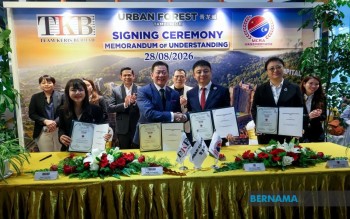
An ambitious RM1 billion urban forest development in Ipoh's Tambun locality is poised to reshape Perak's tourism trajectory, with stakeholders positioning the 84-acre project as a transformative catalyst for regional economic expansion when construction concludes within the next three years. The initiative, spearheaded by Team Keris Bhd in partnership with RJJ Hotels Sdn Bhd and the Malaysian Chinese Restaurant Association, represents a deliberate pivot from Perak's historical reliance on domestic tourism toward capturing international visitor markets.
The development strategy hinges on creating an integrated ecosystem that weaves together premium hospitality, curated food and beverage experiences, retail outlets and commercial spaces. Rather than functioning as an isolated attraction, planners envision the urban forest complementing existing facilities including the Lost World of Tambun theme park, effectively clustering hospitality assets that can collectively position Tambun as a credible regional tourism destination capable of competing with established hubs across Southeast Asia.
Loh Sze Yee, chairman of Perak's Tourism, Industry, Investment and Corridor Development Committee, articulated the strategic aspiration during the memorandum signing ceremony. He stressed that Perak's tourism infrastructure requires comprehensive modernisation and recalibration toward international standards. The urban forest, combined with international-class hotel services, represents an intentional effort to elevate local establishments and ensure that visitors encounter hospitality and amenities comparable to standards found in established tourist destinations elsewhere in the region.
Central to the project's distinctiveness is its deliberate emphasis on Malaysian culinary identity as an export product. Datuk Lee Seng Hee, group executive chairman of Team Keris Bhd, articulated this philosophy, explaining that the F&B component will allocate 40 per cent of operational space to establishments affiliated with the Malaysian Chinese Restaurant Association, whilst 60 per cent will feature other Malaysian operators. This composition strategy serves a dual purpose: showcasing Malaysia's gastronomic diversity to international tourists whilst providing domestic operators with unprecedented exposure to visitor demographics from developed markets including Australia, Britain and the United States.
Religious and dietary inclusivity constitutes another significant design element. The project commits to ensuring that 30 per cent of total F&B offerings accommodate Muslim dietary requirements, with the Chinese Restaurant Association spearheading development of halal-compliant selections including halal dim sum. This commitment recognises both the importance of catering to Malaysia's Muslim population and the substantial tourist markets from Muslim-majority regions, thereby broadening the demographic appeal beyond traditional Western visitor bases.
The hospitality architecture leverages international networks to address a perennial challenge facing Perak tourism: accessibility and travel logistics. Yap Lip Seng, chief executive officer of RJJ Hotels, highlighted that his company's affiliation with Jin Jiang Hotels—a network encompassing more than 200 million members across 50-plus countries and 40 hotel brands—provides unprecedented reach to established travel channels. This partnership essentially solves the connectivity problem that has historically deterred tourists, as package arrangements can be negotiated with travel agents and tour operators to deliver seamless experiences that extend beyond standard overnight stays and encompass full meal plans and activity itineraries within the urban forest itself.
The broader economic implications extend well beyond tourism revenue. Gao Houyun, president of the Malaysian Chinese Restaurant Association, emphasised the project's potential to catalyse workforce development across Perak's hospitality and food sectors. The initiative incorporates training programmes and skills development initiatives designed to equip local workers and operators with capabilities required to meet international service standards, thereby creating employment pathways and upgrading human capital within the state's service industries.
Supply chain development represents an underappreciated dimension of the project's economic impact. The collaboration explicitly encourages Chinese food ingredient manufacturers—producers of sauces, spices and other specialised components—to establish production facilities within Perak. This localised manufacturing approach would create manufacturing employment, retain supply chain margins within the state economy and potentially establish Perak as a regional export hub for Asian food products. Such industrial clustering, when combined with Malaysia's established halal certification infrastructure, creates a competitive advantage for both domestic consumption and regional market expansion.
The halal certification dimension warrants particular emphasis given regional dynamics. Malaysia's reputation for rigorous halal standards positions Perak-based food products and restaurant concepts for market expansion not only within Malaysia but across Southeast Asian markets where halal compliance represents either regulatory requirement or significant consumer preference. This certification advantage could transform local brands developed within the urban forest into exportable concepts, generating intellectual property value and franchise opportunities extending far beyond Perak's geographical boundaries.
For Malaysian and broader Southeast Asian observers, this project exemplifies how experiential tourism—combining hospitality, culinary experiences and cultural expression—increasingly drives visitor spending in mature tourism markets. Rather than competing primarily on price or exotic natural attractions, Perak's strategy leverages authentic food culture and integrated hospitality experiences as differentiating factors. This approach aligns with observable global trends showing that food tourism, cultural immersion and curated local experiences increasingly drive international travel decisions, particularly among affluent demographics from developed economies.
The three-year development timeline suggests the project anticipates market momentum and competitive positioning. Neighbouring regions including Penang and Kuala Lumpur possess established tourism infrastructure and brand recognition, making rapid execution critical for Perak to capture visitor mindshare before alternative destinations saturate regional markets. The synchronisation of hotel development, F&B offerings and retail facilities within a unified geographic location represents deliberate infrastructure clustering designed to maximise visitor spending duration and encourage repeated visitation through diverse experience opportunities.
Successful execution would reposition Perak within Malaysia's tourism hierarchy. Historically regarded as a secondary destination requiring special-interest motivation, an international-class urban forest complex could establish Perak as a viable primary destination for international visitors, potentially extending average stay duration and increasing per-capita visitor spending. For the Malaysian tourism sector broadly, Perak's development demonstrates how secondary regions can employ strategic infrastructure investment and partnership alignment to capture higher-value visitor segments, diversifying Malaysia's tourism economy beyond traditional concentration in Kuala Lumpur and Penang.
The project's emphasis on integrated ecosystem development—rather than isolated attractions—reflects maturing understanding within Southeast Asian tourism sectors that visitor satisfaction correlates with seamless, coordinated experiences across accommodation, dining, transport and activities. By coordinating hospitality standards, culinary offerings and retail experiences within unified development, Perak's urban forest project positions itself to deliver the holistic visitor journey increasingly demanded by international travellers and increasingly prioritised by the distributors controlling access to affluent tourism markets.

