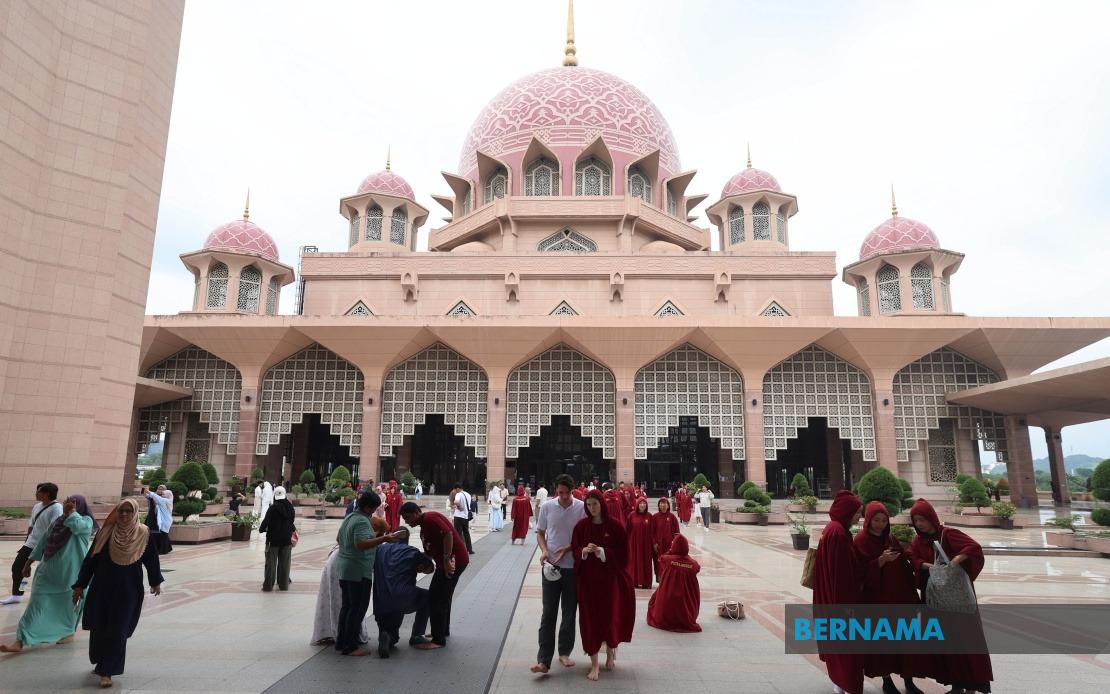
The Islamic calendar's new year will be marked with considerable ceremony as Putra Mosque in Putrajaya prepares to welcome approximately 5,000 guests for the National Maal Hijrah 1448H/2026M celebration. The event represents a significant moment in Malaysia's religious and cultural calendar, bringing together prominent figures from government, international delegations, and faith communities to commemorate the Islamic year and honour excellence within the faith.
Sultan of Perak Sultan Nazrin Shah is set to officiate the proceedings, lending the occasion royal patronage and prestige. The gathering will include Deputy Prime Ministers Datuk Seri Ahmad Zahid Hamidi and Datuk Seri Fadillah Yusof, alongside numerous Cabinet ministers, diplomatic representatives, departmental heads, and senior government functionaries. This convergence of political and institutional leadership underscores the national importance placed upon the Maal Hijrah commemoration and its role in Malaysia's multicultural governance framework.
The centrepiece of the day's programme involves the Sultan's royal address, followed immediately by the presentation of the National and International Tokoh Maal Hijrah Awards. These coveted honours recognise individuals whose accomplishments transcend conventional professional achievement, instead celebrating those whose knowledge, character, and contributions have meaningfully advanced Islamic scholarship, practice, and civilisation on both national and global stages. The recipients represent exemplars within their respective domains, selected through rigorous criteria that assess intellectual capacity, ethical standing, and tangible influence.
The Department of Islamic Development Malaysia (JAKIM) has deliberately crafted this year's thematic framework around the historical Hijrah of Prophet Muhammad SAW, viewing the migration narrative as foundational to Islamic civilisation's emergence and development. Rather than treating the commemoration as merely historical recollection, JAKIM positions Maal Hijrah as an opportunity for contemporary Muslim communities to reconnect with the transformative principles underlying the Prophet's journey. This approach encourages believers to examine their own spiritual trajectories and societal roles through the lens of purposeful transformation.
Innovating upon previous year's formats, organisers have introduced the Tausiyyah @ Maal Hijrah programme, which commenced the preceding evening at Putra Mosque. This addition prioritises deep engagement with Quranic content through structured reflection, or tadabbur, inviting participants to move beyond surface-level recitation toward genuine comprehension of scriptural messages. The initiative combines aesthetic and spiritual dimensions by featuring distinguished qari whose recitations provide the foundation, while facilitating scholarly guidance that elucidates the verses' layered meanings, philosophical implications, and practical applications for contemporary living.
Participants in these sessions are encouraged to conceptualise Hijrah not as a singular historical event but as an ongoing principle—a personal and collective catalyst for constructive change. This reframing invites Muslims to interrogate their own circumstances, examining where spiritual, intellectual, or moral migration might benefit themselves and their communities. The pedagogical approach recognises that ancient Islamic narratives possess contemporary relevance when communities actively interpret and internalise their teachings rather than maintaining them as distant historical phenomena.
The ceremonial component at Putra Mosque represents only the initial phase of a multi-day observance. Following the main celebration, the National and International Tokoh Maal Hijrah Lecture 1448H/2026 will convene the subsequent morning at the Putrajaya Islamic Complex Auditorium, commencing at 9 am. This forum provides the award recipients an elevated platform from which to articulate their intellectual frameworks, share their experiential knowledge, and engage in dialogue with other scholars, officials, and interested participants. Such lectures serve Malaysia's broader ecosystems of Islamic scholarship and policy-making, enabling cross-pollination of ideas and methodologies.
For Malaysian observers, the Maal Hijrah celebration underscores the state's continued investment in religious observance and institutional Islam as components of national identity and governance. The involvement of senior political figures alongside religious authorities signals the intertwined nature of Islamic practice and Malaysian public administration. Moreover, the international dimension—with foreign representatives participating—positions Malaysia as a significant player in global Islamic intellectual and institutional networks, projecting the country's capacity to host meaningful interfaith and Islamic leadership forums.
The emphasis on individual honour through the Tokoh awards also reflects broader Malaysian values regarding meritocracy and excellence within faith communities. By celebrating both domestic and international recipients, the framework acknowledges that Islamic civilisation transcends national boundaries whilst simultaneously anchoring celebration within Putrajaya's symbolic landscape as the federal territory housing Malaysia's institutions. This geographical and institutional choice reinforces the event's national character whilst inviting global participation and recognition.
For the broader Southeast Asian context, Malaysia's Maal Hijrah programming demonstrates how a Muslim-majority democracy with significant non-Muslim populations manages religious observance at state level. The careful orchestration involving multiple government tiers, international participation, and thematic coherence indicates sophisticated approaches to civic religious expression. Such models offer instructive examples for other Muslim-majority nations navigating the intersection of state authority, religious leadership, and inclusive governance in increasingly plural societies.
The Tausiyyah programme's focus on Quranic reflection and contemporary application represents a particularly notable dimension, suggesting deliberate institutional efforts to ground Islamic practice in textual scholarship rather than purely customary or traditionalist frameworks. This pedagogical orientation aligns with broader intellectual currents within contemporary Islam that emphasise hermeneutical engagement and rational reflection. By institutionalising such approaches through government-supported programming, Malaysia signals commitment to knowledge-based religious practice.
As Muslims worldwide enter the new Islamic year, Malaysia's national commemoration at Putra Mosque will serve both ceremonial and substantive functions. The celebration honours tradition whilst innovating programming, recognises excellence across boundaries, and reaffirms state commitment to Islamic civilisation as central to national identity. Through the convergence of royal patronage, political participation, international representation, and scholarly engagement, the event encapsulates Malaysia's particular approach to maintaining religious observance within modern governance structures.

%22%2F%3E%3C%2Fpattern%3E%3C%2Fdefs%3E%3Crect%20width%3D%22100%25%22%20height%3D%22100%25%22%20fill%3D%22url(%23ph21o2sg)%22%2F%3E%3Crect%20width%3D%22100%25%22%20height%3D%22100%25%22%20fill%3D%22url(%23ph21o2sp)%22%2F%3E%3Ctext%20x%3D%2250%25%22%20y%3D%2250%25%22%20text-anchor%3D%22middle%22%20dominant-baseline%3D%22central%22%20fill%3D%22rgba(255%2C255%2C255%2C0.95)%22%20font-family%3D%22Georgia%2C%20'Times%20New%20Roman'%2C%20serif%22%20font-weight%3D%22700%22%20font-size%3D%22170%22%20letter-spacing%3D%22-0.02em%22%3EGabungan%3C%2Ftext%3E%3C%2Fsvg%3E)